Stockwatch: this share is an intriguing special situation
This share is already up almost 80% since analyst Edmond Jackson first backed it, and there is potential for this former growth star to evolve as a value proposition.
12th December 2025 10:40
by Edmond Jackson from interactive investor

For anyone of sufficiently long memory, digital educational supplier RM (LSE:RM.) was among the most spectacular bull displays of the late 1990s to 2000 technology, media and telecoms share boom. It is a classic “head and shoulders” chart pattern of Himalayan proportions with a rise from around 50p in 1995 to over 1,000p, and right back by 2002.
- Invest with ii: Top UK Shares | Share Tips & Ideas | Cashback Offers
This perhaps remains relevant today amid tech euphoria, as a long-term example of how bubble valuations can pop. Yet the shares have since achieved several useful rallies from 70p in early 2012 to over 300p in late 2019; then Covid meant a slump into operating losses by 2022, and another de-rate to as low as 30p from which the shares have made steady progress to 111p.
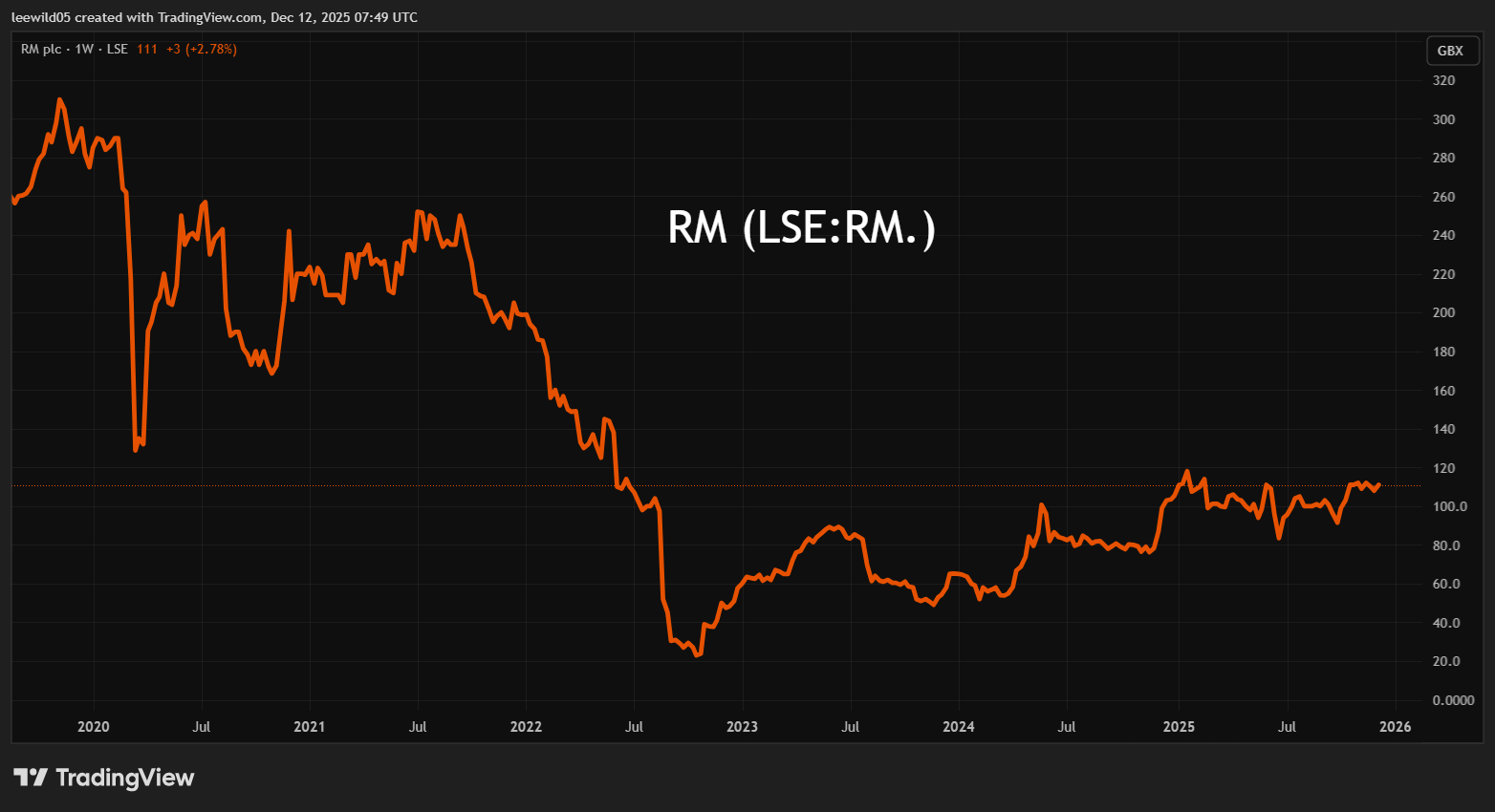
Source: TradingView. Past performance is not a guide to future performance.
I drew attention as a “buy” at 62p in August 2023 and again at 95p last July – most recently on a rationale that despite onerous debt, RM’s core Assessment division was becoming a jewel. The shares were shaping up as a special situation given scope to divest two other divisions, thereby slashing or even eliminating debt.
An “in-line” full-year trading update to 30 November saw the small-cap shares edge up a penny to 111p, with net debt usefully cited at £50-51 million – a good improvement on £60 million at 31 May. The overall context remains awkward, however, given end-May net assets of £11.6 million where the balance sheet had £38.5 million goodwill/intangibles.
In a context of only £3.4 million cash, a chief liability was £47.9 million trade payables versus £25.9 million trade receivables, and current liabilities at 105% of current assets. The interim income statement also showed a £3.3 million net interest charge relative to £0.9 million operating profit, although the going concern statement’s base-case scenario anticipated compliance with banking covenants.
Two institutional shareholders back share placing
While looking off-radar to basic risk appraisal, it was interesting how last October small-cap investor Harwood Capital bought 3.2 million shares in a share placing at 95p, taking its stake to 17.1 million, or 17.4%; and Lombard Odier Asset Management bought 3.7 million to own 13.8 million, or 14.1%.
Lest these appear acts of desperation to prop a failing company, a week later an RM non-executive director bought £17,800 worth at 102p and in May the CEO bought £57,600 worth at 99.1p.
The placing raised near £13 million net to “complete separation work for non-core asset disposals”, invest in development also (reflecting strain) support working capital. In a recent published video, a Harwood fund manager conveyed how they appear a classic “activist” investor – a catalyst to unlock value – in a game plan to dispose of the Technical Teaching Solutions (TTS) side and Technology businesses which should comfortably eliminate debt; the resulting Assessment business being worth more than RM’s market cap today.
Harwood estimates a sum-of-parts value of £170 million versus £108 million currently. The TTS side could fetch £70 million, Technology £35 million, implying debt elimination and a circa £50 million cash boost. The Assessment division “could be worth” between £150 million and £200 million presumably in time, and, if so, then yes could constitute a listed company with legs. The fund manager believes that it has potential for a margin of over 30%, which would be sticky, and in my opinion would justify a price/earnings (PE) more like 20x akin to billings software group Cerillion (LSE:CER).
I take such assumptions with a pinch of salt, and also respect possible time constraints to achieve such a restructuring.
RM financial summary
Year-end 30 Nov
| 2017 | 2018 | 2019 | 2020 | 2021 | 2022 | 2023 | 2024 | |
| Turnover (£ million) | 186 | 221 | 224 | 189 | 206 | 214 | 176 | 166 |
| Operating margin (%) | 8.7 | 10.2 | 10.8 | 6.1 | 1.7 | -10.1 | 4.1 | -3.6 |
| Operating profit (£m) | 16.2 | 22.6 | 24.2 | 11.5 | 3.6 | -21.6 | 7.2 | -6.0 |
| Net profit (£m) | 12.9 | 16.9 | 19.1 | 8.4 | 4.2 | -14.5 | -29.1 | -4.7 |
| Reported earnings/share (p) | 15.7 | 20.6 | 23.0 | 10.1 | 2.6 | -19.3 | 3.1 | -4.6 |
| Normalised earnings/share (p) | 23.1 | 26.0 | 26.1 | 10.1 | 14.3 | 17.5 | -10.4 | 14.5 |
| Operating cashflow/share (p) | 14.3 | 20.0 | 14.1 | 25.3 | 5.5 | -25.0 | -12.6 | 10.1 |
| Capital expenditure/share (p) | 1.6 | 1.4 | 7.3 | 10.1 | 18.7 | 6.3 | 1.3 | 5.8 |
| Free cashflow/share (p) | 12.7 | 18.6 | 6.8 | 15.1 | -13.3 | -31.2 | -13.9 | 4.3 |
| Dividend/share (p) | 6.6 | 7.6 | 2.0 | 3.0 | 4.7 | 0.0 | 0.0 | 0.0 |
| Covered by earnings (x) | 2.4 | 2.7 | 11.5 | 3.4 | 0.6 | 0.0 | 0.0 | 0.0 |
| Return on capital (%) | 22.9 | 31.8 | 25.8 | 10.7 | 2.5 | -25.7 | 8.0 | -6.6 |
| Cash (£m) | 1.8 | 2.6 | 5.5 | 5.9 | 3.6 | 1.9 | 8.1 | 8.2 |
| Net Debt (£m) | 13.4 | 5.8 | 15.0 | 23.5 | 39.2 | 66.0 | 62.1 | 66.6 |
| Net assets per share (p) | 36.6 | 67.2 | 72.2 | 67.0 | 104 | 72.3 | 21.3 | 20.4 |
Source: historic company REFS and company accounts.
Strength in Assessment if not the best time to sell
Assessment is a global provider of software for exam-awarding bodies towards digitisation. In the November 2024 year, its order book more than doubled to near £96 million including high-profile clients such as the International Baccalaureate (IB) and Cambridge University Press & Assessment.
Last July’s interim results cited seemingly modest 4% revenue growth albeit 19% if deducting non-core projects, reflecting further customer renewals and wins. A newly launched Ava platform (a latest recipient of placing funds) was said “to strengthen our position further and be a key driver of profitable growth in the future, unlocking digital assessments and delivering higher margins”.
The adjusted operating margin also rose from 11.6% to 17.6% with potentially further upside as customers adopt fully digital exams.
From the interim financial review, Assessment was 28% of group revenue versus 42% for TTS and 30% for Technology. But a much higher margin meant Assessment contributed 78% of adjusted operating profit. As for it being worth potentially 3-4x revenue as Harwood implies, well, according to the margin it could grow into that.
- Five top share trades for 2026
- Sign up to our free newsletter for investment ideas, latest news and award-winning analysis
- Five macro themes tipped to shape markets in 2026
TTS, supplying educational resources to schools in the UK and abroad, achieved nearly £54 million of sales in the year to November 2024 and has launched AI-generated learning tools for the national curriculum. The technology division was hit that year by tougher school budgets but also won substantial contracts with longer-term recurring fees.
The interim results showed TTS with revenue 9% lower chiefly due to the UK, albeit a similar £0.1 million operating profit. Technology had similar revenue to TTS at just over £20 million, for a consistent £0.9 million profit.
Obviously, the question arises as to whether these businesses can be sold at satisfactory prices within the next 12 months rather than RM appearing a debt-distressed seller in negotiations.
Would the Assessment division constitute a listed plc?
There seems to potentially be a behavioural economics dilemma with the notion that Assessment would warrant being a standalone listed company. Does existing top management want to possibly put themselves out of jobs, slimming RM down to this extent? Might they make a go-private offer after reducing debt, such that shareholders cede longer-term upside?
Yet at 111p a share, risk/reward could still be attractive on a medium-term view. The 11 December update cites “actively progressing strategy to simplify the group’s business...” and the RM Ava accreditation platform “will pave the way for additional growth in Assessment”.
The shares are therefore an intriguing special situation where medium-term “event-driven value” can be entertained from disposals, even though the balance sheet rules any “margin of safety” as a cornerstone of investment value. Hopefully, you get the subtle distinction.
- Sector Screener: time to grab Tesco and Sainsbury’s shares?
- Bank of England ‘behind the curve’ even after likely rate cut
A tease is provided by way of “a further update on strategy and outlook” with the full-year results. These have previously been declared mid-March, although this update just says “in the new year”. We’ll see.
Adjusted operating profit is in line with expectations for £11.5 million and implies 34% growth on November 2024. Assessment’s revenue is up 20% after a record number of exams marked in 115 countries used RM’s platform, and its renewal rate has run at 98%. However, revenue from continuing operation is, overall, expected to be possibly 3% lower due to a challenging UK schools’ market affecting the Technology and TTS divisions in the first half.
So, yes, more detail is needed “in the new year” to understand exactly what management means by “continuing operations” versus Harwood Capital’s agenda for disposals.
At 111p, the forward PE looks to be near 15x reducing to 12x if consensus for £8.5 million net profit in the November 2026 year is fair. Mind how the emphasis is all on earnings, there being no dividend prospects under the extent of debt. For enterprising investors, I continue to recognise a “buy” stance.
Edmond Jackson is a freelance contributor and not a direct employee of interactive investor.
These articles are provided for information purposes only. Occasionally, an opinion about whether to buy or sell a specific investment may be provided by third parties. The content is not intended to be a personal recommendation to buy or sell any financial instrument or product, or to adopt any investment strategy as it is not provided based on an assessment of your investing knowledge and experience, your financial situation or your investment objectives. The value of your investments, and the income derived from them, may go down as well as up. You may not get back all the money that you invest. The investments referred to in this article may not be suitable for all investors, and if in doubt, an investor should seek advice from a qualified investment adviser.
Full performance can be found on the company or index summary page on the interactive investor website. Simply click on the company's or index name highlighted in the article.
Disclosure
We use a combination of fundamental and technical analysis in forming our view as to the valuation and prospects of an investment. Where relevant we have set out those particular matters we think are important in the above article, but further detail can be found here.
Please note that our article on this investment should not be considered to be a regular publication.
Details of all recommendations issued by ii during the previous 12-month period can be found here.
ii adheres to a strict code of conduct. Contributors may hold shares or have other interests in companies included in these portfolios, which could create a conflict of interests. Contributors intending to write about any financial instruments in which they have an interest are required to disclose such interest to ii and in the article itself. ii will at all times consider whether such interest impairs the objectivity of the recommendation.
In addition, individuals involved in the production of investment articles are subject to a personal account dealing restriction, which prevents them from placing a transaction in the specified instrument(s) for a period before and for five working days after such publication. This is to avoid personal interests conflicting with the interests of the recipients of those investment articles.