Bank of England ‘behind the curve’ even after likely rate cut
The UK central bank is widely tipped to cut borrowing costs next week, but many believe it won’t be enough. Graeme Evans looks at the possible path of interest rates in 2026.
11th December 2025 14:02
by Graeme Evans from interactive investor
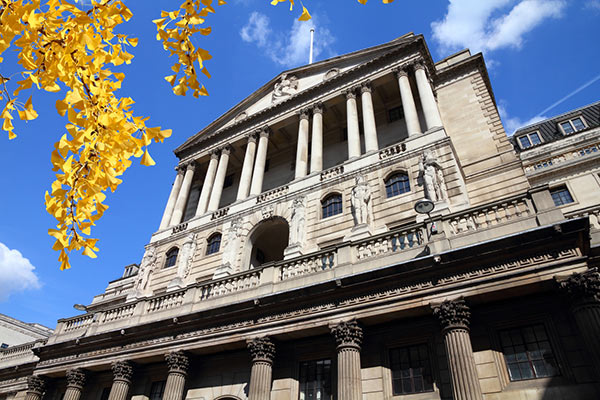
The Bank of England will be under pressure next week to consider faster interest rate cuts after the boss of housebuilder Berkeley Group Holdings (The) (LSE:BKG) accused policymakers of being “behind the curve”.
- Our Services: SIPP Account | Stocks & Shares ISA | See all Investment Accounts
Rob Perrins believes a percentage point reduction by March is necessary to improve mortgage affordability and stimulate demand in the construction industry.
His frustration is likely to be deepened by Thursday’s Bank of England policy decision, when committee members are set to maintain their gradual approach to cutting rates.
The base rate is seen falling by a quarter of a percentage point to 3.75%, but with economists braced for signs of a pushback against the possibility of a back-to-back cut in February.
The vote in favour of a pre-Christmas reduction is also likely to be a close call, with the boost of disinflationary measures in the Budget a key factor in the forecast 5-4 split.
A cut would extend the fall since July 2024 to 150 basis points, with economists at Deutsche Bank pricing a terminal low rate of 3.25% based on further cuts in March and June.
However, Perrins believes faster action is needed. The executive chair, who joined Berkeley in 1994 and has been a board member since 2001, said: “Housing is really hurting the feel-good factor in this country.
“Rates are far too high at the moment, which is why people are very cautious in their expenditure. The Bank is behind the curve.”
- Watch our video: ARK Invest’s Cathie Wood: why we’re betting big on Tesla
- Retail top picks for 2026 revealed
- Berkeley profits fall but guidance held in challenging times
The Federal Reserve last night signalled that it has one more cut in store during 2026, having made six in total since the easing cycle began at 5.5% in September 2024.
The calls for lower UK interest rates are likely to strengthen on Friday when GDP figures show that the fourth quarter began with month-on-month expansion of just 0.1%.
Inflation figures will follow on Wednesday, with the consumer prices print for November set to reveal a further decline to 3.4% or 3.5% from 3.6% the previous month.
That should provide further encouragement for policymakers after the Budget contained no repeat of inflationary policies such as 2024’s increase in national insurance contributions.
Bank of America added today that the backloaded nature of fiscal tightening measures and policies to lower energy bills kept the door open for gradual interest rate cuts.
It said: “Lower inflation via energy bills is a one-off, but it can lower inflation and wage expectations and rein in potential second round effects.”
Next week also sees the release of labour market statistics, when economists expect private regular wage growth to fall from 4.2% to 3.8% alongside a higher unemployment rate of 5.1%.
Bank of America added: “Overall, we think there is enough evidence for the BoE to cut in December on the back of cooling inflation, softening labour market, weaker growth and disinflationary measures in the Budget.”
- We still like gold, but here’s why we’ve halved exposure
- Share Sleuth: the two trades I made to cut cash pile
- Sign up to our free newsletter for investment ideas, latest news and award-winning analysis
The bank expects governor Andrew Bailey to emphasise that the path of rates is downwards but that upside risks remain, including from a 4% increase in National Living Wage.
Deutsche Bank believes the faster pace of disinflation and a still weak labour market will provide the monetary policy committee with enough confidence to continue rate cuts at its current quarterly pace.
“Ultimately, however, the case for faster rate cuts will rest on the evolution of the labour market.
“Our base case for now is that we will see some stabilisation in hiring plans following the Budget. And green shoots in the labour market could emerge as early as the second quarter of 2026.”
With monetary policy now within the Bank’s 2-4% estimate of the neutral interest rate, Capital Economics expects the Bank will slow the pace of rate cuts in the first half of 2026.
However, the consultancy added: “That said, with GDP growth set to remain below trend and inflation to fall further, we still think the Bank will cut rates to 3% in 2026, below the low of 3.50% priced into the financial markets.”
These articles are provided for information purposes only. Occasionally, an opinion about whether to buy or sell a specific investment may be provided by third parties. The content is not intended to be a personal recommendation to buy or sell any financial instrument or product, or to adopt any investment strategy as it is not provided based on an assessment of your investing knowledge and experience, your financial situation or your investment objectives. The value of your investments, and the income derived from them, may go down as well as up. You may not get back all the money that you invest. The investments referred to in this article may not be suitable for all investors, and if in doubt, an investor should seek advice from a qualified investment adviser.
Full performance can be found on the company or index summary page on the interactive investor website. Simply click on the company's or index name highlighted in the article.