Chart Insights: gold, inflation and interest rate outlook
As the Iran war continues to trigger greater volatility, Max Macmillan uses technical analysis to assess the impact of this conflict on key areas of financial markets.
25th March 2026 16:28
by Max Macmillan from Aberdeen

It’s the Voodoo, who do, what you don’t dare!
Technical analysis divides people. Some pray at its altar, others dismiss it as vapid. Certainly, the jury is out on whether it shouldwork in theory, a question to which we may return. For now, however, let us just say: we do not care.
It works for us in practice, as a component of our process, helping us evaluate the risk/reward of tactical set-ups.
Whether it can be academically rationalised matters little to us, other than for reasons of intellectual curiosity. Primarily, we’re here to make money.
Our style of technical analysis will become clear over time, but for today, let us simply point out a couple of recent formations capturing the zeitgeist.
Assets and conflict
Amid the war with Iran, the simultaneous sell-off in bonds and equities, typical of an inflationary supply shock, has given a strong sense that there is nowhere to hide.
Last week was indeed quite rare. We place at 1% the frequency of weeks seeing dollars, gold, the Bloomberg Commodity Index (BCOM), equities and bonds selling off simultaneously, yet that is exactly what happened.
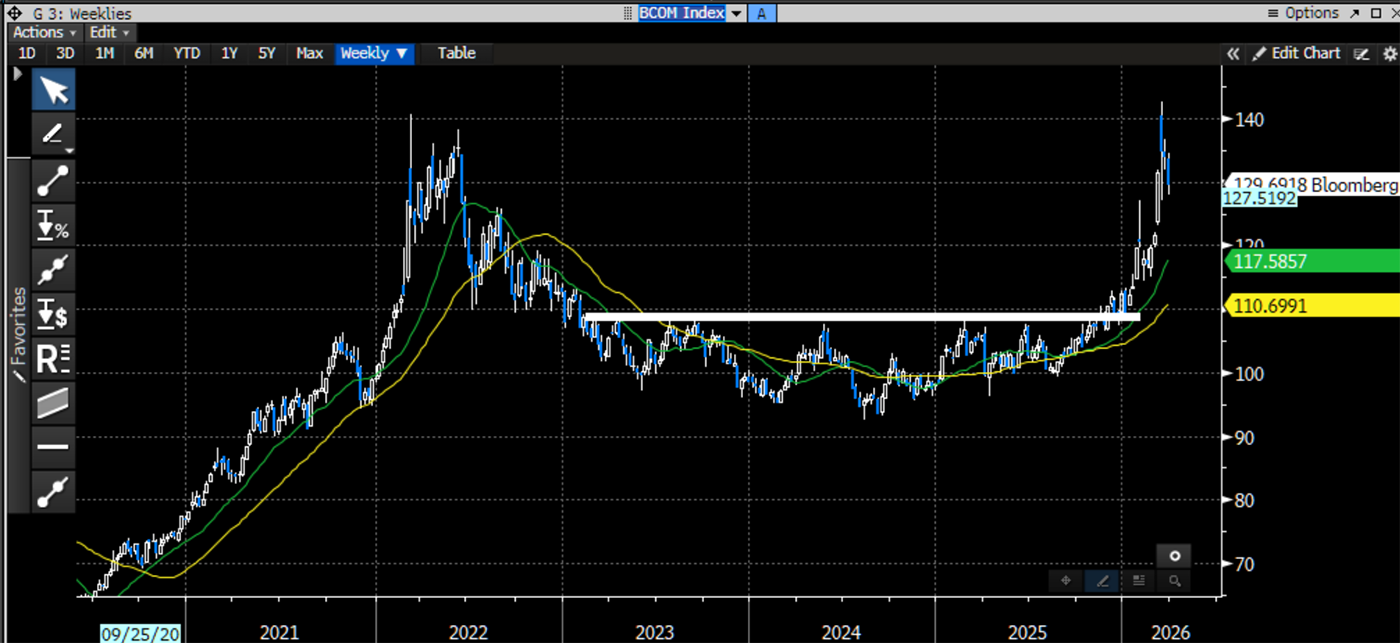
Still, zooming out slightly it is clear that commodities more broadly, up 18% on the year, areperforming their role as a diversifier of financial assets amid supply shocks, or the broad tightening of financial conditions. And there had been hints...
Bloomberg Commodity Index takes off in 2026 after multi-year base formation
Source: Bloomberg.
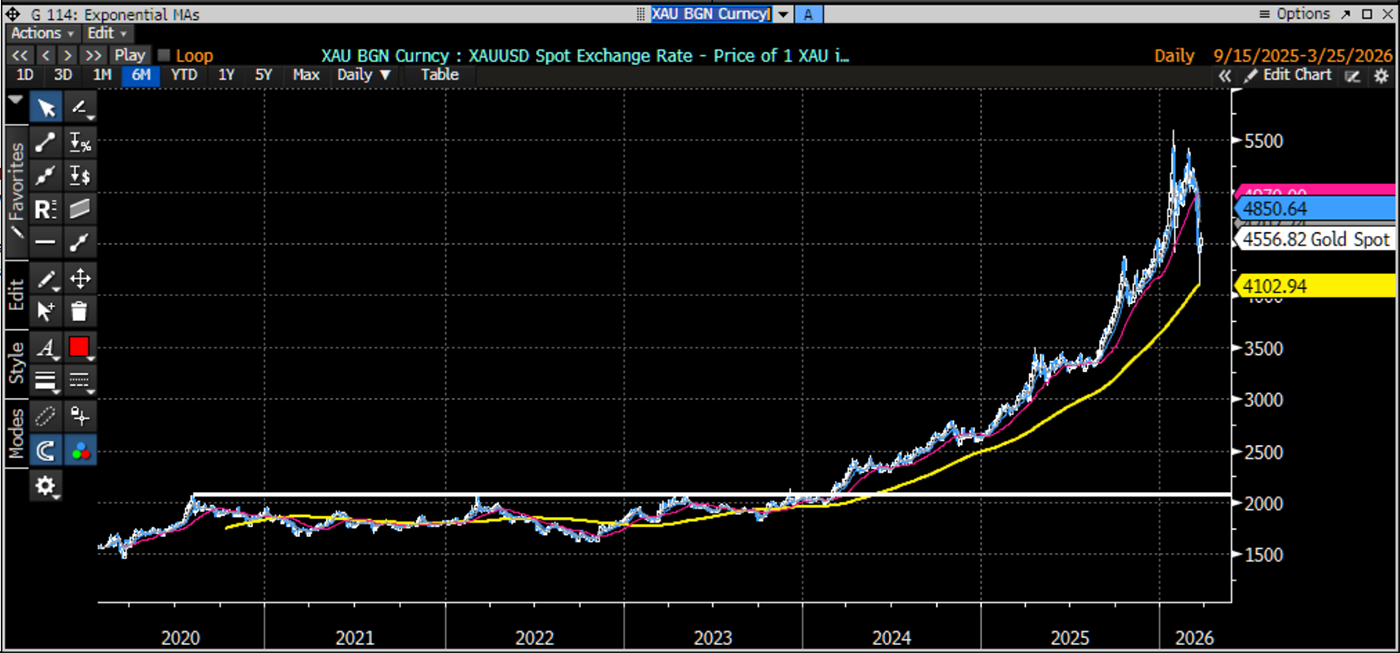
Gold, meanwhile, has been a disappointment as a geopolitical hedge. Perhaps because it had rallied so hard already over the past couple of years, perhaps because it got sold to raise liquidity, or perhaps simply because with government bond yields back up, long-term inflation expectations have been well anchored. No debasement here…not yet, at least, as central banks have responded hawkishly to renewed pressure on inflation.
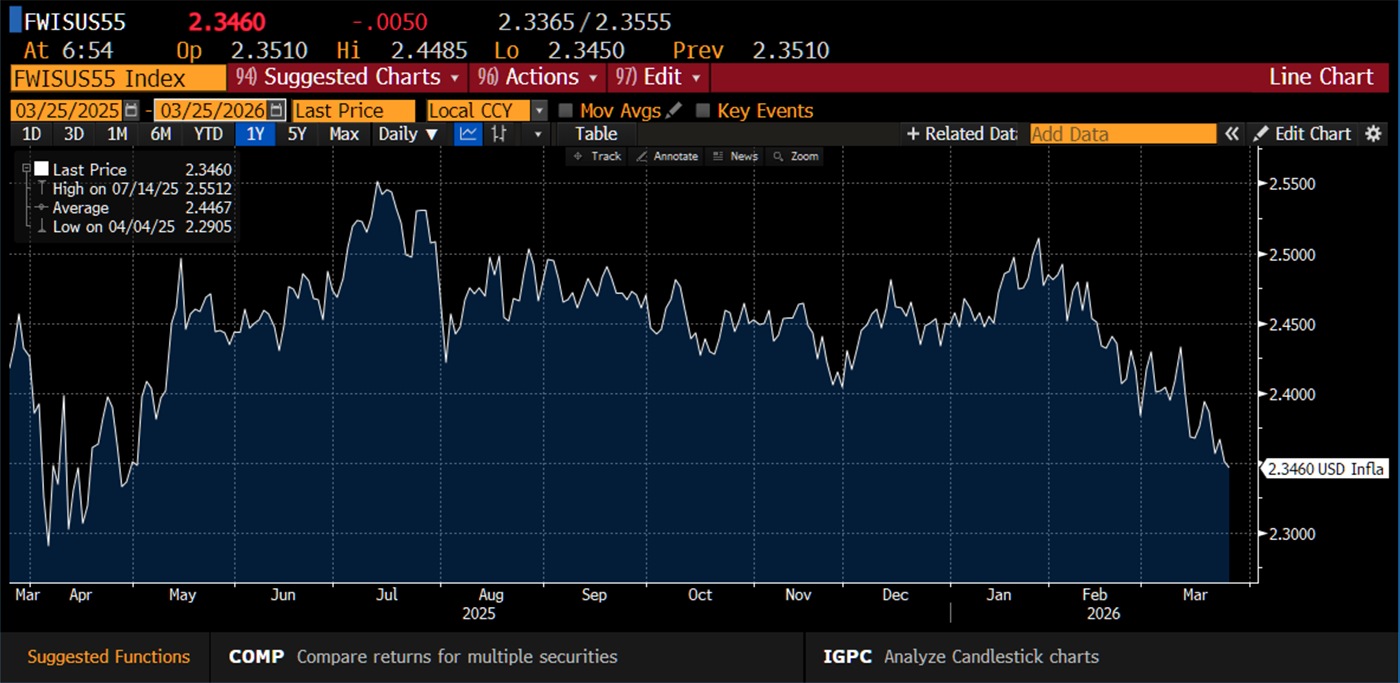
In fact, the gauge of US Federal Reserve credibility, the five-year forward five-year inflation swap (used because it gives a sense of the market’s long-term, structural inflation expectation unaffected by current turbulence) has in fact been fallingthroughout this episode (see chart below), to levels consistent with the Fed meeting its inflation mandate long term.
Worth having a chew on that...
Source: Bloomberg
The inflation swaps chart above shows the long-term inflation rate that the market prices in (neutral inflation, you might call it). If it rises high above the central bank target, this is seen as a challenge to the credibility of the Federal Reserve’s 2% inflation target. If it is falling back towards 2%, however, then paradoxically, amid this inflationary shock, the market is pricing a greaterdegree of long-term inflation target credibility.
This may be because the shock is assumed to knock demand down in the longer run, offsetting the current inflation spike, or it may simply reflect the fact that the market thinks the Fed is being sufficiently credible by displaying a readiness to act should inflation become more entrenched. In any case, well-behaved long-run neutral inflation expectations will be welcome by the Fed, which fears above all a loss of credibility, as this is what leads inflation to become unanchored.
Support for gold
Gold is finding support, for now, on its 200-day moving average, which can be a good buying area for an asset in a structural uptrend. Equally, it behooves us to notice if the 200-day fails, as it would open up the downside considerably.
Source: Bloomberg
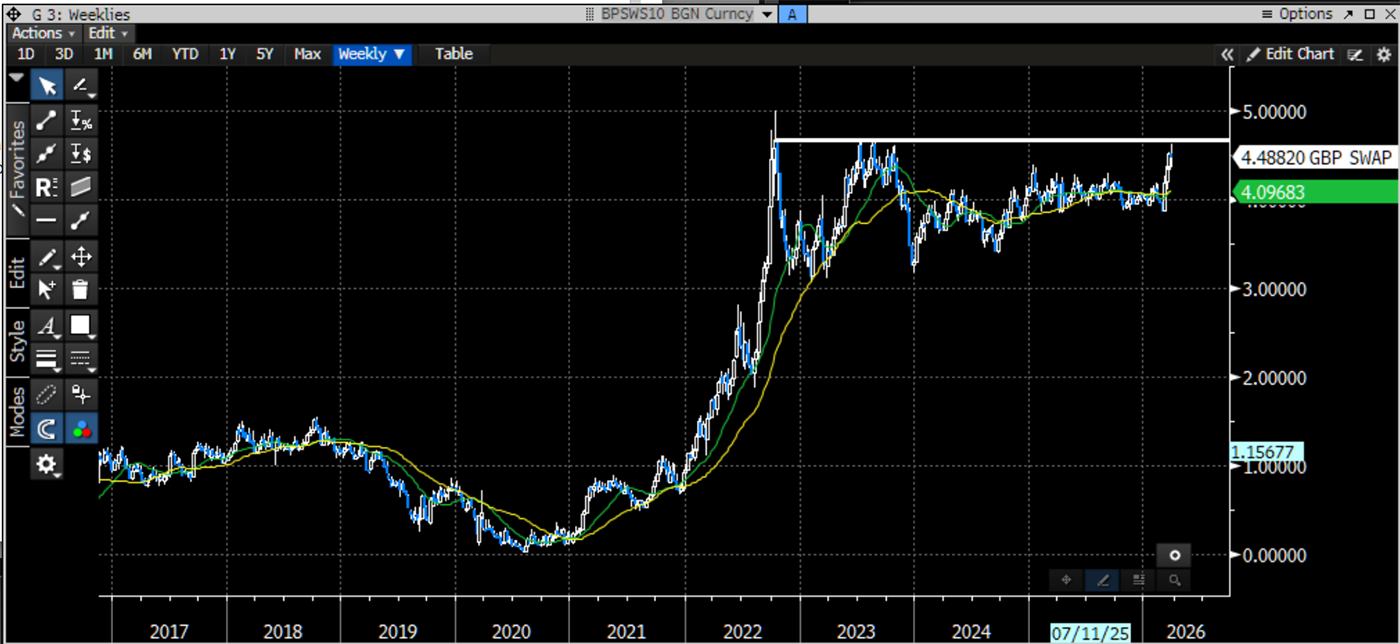
It’s also worth noticing that while government bond markets are selling off aggressively, we’re not meaningfully breaching cyclical highs just yet. It is hard to fathom Western economies currently being able to carry the weight of rates heading higher still, amid an environment that is already detrimental to growth, but the tape should be respected.
Here are, for instance, 10-year UK rate swaps:
Source: Bloomberg
The significance of the white line is that long-end bond yields are reaching the highest levels experienced in this economic cycle, at a time when the economy is arguably more vulnerable than it previously was.
Before this shock, the consensus was for the Bank of England to cut rates further. Now the consensus priced into the market is for it to hike rates twice this year. This is a lot for the economy to take, and if it leads to recessionary fears, then government bond yields will fall rapidly from these highs. The white line, in other words, could be a point of resistance.
On the other hand, a break through previous highs (above the white line) opens new horizons, unambiguously a bad thing for markets. There are no technical limits or anchors when you break new highs, and the sell-off in government bonds (lower prices mean higher yields) may therefore gather pace. It’s hard to imagine this economically speaking, but if the previous frontier is breached, you will start reading much more about a “crisis in the gilts market”.
That’s enough for one sitting.
Good luck!
Max Macmillan is head of Aberdeen’s macro investments team, managing unconstrained multi-asset funds.
The team conducts macro and technical analysis across multiple time frames, helping them manage portfolios dynamically and generate differentiated return streams. Technical analysis is used most actively for their shorter-term tactical risk taking.
The author would like to stress that technical analysis should not be understood as determining the future path of financial markets.
These articles are provided for information purposes only. Occasionally, an opinion about whether to buy or sell a specific investment may be provided by third parties. The content is not intended to be a personal recommendation to buy or sell any financial instrument or product, or to adopt any investment strategy as it is not provided based on an assessment of your investing knowledge and experience, your financial situation or your investment objectives. The value of your investments, and the income derived from them, may go down as well as up. You may not get back all the money that you invest. The investments referred to in this article may not be suitable for all investors, and if in doubt, an investor should seek advice from a qualified investment adviser.
Full performance can be found on the company or index summary page on the interactive investor website. Simply click on the company's or index name highlighted in the article.
Disclosure
We use a combination of fundamental and technical analysis in forming our view as to the valuation and prospects of an investment. Where relevant we have set out those particular matters we think are important in the above article, but further detail can be found here.
Please note that our article on this investment should not be considered to be a regular publication.
Details of all recommendations issued by ii during the previous 12-month period can be found here.
ii adheres to a strict code of conduct. Contributors may hold shares or have other interests in companies included in these portfolios, which could create a conflict of interests. Contributors intending to write about any financial instruments in which they have an interest are required to disclose such interest to ii and in the article itself. ii will at all times consider whether such interest impairs the objectivity of the recommendation.
In addition, individuals involved in the production of investment articles are subject to a personal account dealing restriction, which prevents them from placing a transaction in the specified instrument(s) for a period before and for five working days after such publication. This is to avoid personal interests conflicting with the interests of the recipients of those investment articles.