FX Focus: The big question for currency markets
3rd September 2018 12:54
by Rajan Dhall from interactive investor
Foreign exchange analyst Rajan Dhall runs through the big issues that will drive the major currency pairs this week.

Once we get past the Labour day holidays in the US and Canada, we start a week packed with economic data out of the US, which should give us some colour on the pace of growth and activity which has seen Q2 produce a GDP figure in excess of 4%.
Given tighter financial conditions, exacerbated by a stronger US dollar (USD), there is expected to be some moderation, and this will influence market pricing on whether the Federal Reserve will pull the trigger three or four times this year.
This month's 25 basis point (bp) rate hike is almost fully priced in, and it is hard to see the Fed wrongfooting the market given the prime opportunity to normalise policy.
In the past few weeks, we have seen the US president expressing his disappointment at the Fed's hawkish stance, believing it to be counter-productive to his administration's plans to get the economy firing on all cylinders at a sustainable pace. This led some to believe that Fed chair Powell's address at Jackson Hole last month was a touch on the dovish side, as he qualified further rate rises will be dependent on data - isn't it always?
Listening to some of the Fed members, there is a distinct possibility we only get three hikes this year - Bostic for one maintains his preference this way along with the familiar doves calling for restraint. As the markets start to fill out again after the summer lull, data is expected to have a little more of a reaction from the markets, who seem to have been immune to much of what has been presented so far.
Last week, we noted some of the regional numbers were starting to fade, and this has coincided with a lower USD, though we see much of this down to exhaustion on the upside due to over-positioning and words of caution as mentioned before.
Traders will also start factoring in the impact of the trade wars which continue to see tariff exchanges escalating. While the common consensus is that the US will be largely insulated due to a resilient consumer back home, exports will suffer to some degree and deficits should continue to widen - as they have already started to, very likely off the back of a stronger USD.
With the mid-term elections looming on the horizon, the electorate will also get to have their say on the president and his protectionist policies, though economically, the 'numbers' are on 'his' side with unemployment at record lows.
Wage growth and the level of disposable income will also affect voting this fall, and we get more data on this at the end of the week with the data highlight of August Non-Farm Payrolls on Friday. Headline job gains are expected to come in closer to the 200k mark again, though as we repeatedly say, anything 150k and above will be viewed favourably by the Fed.
The ADP survey, the usual precursor to the jobs report, moves to Thursday due to Monday's holiday, and either side of this we get the ISM manufacturing and non-manufacturing PMIs which will shape growth prospects ahead.
It is fair to say that the USD index has had a good run - a very good run in fact. For many of us, gains have outperformed expectations when you consider the mood on the world's reserve currency at the start of the year.
At the time, the twin deficits were very much in focus and we anticipate this will return at some point. It’s difficult to buy into the view that it is all about yield and monetary policy divergence. At some point, valuation has to matter as trade flow and opportunities present themselves.
Current accounts have dictated the path of exchange rates to a larger degree in history so, with this in mind, we continue to view USD gains as part of a near-term corrective process, which as we’ve said above, has stretched further than we and many others had anticipated.
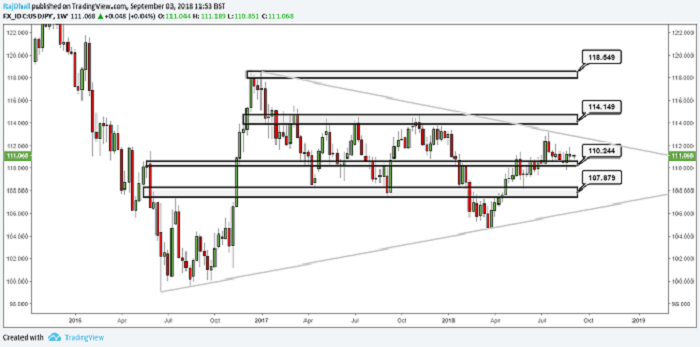
Looking at USD/JPY (yen), it is only the prospect of continued asset buying and yield control from the bank of Japan (BoJ) which is keeping the pair aloft at present. Not that Japan is complaining given its own reliance on exports, though come the time of tapering and deeper consideration into exit strategy, we expect the JPY to come back with a vengeance.
The longer the BoJ maintains its current path, the more severe this will be and, it is this eventuality which is keeping the pair well contained on the upside, currently ahead of 112.00.
Past performance is not a guide to future performance
The data in Japan continues to come in mixed when looking at the broader mix of numbers. Inflation is the one everyone is monitoring, though we have to be mindful of the potential inputs which will (hopefully) raise prices, such as cash earnings and household spending - both of which are out this week.
Capital spending in Q2 was strong at 12.8%, while manufacturing PMIs are still in expansionary territory, but inflation will only pick up if QE is invested domestically rather than divested into external markets.
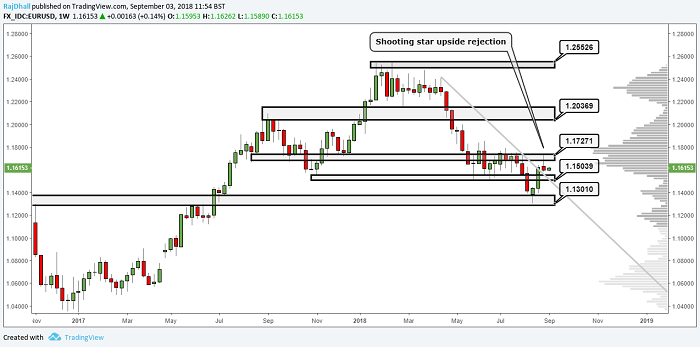
Speaking of undervaluation, EUR/USD is some way off its fair value levels which lies north of 1.2000. Currencies can deviate from this for long periods of time as we have seen in recent years, but on the single currency, we can only see a material threat to its existence prompting a wholesale return to sub 1.1000.
These fears have been revived by the clash between Italy and the EU on the former's budget plans and, while this rages on, it is hard to see the market focusing purely on the economic standpoint, which is also not as strong as it was - partly down to fears of US trade policy.
The PMIs remain well above the expansionary pivot, but in Germany alone, manufacturers and exporters are showing concern (as you would do) and an accommodative European central Bank (ECB) stance is taken as read for now.
Past performance is not a guide to future performance
On Thursday we get German factory orders, followed by industrial production and trade on Friday, all for Jul, to gauge the impact so far.
Just as key for German names is the outcome of the Brexit talks, which have taken yet another twist this week. Last week, the EU's chief negotiator Michel Barnier offered a ray of light on hopes that a cliff edge Brexit can be avoided. His comments that an unprecedented deal could be offered to the UK seemed to suggest some compromise on customs, but over the weekend, his outright rejection of the Chequers plan effectively put this view to bed as the single market will be protected to the hilt.
Back to square one then, with UK's PM May countering that the proposals 'agreed' at Chequers are the only basis on which to move forward.
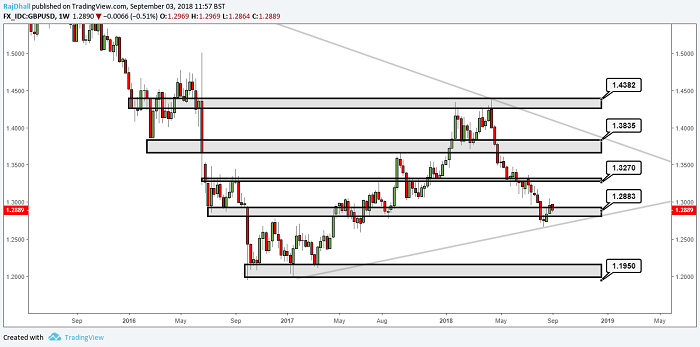
Given that both sides will continue to thrash out a compromise until the end of November, we can expect the pound (GBP) to seesaw along with the series of headlines which are sure to litter the newswires until then. The natural bias will be to the downside, though we are now considering at what point GBP will price in the worst of it - projections at the lower end of the scale coming in at 1.2100-1.2200 for now against the USD.
Past performance is not a guide to future performance
Against the EUR, the sky seems to be the limit as the market is talking about parity once again. This is likely based on the assumption that the EUR finds its footing across the board, with a move above 1.2000 against the greenback.
UK data has already kicked off with manufacturing PMIs coming in weaker than expected at 52.8 - still expansionary - but a full point down on the previous month which was revised lower from 54.0, while export orders have contracted for the first time in two years to add to the economic fears posed by Brexit uncertainty.
We get the construction index on Tuesday, though all eyes will be on the services sector in Wednesday to ascertain whether the bulk of the economic activity is holding up.
Central bank meetings of note in both Canada and Australia this week, though the RBA is much less of an event these days given their persistent communication of a neutral stance in the near term.
These articles are provided for information purposes only. Occasionally, an opinion about whether to buy or sell a specific investment may be provided by third parties. The content is not intended to be a personal recommendation to buy or sell any financial instrument or product, or to adopt any investment strategy as it is not provided based on an assessment of your investing knowledge and experience, your financial situation or your investment objectives. The value of your investments, and the income derived from them, may go down as well as up. You may not get back all the money that you invest. The investments referred to in this article may not be suitable for all investors, and if in doubt, an investor should seek advice from a qualified investment adviser.
Full performance can be found on the company or index summary page on the interactive investor website. Simply click on the company's or index name highlighted in the article.