FX Focus: Why dollar strength could end this week
16th July 2018 11:54
by Rajan Dhall from interactive investor
Foreign exchange analyst Rajan Dhall runs through the big issues that will drive the major currency pairs this week.

Plenty of data risk to contend with this week, with Monday and Tuesday offering up US consumer spending and manufacturing output, while the UK serves up its own jobs report tomorrow, plus inflation and retail sales through to Thursday.
So far, we have received the Chinese growth data for Q2, which on the quarter rose 1.8%, but this kept the annualised rate at 6.7%. A tentative concern is the drop-off in industrial production, however, which came in at 6.0% vs 6.8%, and this will press on commodity prices already under the cosh from the imposition of tariffs with the prospects of more to come.
President Trump's visit to Europe and the UK has moved to Helsinki where he meets his Russian counterpart Vladimir Putin. On the face of it there is little here which could impact markets - oil if anything - with discussions of a political nature and largely an exercise in relationship building.
Over the weekend, the US president responded angrily to the indictment of 12 Russian nationals over interference in the 2016 elections, and this will be a sticking point in the talks, though naturally with some empathy from the US president.
Markets will also be focusing on Fed Chair Powell's semi-annual monetary policy testimony presented to the Senate and House committees over Tuesday and Wednesday, but here also we see a limited impact on the market. Not only are his and the Fed's outlook well versed, but with focus on the pace of economic expansion based on the data going forward, FOMC projections on rates are unlikely to firm up anymore though some members are still of the view that three hikes this year will suffice.
Earnings season also continues and, as we have seen already, this has spurred the Japanese yen (JPY) to lower levels against the dollar (USD).
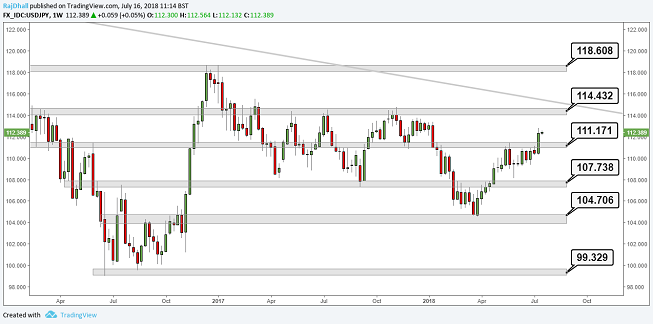
Starting with the greenback, USD/JPY (see chart below) has now pushed through some technical levels at 111.50 with a view to challenging higher still, and this has defied some of the traditional correlations, notably the flattening of the yield curve which now shows a mere 25-27bps in the 2yr vs 10yr spread.
As such, market participants are arguing that the market is under-pricing the Fed dot plot, though this is seen as more a function of heavy Treasury buying, and the JPY moves suggest a large part of this is coming out of Japan. As the Bank of Japan (BoJ) continues to buy assets at the rate they are, divestment will press on global yields and the JPY accordingly.
Technically, there is a tranche of USD/JPY resistance from 112.80 up to 113.50, but there looks to be little interest to reverse gains seen so far, with the carry trade naturally supportive of consolidation.
Concerns over current levels mirror those of stock valuations where the NASDAQ has gone on to print fresh record highs. The S&P and Dow are also pressing higher again and, noted above, earnings releases could be the catalyst for yet more gains which will also nudge USD/JPY and the crosses higher still.
Past performance is not a guide to future performance
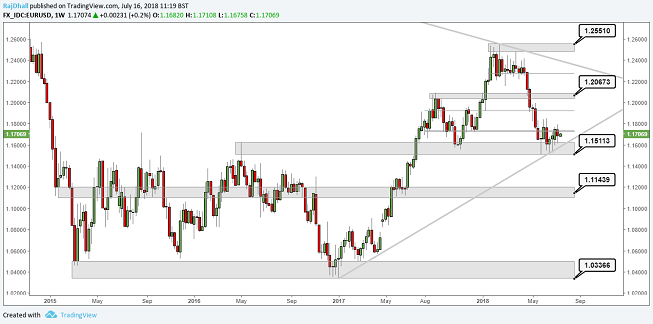
The USD index, however, is heavily dependent on the fortunes of EUR/USD (see chart below), and here we see notable resilience to the downside with selling on Friday contained ahead of the 1.1600 level. Despite the combination of both political and economic risks to the European Union, the single currency may be finding demand on valuation-based metrics once again.
We have seen the 1.1500 level holding strong in recent weeks but, at this point, the lack of follow-through beyond here may also be a result of exhaustion, so we cannot rule out a push lower. This may take some time to materialise though, so 1.1850-75 will continue to act as resistance in the meantime.
Not too much in the way of data to consider this week over than the second CPI reading due out on Wednesday. The EU current account is also due at the end of the week, but markets are trading off rate and policy differentials, so this will not be ingredient in price action and certainly not at the end of the week.
Past performance is not a guide to future performance
There are other factors which seem to be feeding into EUR out-performance at the moment, and looking at the crosses, all of the Swiss franc (CHF), JPY and GBP rates are buoyant at the moment. For the CHF, broad-based weakness seen towards the end of last week suggests thin volumes may have assisted some of the Swiss National bank (SNB) efforts to curb CHF gains of late, with the central bank making no secret of their intentions on limiting strength.
EUR/GBP however continues to hold the line at 0.8800. There was good buying interest at this level last week, and for all the optimism over the fresh Brexit plans, there are still plenty of question marks over Theresa May's concessions which have been designed to address some of the fears of British industry closely tied to Europe.
Goods and agricultural products are now proposed to come under EU ruling in order to maintain a customs territory, but on the basis of the referendum vote, the familiar hard liners insist this is a betrayal of the vote. Services will be kept out of this arrangement, and this is something the EU are expected to resist vehemently.
As such, the odds of a no deal scenario are substantial, with German industry being urged to prepare for what would effectively be a move to WTO rules. Parliament votes on Monday night on the latest proposals, and few expect an easy pass for the PM and this prolongs the agony of uncertainty which is destabilising the economy from a business investment perspective.
Away from Brexit, the release of data series referred to above will be influential. Earnings growth is perhaps the more significant number as inflation has been trickling lower in recent months to more comfortable levels.
Retail sales can be erratic, but good weather and World Cup fever could bolster the stats in June, which could lift the odds of a rate hike in August. Many believe the Bank of England (BoE) should sit on its hands until there are clearer signs on the Brexit talks and, given the tenuous nature of growth and more importantly investment amid general uncertainty, a safety first approach would make sense.
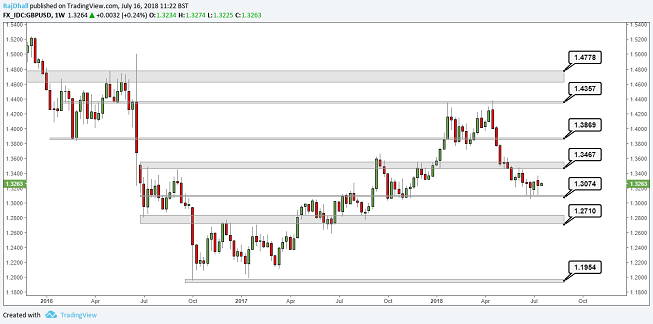
Nevertheless, valuation is also a key factor in Cable. We have seen the post-referendum panic taking us down below 1.2000, albeit briefly, while circa 1.2500 looks to have established itself as a value point for longer term investors happy to ride the volatility anticipated over the next couple of years.
As such, any moves below 1.3000 could be seen as temporary when considering the variety of time-frames. Technically, 1.3050 has held well to suggest traders are pre-empting demand at the lower levels mentioned.
Past performance is not a guide to future performance
These articles are provided for information purposes only. Occasionally, an opinion about whether to buy or sell a specific investment may be provided by third parties. The content is not intended to be a personal recommendation to buy or sell any financial instrument or product, or to adopt any investment strategy as it is not provided based on an assessment of your investing knowledge and experience, your financial situation or your investment objectives. The value of your investments, and the income derived from them, may go down as well as up. You may not get back all the money that you invest. The investments referred to in this article may not be suitable for all investors, and if in doubt, an investor should seek advice from a qualified investment adviser.
Full performance can be found on the company or index summary page on the interactive investor website. Simply click on the company's or index name highlighted in the article.