Lloyds Bank’s annual results: Black Horse returns to form
Things continue to look good for Lloyds as the bank makes more money than expected in 2025. ii's head of markets runs through the numbers.
29th January 2026 08:13
by Richard Hunter from interactive investor
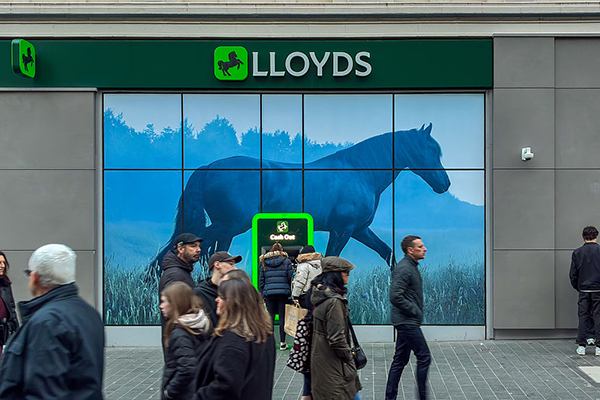
People walk past a Lloyds Bank branch in Newcastle, England. Photo: Michael Nguyen/NurPhoto via Getty Images.
First out of the gates in an unusually elongated reporting season for the UK banks, Lloyds Banking Group (LSE:LLOY) has opened proceedings in some style.
- Our Services: SIPP Account | Stocks & Shares ISA | See all Investment Accounts
The third quarter was marred by an additional £800 million motor finance redress provision which took the total to £1.95 billion and skewed the group’s overall numbers. However, in the context of the full year, the provision has done little to prevent a strong performance, in addition to which the consensus is that the current provision will be sufficient, enabling the matter to be brought to a close.
Indeed, the numbers are solid proof of the progress which Lloyds is achieving. Net income rose by 7% in 2025 to £18.3 billion, which included a 6% hike in Net Interest Income (NII) to £13.6 billion. Net Interest Margin, which grew to 3.06% from 2.95%, saw the benefit of a growing structural hedge contribution, which is designed exactly to mitigate the group’s susceptibility to changes in a falling interest rate environment, and which should provide a further revenue boost this year.
- Investment outlook: expert opinion, analysis and ideas
- Five UK blue-chips among these 25 best stock ideas
- New price targets for Lloyds Bank, Barclays, NatWest and others
Such growth propelled pre-tax profit ahead by 12% to £6.7 billion, above the £6.4 billion which the market was expecting, while the key metrics returned to form for the year. The motor provision failed to prevent growth in the Return on Tangible Equity (ROTE) to 12.9% for the year (including 15.7% in the final quarter), without which the cumulative number would have been 14.8%. The cost/income ratio fell to 58.6% from 60.4% in the corresponding period last year, while the capital cushion or CET1 ratio remains at a robust 13.2%, ahead of the 13% group target.
There was also positive news in terms of the group’s more traditional business, with growth in both loans and deposits. Loans increased by 5%, or £22 billion to £481.1 billion over the year, with UK mortgages a highlight. Meanwhile, the customer deposit exodus which had been in place with higher rates being sought elsewhere seems to have steadied for the time being, with an increase of 3%, or £13.8 billion in deposits to £496.5 billion, driven largely by Commercial Banking.
- Gold: a new price target, favourite stocks and when to sell
- Aviva vs Legal & General: analyst names their winner
Overall, Lloyds is pursuing its refocused strategy, especially on the digital front where the total number of banking app users of 21.5 million provides a springboard for further capital light growth. The group is also prioritising higher value areas, such as what it describes as the Mass Affluent segment, deepening customer relationships and where the recent acquisition of Schroders Personal Wealth, previously run as a joint venture, is a statement of intent. In addition, the group is separately expecting in excess of £2 billion of annualised additional revenues from strategic initiatives next year, up from a previous estimate of £1.5 billion.
The strength of the performance and indeed the outlook has enabled Lloyds to announce a new share buyback scheme of £1.75 billion alongside further evidence of the group’s progressive dividend policy, where the annual increase lifts the projected yield to 3.5%, an attractive level with the strong likelihood of more to come. The outlook comments will also provide some comfort for investors, with Lloyds targeting NII of around £14.9 billion, a cost/income ratio of less than 50% and a ROTE in excess of 16% next year.
Lloyds continues to display the kind of strong and dependable performance which has increasingly attracted global investors not only to the bank and the sector, but the primary index as a whole.
- Trading Strategies: share price growth ahead for Marks & Spencer?
- Sign up to our free newsletter for investment ideas, latest news and award-winning analysis
Buoyed also by a possibly overdue rerating for UK banks, particularly in comparison to their European counterparts, the Lloyds share price has risen by 70% over the last year, as compared to a gain of 18.6% for the wider FTSE100, and by 148% over the last two years. Overall, this performance continues to validate the bank’s strategy, with the market consensus of the shares as a buy unlikely to waver any time soon.
These articles are provided for information purposes only. Occasionally, an opinion about whether to buy or sell a specific investment may be provided by third parties. The content is not intended to be a personal recommendation to buy or sell any financial instrument or product, or to adopt any investment strategy as it is not provided based on an assessment of your investing knowledge and experience, your financial situation or your investment objectives. The value of your investments, and the income derived from them, may go down as well as up. You may not get back all the money that you invest. The investments referred to in this article may not be suitable for all investors, and if in doubt, an investor should seek advice from a qualified investment adviser.
Full performance can be found on the company or index summary page on the interactive investor website. Simply click on the company's or index name highlighted in the article.