One year on from DeepSeek: China and the tech race
China’s DeepSeek reset expectations in AI. One year on, its impact on the global tech race is becoming clearer.
6th February 2026 11:05
by Xin-Yao Ng from Aberdeen
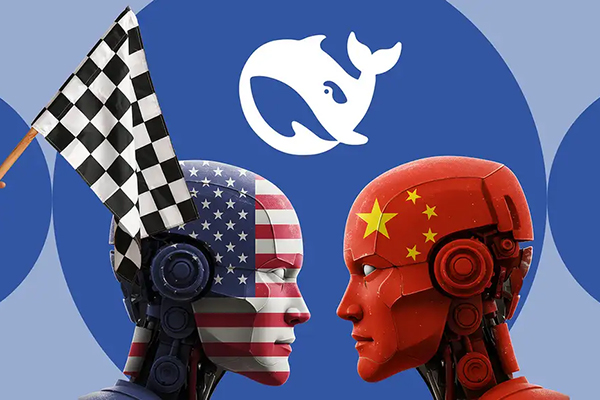
The Soviet Union launched Sputnik 1, the first artificial satellite, in October 1957. Rocked by the abrupt realisation that it was trailing its arch-enemy in the nascent “space race”, America was instantly plunged into panic.
Reactions were varied in their wildness but united in their pessimism. Although Sputnik I measured only 58 centimetres in diameter, one prominent astrophysicist claimed the Soviets could land on the Moon within a week. Future President Lyndon B. Johnson spoke of “a second Pearl Harbor”, while one of his aides warned that the US was losing the battle “for control of the universe”.
Fast-forward nigh on 70 years and, true to Mark Twain’s oft-quoted dictum, we find history might not repeat but often rhymes. The Soviet Union is no more, yet the US is now engaged in another epic technological showdown with a rival superpower – and it once again dreads the prospect of finishing as runner-up.
The “Sputnik moment” in this instance came in January 2025, with the unveiling of DeepSeek-R1. Evidence of China’s ability to produce a chatbot capable of matching and even outstripping those of the US immediately sent shockwaves around the West.
First and foremost, it became clear that the fight for AI supremacy would no longer be contested only by a handful of established American tech titans. More broadly, the prevailing notion that China should be seen as little more than a determined “fast follower” was dramatically undermined.
With $1 trillion (£736 billion) wiped off the US stock market, even Donald Trump – not exactly an individual renowned for episodes of humility and introspection – was moved to sound a note of caution. “The release of DeepSeek – AI from a Chinese company – should be a wake-up call for our industries that we need to be laser-focused on competing to win,” he said.
What really spooked the Americans, of course, was that DeepSeek proved able to go toe-to-toe with the likes of ChatGPT despite having been developed with far fewer resources. In other words, compared to its US counterparts, China’s upstart was remarkably cheap to produce.
So, where do things stand now? According to Demis Hassabis, CEO of Google DeepMind, China’s AI models may be only “a matter of months” behind the best of the West.
Considering its source, that’s quite a compliment – even if it comes with the caveat that the US remains more likely to deliver further genuine breakthroughs. Meanwhile, perhaps even more compellingly, there’s no doubt that China has carved out a clear advantage in a number of other tech arenas.
Take electric vehicles (EVs). China is now the number one exporter of EVs. Last year, with annual sales exceeding 2.25 million, BYD surpassed Tesla to become the biggest seller of battery-powered cars. Here, again, lower pricing has been key.
Relatedly, China is also the leading manufacturer of batteries for EVs, as well as for energy storage. In addition, while its enduring affection for fossil fuels continues to earn negative headlines, the world’s second-largest economy is at the forefront of sustainable energy.
Research capacity is an important driver here. According to a report by the Australian Strategic Policy Institute (ASPI), China is now at the vanguard of studies into 66 out of 74 critical technologies – including generative AI and brain-computer interfaces – leaving the US top of the heap in just eight.
In this regard, notes ASPI, a particular pattern is becoming all too familiar. In short: the US initially holds the upper hand, only for China to catch up and move ahead.
Another major factor is the renewed enthusiasm for tech in policymaking circles. Whereas entrepreneurship was in many ways strongly discouraged several years ago, Beijing now has a healthy appetite for companies keen to achieve growth by embracing the cutting edge.
Many of these are still relatively small, which can present a difficulty for investors. The basic problem is that the long-term promise of such firms is likely to go widely unrecognised – not least amid the noise that constantly surrounds the likes of Nvidia, Microsoft and other household-name mega-caps.
This is where on-the-ground knowledge and direct engagement can make a real difference to portfolio construction and management, especially from the perspective of diversification. It’s why the members of the Aberdeen Asia Focus plc team see discovering “hidden gems” as fundamental to the fund’s continued outperformance.
Unlike the incredulous Americans when their shortwave radios first picked up Sputnik 1’s distant signal, we’re not in the business of overreacting. But if we encounter something small, innovative and potentially game-changing – whether in China or elsewhere in Asia – we’re certainly likely to take a very keen interest.
Xin-Yao Ng is investment manager, Aberdeen Asia Focus.
ii is an Aberdeen business.
Aberdeen is a global investment company that helps customers plan, save and invest for their future.
These articles are provided for information purposes only. Occasionally, an opinion about whether to buy or sell a specific investment may be provided by third parties. The content is not intended to be a personal recommendation to buy or sell any financial instrument or product, or to adopt any investment strategy as it is not provided based on an assessment of your investing knowledge and experience, your financial situation or your investment objectives. The value of your investments, and the income derived from them, may go down as well as up. You may not get back all the money that you invest. The investments referred to in this article may not be suitable for all investors, and if in doubt, an investor should seek advice from a qualified investment adviser.
Full performance can be found on the company or index summary page on the interactive investor website. Simply click on the company's or index name highlighted in the article.