Stockwatch: an exciting share off the radar of most investors
This small company doubled profit in 2025, boasts a track record of upgrades and has attracted director share buying. Understandably, it’s caught the attention of analyst Edmond Jackson.
30th January 2026 11:17
by Edmond Jackson from interactive investor

It’s off the radar of most investors, who may baulk at a developing country lender listed in London.
- Invest with ii: SIPP Account | Stocks & Shares ISA | See all Investment Accounts
But £238 million ASA International Group (LSE:ASAI) combines a habit of upgrades with a distinct “bowl” chart and low valuation, which looks extremely attractive relative to near-term earnings growth prospects.
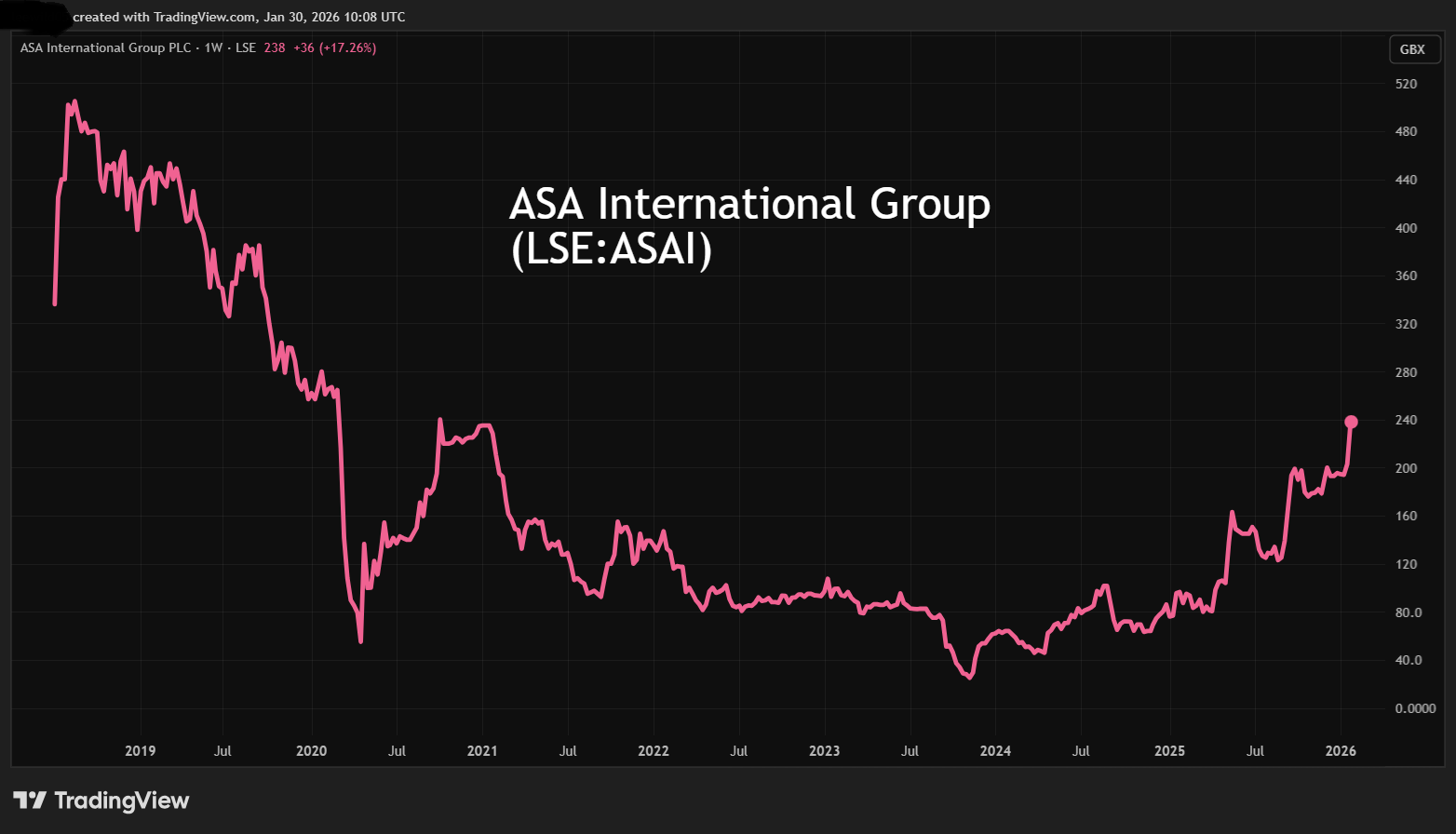
Source: TradingView. Past performance is not a guide to future performance.
ASA listed on the stock market in July 2018 at 313p, and at 238p currently, is down 23% after nearly eight years. Some investors might say this is a verdict on its business model. Showing its sensitivity to the economy, even in relatively fast-growing regions, Covid wiped out $34 million (£24.7 million) of net profit in 2019 and a recovery to near $18 million profit in 2022 was halved in 2023.
But with a 2026 price/earnings (PE) ratio below 5x, given the prospect of net profit well over $60 million after $57 million has just been cited in a full-year 2025 update, are the risks more than priced in? The market appears to be sensing so, with the share price up 10% as I finish writing this piece early on Friday morning.
- 10 shares to give you a £10,000 annual income in 2026
- Investment outlook: expert opinion, analysis and ideas
The prospective dividend yield is over 5% with earnings cover of 4.3x. The cash-flow profile worsened from 2023 but chiefly reflected “movement in loans and advances to customers” as shown in note 26.1 to the 2025 interim results. I am therefore inclined to be tolerant where normally cash flows differing from reported earnings can be a red flag.
With net assets of £99 million equivalent last June, the shares now trade at over twice book value, where most UK lenders tend to be just over 1x even after a bull market in recent years. Yet operating margins towards 50% are ahead of the best in the UK such as NatWest Group (LSE:NWG) at around 40%.
ASA International Group - financial summary
Year-end 31 Dec
| 2019 | 2020 | 2021 | 2022 | 2023 | 2024 | |
| Turnover $ million | 180 | 153 | 200 | 188 | 160 | 228 |
| Operating margin (%) | 52.0 | 27.9 | 34.8 | 46.8 | 32.3 | 48.4 |
| Operating profit ($m) | 93.6 | 42.5 | 69.7 | 88.2 | 51.6 | 111 |
| Net profit ($m) | 34.0 | -0.7 | 8.8 | 17.9 | 9.2 | 29.2 |
| Reported earnings/share (cents) | 34.0 | -0.7 | 8.8 | 17.9 | 9.2 | 29.2 |
| Normalised earnings/share (cents) | 34.0 | -0.7 | 8.8 | 17.9 | 9.2 | 29.2 |
| Operating cashflow/share (cents) | -26.4 | -8.2 | 12.5 | 43.1 | -17.3 | -24.1 |
| Capital expenditure/share (cents) | 2.8 | 1.0 | 2.2 | 6.2 | 7.5 | 6.1 |
| Free cashflow/share (cents) | -29.2 | -9.1 | 10.4 | 37.0 | -24.8 | -30.3 |
| Dividend/share (cents) | 0.0 | 0.0 | 0.0 | 0.0 | 0.0 | 6.7 |
| Covered by earnings (x) | 0.0 | 0.0 | 0.0 | 0.0 | 0.0 | 6.7 |
| Return on capital (%) | 16.7 | 7.3 | 12.4 | 18.0 | 10.5 | 19.4 |
| Return on equity (%) | 14.7 | -0.7 | 8.4 | 18.5 | 11.0 | 33.2 |
| Cash ($m) | 65.5 | 71.8 | 66.5 | 50.5 | 48.5 | 50.2 |
| Net debt (%) | 339 | 354 | 343 | 298 | 307 | 365 |
| Net assets/share (cents) | 108 | 105 | 104 | 89.8 | 77.9 | 98.5 |
Source: company accounts.
Are developing countries a better risk prospect than the UK?
ASA originated in Bangladesh in 1978 and is now headquartered in Amsterdam. It is a small-scale lender to low-income entrepreneurs, mostly women, across Asia and Africa.
Notionally, women seem more likely to target realistic down-to-earth operations versus men’s tendency to be aggressive, hence women are potentially a better credit risk, although more research is needed to substantiate that.
Ghana, Pakistan, Tanzania, Myanmar, Uganda, Kenya and Nigeria have recently been the main drivers of growth; countries that UK-based investors would regard as high risk.
Yet as Labour’s taxes and business rates bear down on hospitality especially, can the UK avoid recession if pain spreads?
The latest Begbies Traynor Red Flag Alert research cites the number of UK businesses in critical financial distress surging 44% year-on-year, with 67,369 companies affected – chiefly consumer-focused ones such as leisure, hotels and accommodation, bars and restaurants.
Vodafone Group (LSE:VOD) has material African exposure, which investors are coming round to regard positively.
Well-defined commercial momentum since 2023
Last year in particular saw profit guidance raised at both September’s interim results and early December trading update, which cited net profit would significantly exceed consensus for $48.3 million (£35.0 million) “building on the sustained momentum seen during the first half year...”
This pushed the shares up from around 170p in September to 200p, then a modest retreat to 195p until 200p was breached 10 days ago. The current jump to near 240p puts ASA on the chart radar, begging the question if its PE remains too low to ignore.
The total number of clients has risen 11% in 2025 to 2.8 million, helping the loan book grow 37% to $628 million and 13% higher than last September. It appears good quality given loans overdue by more than 365 days improved from 2.0% as of 30 September to 1.8% at 31 December.
- BT, Vodafone and BAT to reward income investors in February
- Gold: a new price target, favourite stocks and when to sell
Helped by the operational gearing often inherent to financial businesses, 2025 net profit is now expected to double to $57 million. Moreover, this is being achieved from “disciplined execution of the group’s strategic growth agenda” rather than acquisitions. The CEO says: “It is encouraging to see that the refined strategy we adopted at the start of the year, alongside strengthened leadership layers and an expanded product suite is already starting to pay off.”
Given US President Donald Trump’s trade tariffs – like much elsewhere in US policy – are being exposed as bluster and threats rather than sustained action, it would appear that the magnitude of risk to the global economy is contained, certainly relative to what was feared last March. While there will likely be some effect on international trade, this could direct attention to emerging economies doing indigenously well.
Perhaps ASA is also succeeding due to a marketing niche. The company said: “As 2026 progresses, our priorities remain firmly centred on sustainable growth, transforming the business through our digital agenda, creating further resilience across the organisation and driving operational excellence. At the heart of this remains our mission of increasing financial inclusion for underserved female entrepreneurs.”
Does net gearing around 300% contributes to modest PE?
Yesterday’s update did not mention year-end debt, but the 30 June balance sheet had $351 million of financial debt. There was no clarity as to timescale except saying (note 22) the 9% increase year-on-year related to Pakistan, Ghana and Tanzania, “driven by business expansion and currency appreciation in Ghana”.
End-June cash was $89 million, and the interim income statement showed $25 million “interest and similar expense” (near $20 million related to debt expense versus $3 million as deposit interest and $2 million miscellaneous). At least the $136 million overall interest income from loans was a substantial buffer, such that net interest income in the first half of 2025 came out at $111 million. There was also $7 million of other operating income.
So, management can reasonably claim that over $350 million of debt is justified in pursuit of strategic objectives that are now hitting pay dirt.
Dividends from 2024
Sceptics might reasonably question that it took six years of listed life before ASA began paying out; a somewhat postponed proof of cash flows, although recovery from the Covid episode plus investment opportunities arguably justifies leaving it until then.
- Ask ii: should I switch my ISA savings into my pension?
- Sign up to our free newsletter for investment ideas, latest news and award-winning analysis
Consensus targets an 8.1p per share, sterling equivalent dividend in respect of 2025, rising to 10.8p for 2026. It was just 4.9p in 2024.
Firm recent examples of director buying
There has been no selling or expansion of holdings via options exercising, just material cash buying.
Last November, the CEO bought £182,000 worth of ASA shares at 150p, as did ASA’s chief legal officer, while the senior non-executive director bought £120,000 near 150p. In October, the CEO bought £12,000 worth at 180p. Last July, another non-executive director bought £373,000 at 129p.
In April 2024, the previous CEO bought £82,500 worth at 54p and that November £50,000 worth at 45p.
Also, in November 2023, the current CEO bought £158,000 worth at 30p and the chief legal officer £15,000 worth at 37p.
It reflects confident buying in the cash market, in partnership with outside investors, rather than share options’ exercising and sales.
Does the market spike ease?
Is this just a spike is the tactical question for potential buyers. There are plenty of examples in the market currently, as if bullish sentiment is quick to alight on the next opportunity, and ASA’s situation is not radically different from when it last updated nearly a month ago. I rate the shares broadly as a “buy”, but decide your own timing.
Edmond Jackson is a freelance contributor and not a direct employee of interactive investor.
These articles are provided for information purposes only. Occasionally, an opinion about whether to buy or sell a specific investment may be provided by third parties. The content is not intended to be a personal recommendation to buy or sell any financial instrument or product, or to adopt any investment strategy as it is not provided based on an assessment of your investing knowledge and experience, your financial situation or your investment objectives. The value of your investments, and the income derived from them, may go down as well as up. You may not get back all the money that you invest. The investments referred to in this article may not be suitable for all investors, and if in doubt, an investor should seek advice from a qualified investment adviser.
Full performance can be found on the company or index summary page on the interactive investor website. Simply click on the company's or index name highlighted in the article.
Disclosure
We use a combination of fundamental and technical analysis in forming our view as to the valuation and prospects of an investment. Where relevant we have set out those particular matters we think are important in the above article, but further detail can be found here.
Please note that our article on this investment should not be considered to be a regular publication.
Details of all recommendations issued by ii during the previous 12-month period can be found here.
ii adheres to a strict code of conduct. Contributors may hold shares or have other interests in companies included in these portfolios, which could create a conflict of interests. Contributors intending to write about any financial instruments in which they have an interest are required to disclose such interest to ii and in the article itself. ii will at all times consider whether such interest impairs the objectivity of the recommendation.
In addition, individuals involved in the production of investment articles are subject to a personal account dealing restriction, which prevents them from placing a transaction in the specified instrument(s) for a period before and for five working days after such publication. This is to avoid personal interests conflicting with the interests of the recipients of those investment articles.