Demographics: finding winners in a world of fewer workers and older consumers
Growth is shifting from headcount to productivity, and the investment map is shifting with it.
18th November 2026 13:00
by Rebecca Maclean from Aberdeen

For decades, demographics quietly powered global growth. For most major economies, that era is over. Investors who still treat population trends as slow-moving background noise are misreading the market. Two-thirds of the world’s population now live in countries with below replacement fertility rate [1]. This means that growth will increasingly come from productivity, not headcount. That points investors in two directions: towards companies helping ageing economies do more with fewer people, and towards businesses capturing rising incomes where workforces are still growing.
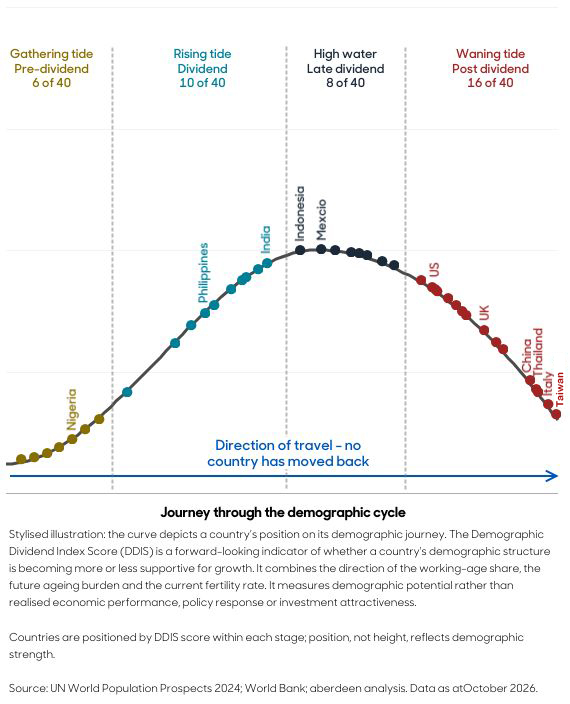
Think of the demographic journey as a tide. In a gathering tide, fertility is high but the working share of the population barely rises. In a rising tide, falling fertility leaves more workers supporting fewer dependants – a dividend that can last for decades. After a period of high water, once fertility has fallen below replacement, workforce growth stalls, populations age and migration doesn’t fill the gap. The tide wanes, never to return.
Demographic surprise
The shift is happening faster than almost anyone predicted, and the forecasts are still playing catch-up. A decade ago, the United Nations put the probability of the global population peaking this century at around 30%; it now puts it at 80% [2]. The world is past peak child. China recorded just 7.92 million births in 2025, down from 9.54 million in 2024 [3]. South Korea's fertility collapse has consistently outpaced expectations, with each successive forecast revising the recovery path lower [4].
Some countries are growing old before they are rich. Thailand and Italy face similar pressures – both have a fertility rate of around 1.2 and a shrinking workforce – yet Italy’s income per person is more than five times higher. Combined with economic analysis, demographics can help investors identify opportunities across developed and emerging markets.
The tide has turned in more places than you think
Aberdeen Investments scores major economies on three equally weighted measures: the projected change in working-age share over 25 years, the share aged over 65 in 2050, and current fertility.
Among the 50 largest economies, only Nigeria is in a gathering tide. India, the Philippines and parts of Africa are in a rising tide, with growing workforces and expanding consumer markets (see figure 1).
Most major economies – those that have driven global growth over the past three decades – have lost their demographic tailwind. China, Japan and Italy are in a waning tide, each expected to lose more than a fifth of its working-age population over the next 25 years [5]. China alone could lose more than 200 million working-age people by 2050 – more than the current US civilian labour force. In these markets, labour becomes the scarce resource, and output per worker will decide which companies pull ahead.
Meanwhile, the number of over-65s is set to double from 703 million in 2019 to 1.5 billion by 2050 [6]. Italy will go from over two people of working age per person over 65 today to just over one by 2050 [7]. That shifts spending towards healthcare, long-term care and retirement income – and puts a strain on public finances that will be hard to ignore.
Figure 1: The turning tide: where major economies sit on the demographic tide
Where is the tide creating opportunities?
Productivity
This is the clearest opportunity. As labour becomes scarcer, growth depends on what each worker can produce. Automation, robotics, industrial software, AI and training are no longer nice-to-haves. But the strongest cases are companies that show measurable productivity gains, not those simply riding the AI wave.
Recent insights from Taiwan bring this tension into sharp focus. It’s in the middle of a historic semiconductor investment cycle, yet it has one of the world’s lowest birth rates and a shrinking workforce, with more than 20% of its population over 65. Across the supply chain, companies repeatedly highlighted labour shortages, engineering talent constraints and factory construction bottlenecks. Capital and demand are abundant, but people and infrastructure are now the binding constraints. Capacity expansion elsewhere in Asia therefore reflects demographics as much as geopolitics.
Longevity
Longer lives shift demand towards healthcare innovation, preventative care, retirement savings and insurance, creating opportunities in diagnostics, medical devices, digital health and chronic-disease management. But labour-intensive providers face staffing shortages and wage pressure, and some will see margins squeezed even as patient numbers rise.
Living
In wealthier ageing economies, such as Japan and Germany, retirees hold a growing share of spending and wealth. This ‘silver economy’ spans housing adaptation, mobility, travel, leisure, wealth management and consumer brands. But it’s fast becoming a marketing label. Investors can back genuine demand and pricing power, not companies simply leaning on an ageing story.
Where workforces are still growing, opportunities may arise in financial services, consumer goods, infrastructure, housing and education. But a young population alone doesn’t guarantee returns – jobs, skills, governance and capital-market depth decide whether that potential becomes profitable growth.
Both sides of the tide
The age of easy, population-driven growth is over for most major economies. From here, growth must be earned through productivity, innovation and capital. India and parts of Africa still have the tide with them. Demographics don’t determine outcomes, but investors who ignore them are valuing companies against a backdrop that no longer exists. The opportunity lies on both sides of the tide – in countries that turn demographic potential into growth, and companies that adapt fastest.
1. Total fertility rate: the average number of children a woman is expected to have in her lifetime. A rate of around 2.1 is needed to keep a population stable without migration (the "replacement" level).
2. United Nations, Department of Economic and Social Affairs, Population Division (2024), World Population Prospects 2024: Summary of Results, July 2024.
4. UN World Population Prospects (2000, 2006, 2012, 2019 and 2024 editions), South Korea total fertility rate projections.
5. Based on 25-64 year old. United Nations, Department of Economic and Social Affairs, Population Division (2026). Data Portal, custom data acquired via website.
6. United Nations, Department of Economic and Social Affairs, Population Division (2020). World Population Ageing 2019 (ST/ESA/SER.A/444). New York: United Nations.
7. United Nations, Department of Economic and Social Affairs, Population Division (2024). World Population Prospects 2024, medium variant. Data Portal
Rebecca Maclean, investment director, developed market equities, at Aberdeen.
ii is an Aberdeen business.
Aberdeen is a global investment company that helps customers plan, save and invest for their future.
These articles are provided for information purposes only. Occasionally, an opinion about whether to buy or sell a specific investment may be provided by third parties. The content is not intended to be a personal recommendation to buy or sell any financial instrument or product, or to adopt any investment strategy as it is not provided based on an assessment of your investing knowledge and experience, your financial situation or your investment objectives. The value of your investments, and the income derived from them, may go down as well as up. You may not get back all the money that you invest. The investments referred to in this article may not be suitable for all investors, and if in doubt, an investor should seek advice from a qualified investment adviser.
Full performance can be found on the company or index summary page on the interactive investor website. Simply click on the company's or index name highlighted in the article.