How to become a better investor
27th June 2018 11:03
by Douglas Chadwick from interactive investor
This content is provided by Saltydog Investor. It is a third-party supplier and not part of interactive investor. It is provided for information only and does not constitute a personal recommendation.

It's said that there are three things a wise man has to fear: the sea in a storm, a night with no moon and the anger of a gentle man. I would like to add a fourth: the uncontrolled interference and meddling of politicians, bureaucrats and bankers in the world's economies.
It is difficult enough to make sensible investment decisions when there is permanence and solidarity in the financial markets, but when we are operating in an environment of false news and tweets it has definitely become more challenging. The stability of history is being eroded, making it more difficult to look back in order to look forward.
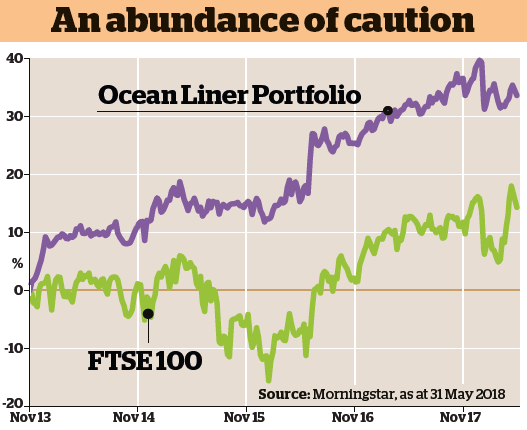
Over the last couple of years we have seen our portfolios growing, and we have become used to this direction of travel and the increase in our paper wealth. So when earlier this year there was a 10% drop in the American stockmarket, with the bond market also appearing to be on the slide, it seemed logical to move more of our portfolios into cash.
Nightmare scenario
This downwards slip, in the context of the financial news and the political environment, could be the forewarning of a much larger fall. A nightmare scenario such as those of 1929, 1966 and 2008 could be around the corner. I am not saying it is, as I obviously do not know, but it could be.
The question I now keep asking myself is this:
"With my portfolios at (or very near to) their all-time highs, why am I not happy to leave them safe and sound where they are and hold a large percentage of cash?"
As the markets recover somewhat, why do I have the urge to ignore my previous analysis and step back in?
Past performance is not a guide to future performance
The Saltydog numbers and graphs, with the exception of the UK funds, are dismal. The UK equity income, UK all companies and UK smaller companies sectors have made good progress over the past eight weeks, but most of the recent gains have come from funds benefiting from the strengthening of the dollar, and I would not like to bet on that continuing.
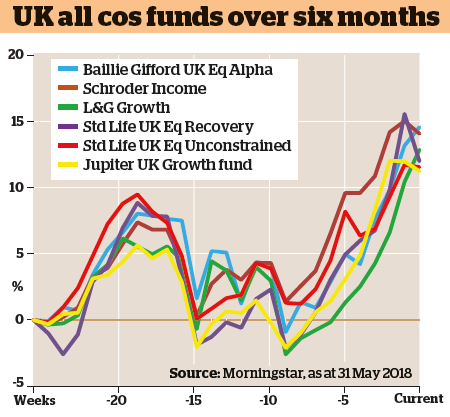
Below is a graph showing some of the leading funds in the UK all companies sector (based on their performance over the past six months). Although their eight-week recovery has been impressive, when you look over 26 weeks you can see that it's not all been plain sailing.
Past performance is not a guide to future performance
Now must be the time to listen and take heed of the sayings of two famously successful investors. The first, Warren Buffett, stated:
"The greatest asset an investor can have is patience."
The second, Jesse Livermore, said:
"What beat me was not having brains enough to stick to my own game - that is, to play the market only when I was satisfied that precedents favoured my play."
These are easy things to say, but much harder to put into practice. I have just finished reading Sapiens, by Yuval Noah Harari, in which the author gives a 'brief history of mankind'. In the book there is a section about Buddhism. The central figure of Buddhism was a man named Siddhartha Gautama (Buddha) and he recognised that no matter what a person achieves, they are rarely satisfied. This is part of the human condition.
Even if you achieve wealth, power, knowledge and possessions, you will still want more. Whatever your circumstances, your mind will usually react with craving, and craving always involves dissatisfaction.
When the mind experiences unpleasantness it craves to be rid of the problem, and when the experience is pleasurable it craves more. This is an over-simplification, but it means that as humans we are nearly always dissatisfied. The Buddha sought to change this, and encapsulated his teachings into a single law, known as 'dharma' This states that suffering arises from craving; the only way to be liberated from suffering is to be fully liberated from craving; and the only way to be liberated from craving is to train the mind to experience reality as it is.
So there you have it, reality as it is. That is the way forward to make me into a better investor and happier with my lot. Trust the numbers without embellishment, and do not seek what is not there today whilst wishing for an early tomorrow.
Douglas Chadwick is a founder director of Saltydog Investor.
These articles are provided for information purposes only. Occasionally, an opinion about whether to buy or sell a specific investment may be provided by third parties. The content is not intended to be a personal recommendation to buy or sell any financial instrument or product, or to adopt any investment strategy as it is not provided based on an assessment of your investing knowledge and experience, your financial situation or your investment objectives. The value of your investments, and the income derived from them, may go down as well as up. You may not get back all the money that you invest. The investments referred to in this article may not be suitable for all investors, and if in doubt, an investor should seek advice from a qualified investment adviser.
Full performance can be found on the company or index summary page on the interactive investor website. Simply click on the company's or index name highlighted in the article.
This article was originally published in our sister magazine Money Observer, which ceased publication in August 2020.
These articles are provided for information purposes only. Occasionally, an opinion about whether to buy or sell a specific investment may be provided by third parties. The content is not intended to be a personal recommendation to buy or sell any financial instrument or product, or to adopt any investment strategy as it is not provided based on an assessment of your investing knowledge and experience, your financial situation or your investment objectives. The value of your investments, and the income derived from them, may go down as well as up. You may not get back all the money that you invest. The investments referred to in this article may not be suitable for all investors, and if in doubt, an investor should seek advice from a qualified investment adviser.
Full performance can be found on the company or index summary page on the interactive investor website. Simply click on the company's or index name highlighted in the article.