Why income investing in emerging markets in 2026?
Most often associated with growth investing, a new look at how emerging markets represent a uniquely appealing income universe for today’s active investors with a total return mindset.
17th June 2026 09:44
by Matt Williams from Aberdeen

Emerging markets (EM) are typically viewed through a growth lens. But that perspective risks overlooking a key part of the story.
Today, EM also represents a broad and increasingly compelling income universe for active investors focused on total return.
We believe the combination of expanding dividend opportunities and structural growth potential makes this a compelling and often underappreciated opportunity.
Income investing is powerful in emerging markets
Income investing is often associated with mature markets. Yet the evidence suggests that emerging markets now offer a deeper and more established income landscape than many investors realise.
Dividend-paying companies have become the norm rather than the exception. Since 2010, the proportion of EM companies paying dividends - some 85% - has often exceeded that of companies in developed markets (see Chart 1).
Chart 1: More companies paying dividends in EM than in DM
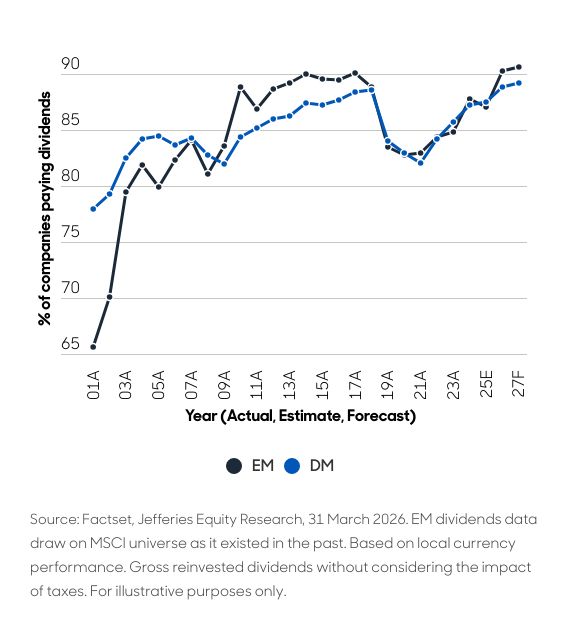
This shift reflects improving corporate governance, stronger balance sheets and a growing recognition of the importance of shareholder returns.
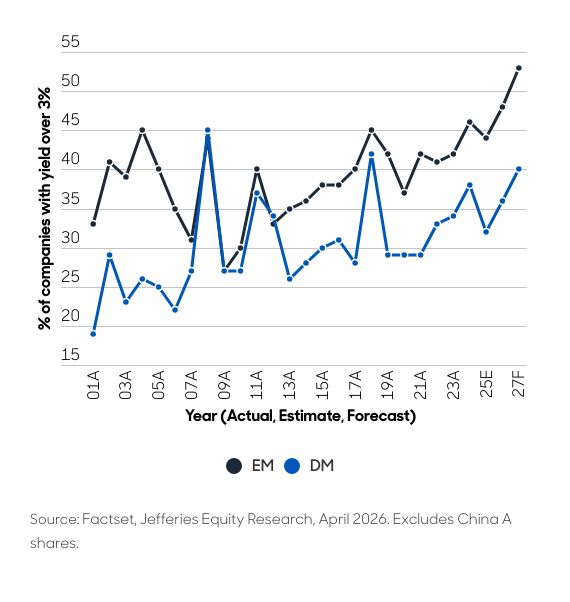
Just as important is the level of income available. More than half of EM companies offer a dividend yield above 3%, highlighting the relevance of income investing within the asset class (see Chart 2).
Chart 2: More than 50% of EM companies have a dividend yield above 3%
Critically, these income streams are increasingly supported by structural drivers of growth. In technology, for example, many EM companies sit at the heart of global supply chains for semiconductors, connectivity and memory. Rising demand linked to artificial intelligence and digitalisation is helping to support both earnings growth and dividend capacity.
Isn’t income investing just telecommunications and utilities?
A common assumption is that income investing leads to a narrow set of opportunities concentrated in traditional defensive sectors.
In emerging markets, this is not the case. Dividend opportunities span a wide range of sectors, including financials, materials, energy and technology (see Chart 3).
Chart 3: Market cap weighted yield by sector
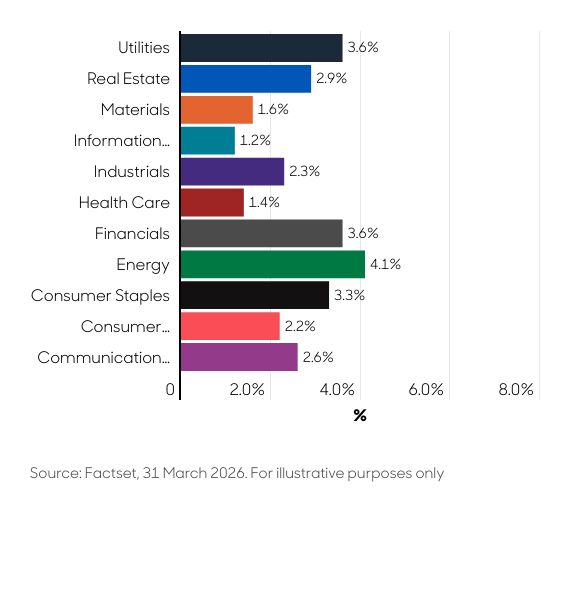
Infrastructure-related sectors provide a good illustration of this breadth. Demand for power, electrification and grid upgrades is rising, driven in part by digitalisation and energy transition trends. Materials such as copper, alongside developments in energy supply chains, highlight the diversity of income opportunities beyond traditional high-yield sectors.
The same is true geographically. There are meaningful income opportunities across a wide range of economies, from Asia and Latin America to the Middle East and Eastern Europe (see Chart 4).
Chart 4: Market cap weighted yield by country
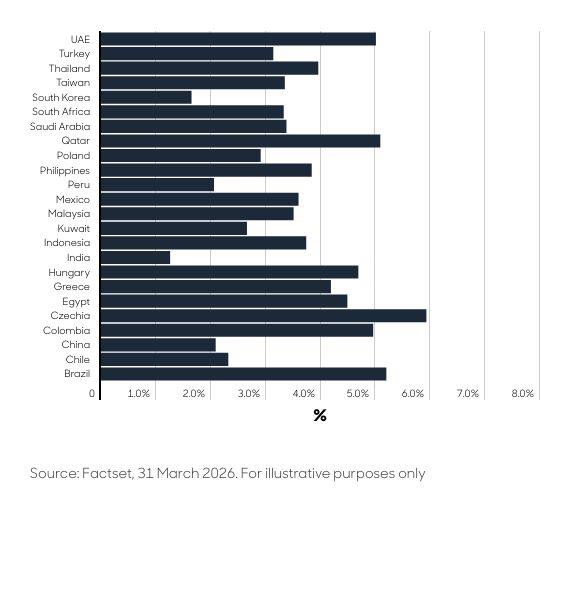
Taken together, this breadth challenges the idea that income investing in EM is either narrow or defensive. Instead, it provides diversified income opportunities across sectors and regions.
Yield doesn’t preclude growth
Another misconception is that income investing comes at the expense of growth. In emerging markets, we believe the opposite is often true.
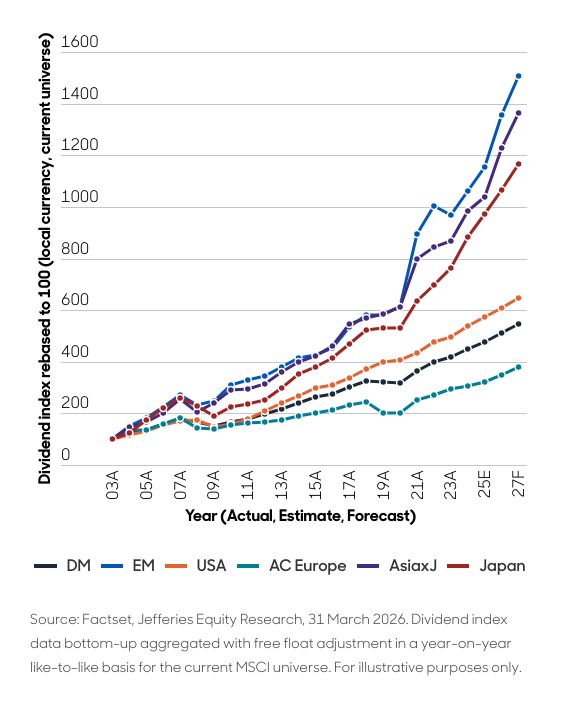
Dividends in EM have grown strongly over time, supported by improving fundamentals and economic expansion. Dividend growth has been significantly faster in EM than in developed markets since the early 2000s, equivalent to almost 12% compound annual growth over the past two decades (see Chart 5).
Chart 5: Dividend growth in EM over the last two decades
This reflects both rising corporate earnings and an increase in payout ratios as companies mature.
Importantly, this growth is underpinned by long-term structural trends. Increasing investment in infrastructure, the expansion of digital technologies, and rising consumer demand are all contributing to stronger and more sustainable cash flows.
As incomes rise and middle classes expand across emerging markets, leading domestic brands are benefiting from higher demand and improving profitability - creating a supportive backdrop for dividend growth.
In other words, income and growth are not mutually exclusive in EM. Instead, they are closely linked.
Total returns’ two components
Income has historically been an important contributor to total returns in emerging markets.
Dividend returns in EM have been among the highest relative to other regions in the MSCI universe over the past two decades (see Chart 6).
Chart 6: Contribution of dividends to total returns
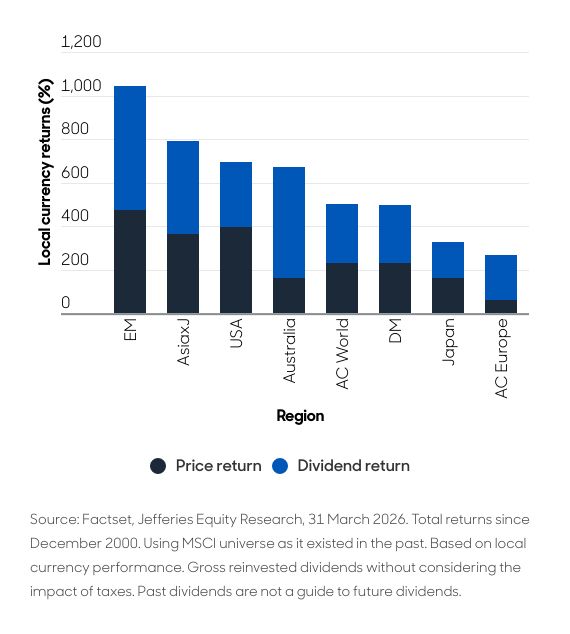
The compounding effect of dividend payments accounts for around half of investor returns. Meanwhile, the price return component is primarily driven by cash flow growth, which also fuels dividend growth.
While total returns are driven by a combination of price return and dividends, the key point is that income has played a meaningful and consistent role over time.
This reflects a virtuous cycle: strong economic growth supports earnings, which in turn supports dividend growth, reinforcing the income component of returns.
Why now?
Despite ongoing geopolitical uncertainty, the long-term outlook for emerging markets remains intact.
The asset class appears to be in the early stages of an upcycle supported by a new global capital expenditure cycle. Structural shifts - including greater focus on energy security, supply-chain resilience, defence spending and investment in artificial intelligence — are driving increased investment globally.
These trends align well with emerging markets’ strengths, both as producers of critical commodities and as key players in global supply chains and technology ecosystems.
Valuations are also supportive. The MSCI EM Index continues to trade at a 40% discount to the S&P500, even after recent strong performance, while earnings expectations have been revised higher.
This combination of attractive valuations and improving earnings momentum may provide a favourable backdrop for active managers.
Final thoughts
Emerging markets are evolving into a compelling destination for income-focused investors.
Dividend-paying companies are widespread, with the majority of firms now distributing income and more than half offering yields above 3%.
At the same time, dividend growth has been strong, supported by improving fundamentals and structural economic trends.
Importantly, income opportunities are broad, spanning sectors and geographies and supported by long-term investment themes across technology, infrastructure and consumption.
For investors willing to look beyond the traditional growth narrative, EM offers something more nuanced: the potential for attractive income today, combined with exposure to structural drivers that can support total returns over time.
Matt Williams, senior investment director at Aberdeen.
ii is an Aberdeen business.
Aberdeen is a global investment company that helps customers plan, save and invest for their future.
These articles are provided for information purposes only. Occasionally, an opinion about whether to buy or sell a specific investment may be provided by third parties. The content is not intended to be a personal recommendation to buy or sell any financial instrument or product, or to adopt any investment strategy as it is not provided based on an assessment of your investing knowledge and experience, your financial situation or your investment objectives. The value of your investments, and the income derived from them, may go down as well as up. You may not get back all the money that you invest. The investments referred to in this article may not be suitable for all investors, and if in doubt, an investor should seek advice from a qualified investment adviser.
Full performance can be found on the company or index summary page on the interactive investor website. Simply click on the company's or index name highlighted in the article.