Why Vodafone shares are still cheap
Already at a multi-year high, this team of experts believes the telecoms giant remains a strong recovery play. City writer Graeme Evans reveals their rationale and price target.
7th January 2026 15:15
by Graeme Evans from interactive investor
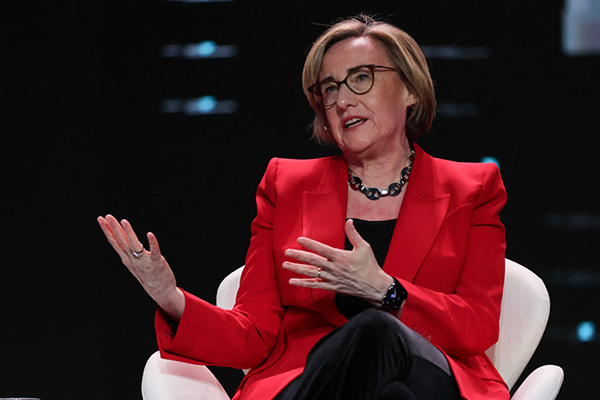
Vodafone CEO Margherita Della Valle at the MWC (Mobile World Congress), the world's biggest mobile fair, in Barcelona, Spain, in March 2025. Photo: LLUIS GENE/AFP via Getty Images.
A Vodafone Group (LSE:VOD) Buy recommendation amid confidence that the mobile phone giant is well placed for future dividend growth today helped shares to sustain their recent recovery.
The support of City firm Berenberg included a 45% hike in price target to 119p, which compares with last night’s closing level of 100.5p and the 64p in the post-tariffs turmoil in early April.
- Invest with ii: SIPP Account | Stocks & Shares ISA | See all Investment Accounts
The shares spent much of the morning as the best in FTSE 100 before settling at 102.1p.
The Buy upgrade and improved price target of Berenberg reflects the impact of November’s first-half results, which showed Vodafone on track for the upper end of its full-year guidance.
The bank raised its long-term free cash flow forecasts and said it was increasingly confident that Vodafone can execute well in its core markets, which include Germany and the UK.
Based on its analysis, the bank points out that Vodafone shares continue to screen as “relatively cheap” versus the European telecoms sector.
Berenberg’s support follows a long period of restructuring that has seen Vodafone refocus on markets where it holds a relatively strong position and can target a return on capital employed above its cost of capital.
- ii view: Vodafone commits to further dividend increases
- Vodafone beginning to ring the changes
- 21 top growth stocks for 2026
The strategy, which included the sale of operations in Italy and Spain and merger of UK operations with Three, was accompanied by a new capital allocation framework that halved the total 2025 dividend to 4.5 euro cents.
Berneberg’s forecasts point to a dividend of 4.61 cents in 2026, rising to 4.75 cents in 2027 and the 4.89 cents the year after. The shares trade with a projected dividend yield of about 4%, which compares with 9.5% in 2024.
It estimates that Vodafone has more than 10 billion euros in excess free cash flow to allocate over the next four years, whilst still maintaining both a progressive dividend and its 2.25-2.75 times debt leverage target.
The bank believes that management’s future capital-allocation priorities will be focused on small value-creating in-market M&A deals and improved shareholder remuneration.
Vodafone is close to completing its existing four billion euros share buyback, which Berenberg thinks could be extended given ample balance-sheet capacity. An announcement on this could potentially form part of new medium-term forecasts and capital-allocation priorities.
- Investment outlook: expert opinion, analysis and ideas
- New price targets for Lloyds Bank, Barclays, NatWest and others
- The shares attracting fund managers at start of 2026
Berenberg notes improving market conditions in Vodafone’s biggest market of Germany, which has been impacted by changes in multi-dwelling unit regulation and mobile price disruption.
It believes the merger with Three UK will ultimately be good for both Vodafone as a result of synergies and for the UK market through substantial investment over the next decade.
These articles are provided for information purposes only. Occasionally, an opinion about whether to buy or sell a specific investment may be provided by third parties. The content is not intended to be a personal recommendation to buy or sell any financial instrument or product, or to adopt any investment strategy as it is not provided based on an assessment of your investing knowledge and experience, your financial situation or your investment objectives. The value of your investments, and the income derived from them, may go down as well as up. You may not get back all the money that you invest. The investments referred to in this article may not be suitable for all investors, and if in doubt, an investor should seek advice from a qualified investment adviser.
Full performance can be found on the company or index summary page on the interactive investor website. Simply click on the company's or index name highlighted in the article.