The Analyst: alternative ideas for portfolio positioning
In a market without clear signals either way, analyst Dzmitry Lipski discusses a shift in portfolio construction towards balance, flexibility and resilience.
23rd April 2026 08:39
by Dzmitry Lipski from interactive investor

As Generation Alpha continues to confuse parents with brain-rot phrases like “six seven”, investors are facing their own version of that uncertainty.
By the way, “six seven” apparently describes something a bit unclear or in the middle, like it could go either way, not great but not terrible either – a phrase accompanied with a shrugging gesture that went viral across TikTok and other social media late last year.
In the same way, markets today don’t give clear signals, they sit somewhere in the middle, with growth and earnings broadly holding up but risks still present.
- Our Services: SIPP Account | Stocks & Shares ISA | See all Investment Accounts
Middle East tensions have become a dominant market story, pushing energy prices higher and unsettling risk assets. Rising geopolitical risks have revived inflation concerns and reversed earlier easing trends. Markets have shifted from expecting rate cuts to anticipating possible hikes, pressuring market valuations.
In other words, it feels like a “six seven’ environment. Investors do not know what’s going to happen next in the Middle East. It seems like there is a lot of doom and gloom in the market, but there are reasons to be optimistic as economic data is still relatively strong and Q2 earnings season is expected to be a good one.
Portfolio positioning in a ‘six seven’ environment
When outcomes are uncertain, portfolio construction naturally shifts towards balance, flexibility and resilience rather than conviction-driven bets.
Diversification becomes the main consideration. Instead of relying on a single asset, investors spread risk across equities, bonds and alternatives, recognising that different parts of the market will respond differently to inflation, rates and growth surprises. At the same time, it becomes harder to justify being fully invested in equities or overly defensive given both carry risks when the outlook is uncertain.
This is why the traditional 60/40 approach, such as theVanguard LifeStrategy 60% Equity A Acc fund, remains a useful reference point. It provides growth through equities (60%) and stability and income through bonds (40%).
Multi-asset funds like this are designed to navigate a range of outcomes, not optimise for one specific scenario, which makes them well suited to a “six seven” environment.
- How to build a higher-risk ISA portfolio
- How to build a medium-risk ISA portfolio
- How to build a cautious ISA portfolio
Moving beyond 60/40: adding flexibility
However, in today’s environment, some investors are calling for more flexibility than what a static 60/40 can offer. The potential shortcomings of a simple 60/40 strategy were exposed in the inflation-driven shock environment of 2022 when both equities and bonds broadly sold off - the Investment Association (IA) 40-85% Mixed Investment category (actively managed, diversified growth and income portfolios with exposure of 40-85% in company shares) average return fell below 10%.
This is where actively managed multi-asset strategies come into play, ranging from simple long-only approaches to more sophisticated, macro-driven absolute return strategies, depending on investor needs.
An income-focused alternative
The Artemis Monthly Distribution I Inc fund offers a different angle on multi-asset investing. It is an actively managed strategy that blends equities and bonds with a clear objective: delivering regular monthly income alongside growth, while carefully managing risk.
The fund is managed by an experienced team: Jacob de Tusch-Lec co-manages the equity allocation alongside James Davidson, while David Ennett and Jack Holmes oversee the bond component. Almost half the portfolio is invested in the US and UK, with the largest sector allocation to financials.
The fund is well diversified, but its simplicity and meaningful overseas exposure help set it apart from peers. The current yield is around 3.7%.
In an uncertain market, this type of strategy can be particularly appealing, not just for income, but for the consistency it can bring to returns.
- Funds and trusts the pros are buying and selling: Q2 2026
- Sign up to our free newsletter for investment ideas, latest news and award-winning analysis
Absolute return alternative
For investors looking to go a step further, the TM Fulcrum Divers Cor Abs Ret C GBP Accfund represents a more flexible approach.
Unlike traditional multi-asset funds, absolute return strategies aim to deliver positive returns across different market conditions using a broader toolkit (including derivatives, macro positioning) and are less correlated to equity or bond markets. This makes them particularly relevant when both asset classes face uncertainty, as seen recently with inflation shocks and rate volatility.
The Fulcrum Diversified Absolute Return fund is a differentiated, macro-driven strategy that draws on the firm’s alternative investment capabilities and aims to deliver returns of 3–5% above the base rate with low volatility.
Headed by CIO Suhail Shaikh, the fund takes an unconstrained approach. The team makes dynamic allocation decisions based on macro views across equity regions and themes, fixed income, commodities and currencies, with the ability to take both long and short positions.
The return profile is designed to be relatively uncorrelated with global equity and bond markets. While the strategy experienced a period of weakness between 2016 and 2018, it has not produced a negative calendar year return since, and performance during the challenging market conditions of 2022 was particularly strong.
The key takeaway
In a “six seven” market, there’s no perfect answer. The focus is on building a portfolio that can adapt to whatever comes next. Rather than trying to pick one asset class that will outperform, it’s better to combine different strategies to improve your chances of navigating uncertainty.
In that context, moving beyond a pure 60/40, by adding income and absolute return strategies, is less about taking more risk, and more about managing it more effectively.
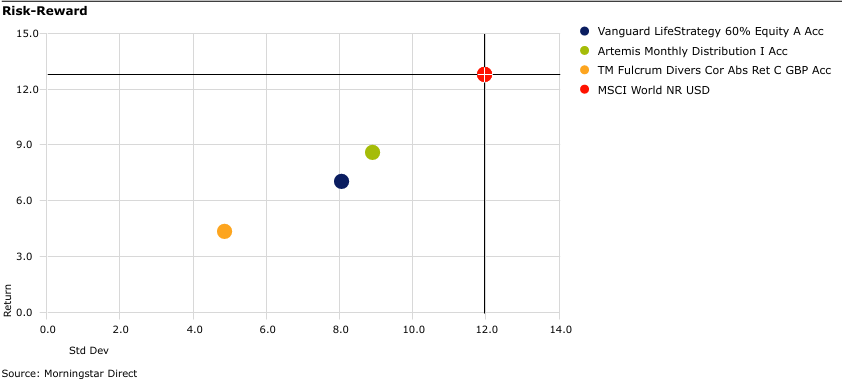
The risk–return chart below compares different strategies by showing how much return they have delivered over 10 years for the level of risk taken, measured by standard deviation. It helps investors see which options offer a better balance - for example, whether a multi-asset or absolute return strategy delivers similar returns with lower volatility than a pure equity index such as the MSCI World index.
Past performance is not a guide to future performance.
Over the period, the Vanguard and Artemis funds delivered lower returns than pure equities, but with a lower risk. The Fulcrum strategy generated even lower returns, but with significantly reduced volatility, which is consistent with its objective of delivering more stable outcomes across market conditions.
These articles are provided for information purposes only. Occasionally, an opinion about whether to buy or sell a specific investment may be provided by third parties. The content is not intended to be a personal recommendation to buy or sell any financial instrument or product, or to adopt any investment strategy as it is not provided based on an assessment of your investing knowledge and experience, your financial situation or your investment objectives. The value of your investments, and the income derived from them, may go down as well as up. You may not get back all the money that you invest. The investments referred to in this article may not be suitable for all investors, and if in doubt, an investor should seek advice from a qualified investment adviser.
Full performance can be found on the company or index summary page on the interactive investor website. Simply click on the company's or index name highlighted in the article.