China stock market outlook 2026: problems at home
Achieving political success overseas but with domestic issues to solve. Analyst Rodney Hobson discusses whether the world’s second-largest economy can keep growing over the next year.
31st December 2025 09:25
by Rodney Hobson from interactive investor
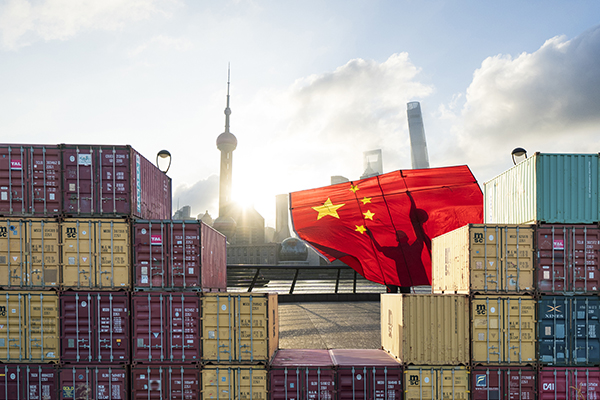
Credit: Yaorusheng via Getty Images.
Economic progress for China is not so much a long march as a series of great leaps forward. The first came more than 40 years ago under legendary leader Chairman Mao when he realised belatedly that the country had been left behind in the economic emergence of Asia. The latest leap is happening now and should not be underestimated. China is already the second-largest economy in the world, and it is perhaps the only country that can successfully stand up to US President Donald Trump.
- Our Services: SIPP Account | Stocks & Shares ISA | See all Investment Accounts
Already China has skillfully assumed leadership of the developing world, not only through its Belt and Road aid programme but also by playing off rivals Russia and India. While many Pacific Rim countries view China, and its leader Xi Jinping, with suspicion or even outright hostility, no one is keen to challenge its growing might.
The way that Xi has outmanoeuvred Russian President Vladimir Putin is instructive. He seemed to be positioning China, Russia and India as joint alternative leaders to the US. China was propping up Putin by buying Russian oil on the cheap. However, Putin needs China far more than Xi needs Russia, and there is little love lost between two nations that were willing to fall out and even go to war with each other even when they were both communist.
Now that it suits Xi to make his peace with Trump, China has reduced its purchases of Russian oil, thus undermining Putin just as he was returning to the world stage and leaving him further sucked into the prolonged war in Ukraine.
Already Russia’s influence over Central Asian republics that once formed part of the Soviet Union is waning, to China’s advantage. A Russia-led summit held at Astana, capital of Kazakhstan, was remarkable for the way that formerly subservient leaders showed open defiance towards Putin.
- Investment outlook: expert opinion, analysis and ideas
- Three high-risk areas return to form in 2025: will it last?
- Fund Spotlight: the racy trust riding the China wave
President Rahmon of Tajikistan demanded respect from Russia, saying that not enough attention was paid to the small republics. This may sound fairly mild, but for a leader of a country within Russia’s sphere of influence to speak out at all, especially in Putin’s presence, is unprecedented and the silence of the other three leaders, rather than leaping to Russia’s defence, spoke volumes.
While Russia has been distracted by the war in Ukraine, China is pushing to fill the vacuum in a region rich in uranium, copper and oil. China’s Belt and Road initiative has included upgrading the highway through the Pamir mountains, which will allow goods to be exported westwards.
China was quick to demonstrate that it is the dominant partner with Russia by buying Russian oil while prices were forced down by the boycott in the Western world, then suspending significant amounts of imports when President Trump stepped up sanctions on Russia to force Vladimir Putin to negotiate a peace deal in Ukraine.
Meanwhile, Xi has played Trump just as skillfully, standing up to his threats of sky-high tariffs and trade quotas. Xi knows that China has a stranglehold on the supply of the rare earth minerals that are essential to the production of modern technology, especially the rechargeable lithium batteries needed in the production of computers, vehicles and much more. This stranglehold is much greater than Opec has ever had over the supply of oil, the previous essential for all developed and developing nations.
- China’s flying: should you go all in or invest across emerging markets?
- Around the world in ETFs: tapping the Asian growth story
Under the deal struck between Xi and Trump, China has suspended the export restrictions on rare earths that it introduced in October. This is hardly an imposition on China, as it restores lucrative Chinese exports and, in any case, these restrictions can easily be re-introduced if Trump gets out of line. China is buying American soybeans again and has thrown in the genuine concession of policing shipments of chemicals used in the production of fentanyl, a recreational drug that Trump is particularly keen to stamp out.
Trump has had to suspend some of the tariffs he threatened to impose on Chinese goods and delay levies that he planned to impose on Chinese shipping. It is quite likely that they will never be mentioned again.
Arguably most importantly, Trump agreed to delay for a year expanding a blacklist blocking US companies from trading with foreign entities deemed to pose a threat to American national security. This is shorthand for Chinese companies trying to access advanced technology, and Xi has clearly won a major concession that could give China a way into security-sensitive areas.
The outcome has been to embolden Xi to step up his efforts to browbeat his nearest Asian neighbours, particularly Taiwan, which China has long claimed sovereignty over, but also Japan. China has launched a trade and cultural war against Japan, banning imports of Japanese seafood and disrupting performances in China by Japanese artistes, who have become increasingly popular in China.
- Five top share trades for 2026
- Sign up to our free newsletter for investment ideas, latest news and award-winning analysis
The bone of contention is new Japanese prime minister Sanae Takaichi, who wasted little time in declaring that if China invaded Taiwan, it would constitute an “existential threat” to Japan. The Japanese postwar constitution bans its troops from fighting overseas but they can fight alongside allies in collective defence where Japan’s survival is deemed to be threatened. Tensions are ramping up in East Asia.
Despite the antagonism in the Far East, China is making headway in South East Asia, thanks largely to its Belt and Road Initiative of funding infrastructure. Xi has quickly stepped into the gap created when Trump cut off funds to the US aid agency.
Xi’s potential problems at the moment are domestic rather than international. The meteoric economic growth earlier this century has been slowing for several years but is possibly falling slightly short of the target of 5% for 2025. Growth in GDP slowed from 5.2% in the second quarter to 4.8% in the third as the housing market crisis that began in 2021 continues to weigh on the economy.
Domestic demand generally is weak, with an oversupply of goods and services causing intense competition between businesses. This effect has been partly, but not entirely, ameliorated by increased exports as China has rerouted goods intended for the US into other markets. Economic growth may have slowed but it is still better than in other major economies.
Xi is pushing through a five-year plan for industrial growth in an attempt to raise incomes to those available in “medium-level developed economies”. He must do this with an ageing population and a shrinkage of the workforce, while maintaining the largest army in the world.
For the foreseeable future China is likely to cope well but foreign investors should beware. This is a tightly controlled economy where foreign interests are very much second to those of China, and Xi is quite prepared to ignore overseas governments, as he has demonstrated by gradually eroding the freedoms that Hong Kong once enjoyed.
UK investors will find that there are far safer overseas investments elsewhere in the world.
Rodney Hobson is a freelance contributor and not a direct employee of interactive investor.
These articles are provided for information purposes only. Occasionally, an opinion about whether to buy or sell a specific investment may be provided by third parties. The content is not intended to be a personal recommendation to buy or sell any financial instrument or product, or to adopt any investment strategy as it is not provided based on an assessment of your investing knowledge and experience, your financial situation or your investment objectives. The value of your investments, and the income derived from them, may go down as well as up. You may not get back all the money that you invest. The investments referred to in this article may not be suitable for all investors, and if in doubt, an investor should seek advice from a qualified investment adviser.
Full performance can be found on the company or index summary page on the interactive investor website. Simply click on the company's or index name highlighted in the article.