eyeQ: bond markets issue clear warning sign
Experts at eyeQ use AI and their own smart machine to analyse macro conditions and generate actionable trading signals. Here it has another look at falling bond yields.
17th February 2026 10:24
by Huw Roberts from eyeQ

“Our signals are crafted through macro-valuation, trend analysis, and meticulous back-testing. This combination ensures a comprehensive evaluation of an asset's value, market conditions, and historical performance.” eyeQ
- Discover: eyeQ analysis explained | eyeQ: our smart machine in action | Glossary
We wrote about the bond market only last week but need to revisit it again today because of recent price action in financial markets. The 10 February article focused on gilts as a way to measure political stress in the UK and fears around the longevity of the Keir Starmer government.
But, in recent weeks, global bond markets have arguably provided the most interesting price action.
First, we had Japan’s supermajority, which gives Sanae Takaichi freedom to aggressively pursue her chosen policy mix as prime minister. Many fear that will mean fiscal stimulus, which should mean more Japanese government bond (JGB) issuance and, hence, higher yields. Instead, 10-year JGB yields are around 20 basis points (bp) lower.
Then, in the US, we’ve had a run of stronger economic data which, even with last week’s benign CPI print, should mean lingering inflation concerns weigh against immediate rate cuts. On paper, it wouldn’t have been surprising if that forced US Treasury yields higher. Instead, they’ve fallen around 25bp so far in February.
There’s an old adage in markets that when something doesn’t sell-off on bad news, that’s an important tell. So, what’s happening?
The timing of this significant re-pricing in global government bonds coincided with the escalation of the artificial intelligence (AI) scare trade.
In equities, that means various sectors take it in turns to get de-rated on fears of AI disruption. But is the bond market sniffing a broader deflationary move? That AI could lead to job losses and disinflation across the whole economy?
On eyeQ, our model suggests 10-year US Treasury yields should be grinding higher, not falling. The sharp fall in yields has been accompanied by a big drop in eyeQ macro relevance. A score of just 25% means US Treasuries are not a macro trade right now.
eyeQ’s model for 10-year gilt yields looks the same - model value remains elevated, actual 10-year yields are falling, and low macro relevance.
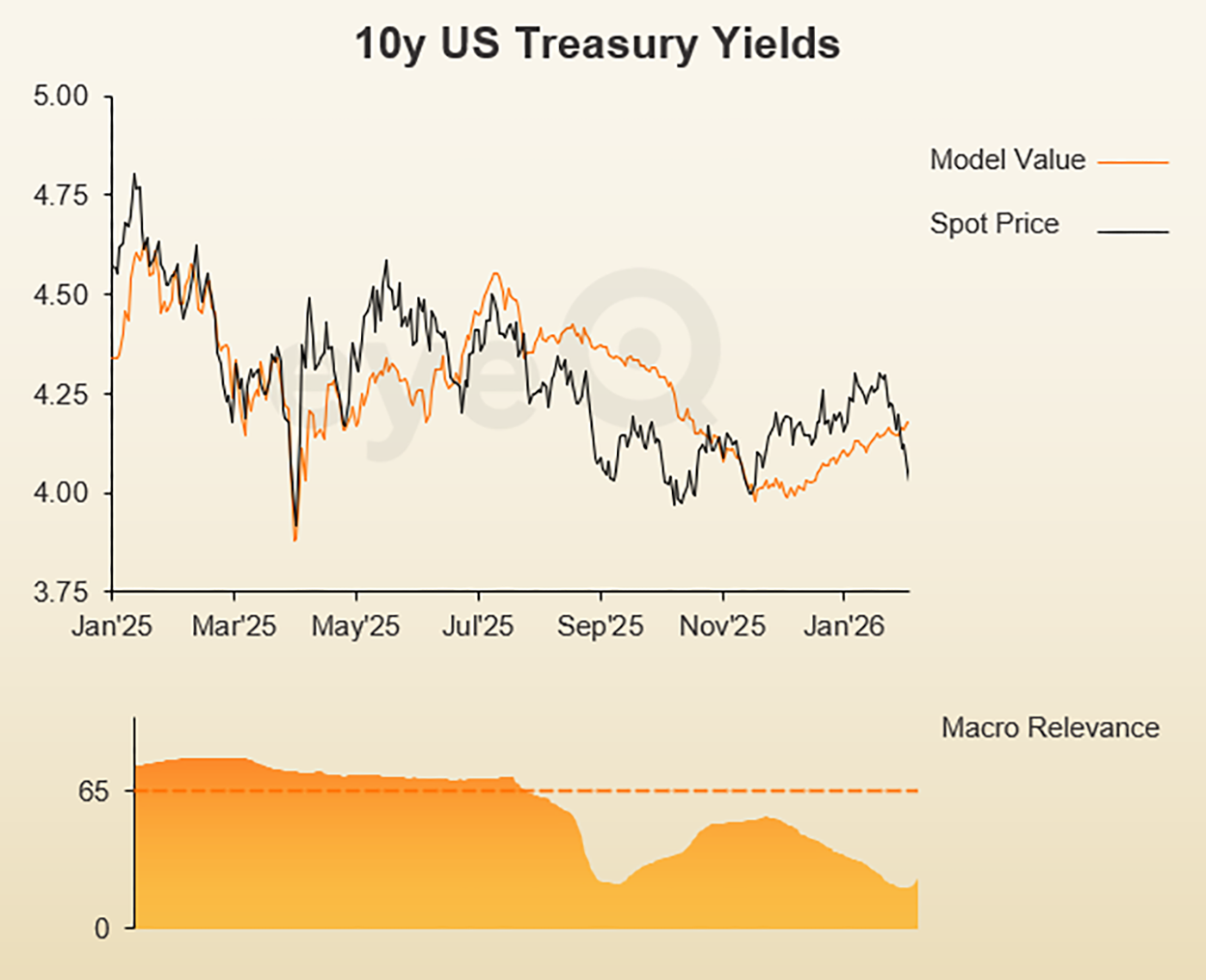
Source: eyeQ. Past performance is not a guide to future performance.
So, to try and summarise, the bond market seems to be sniffing out a hard landing for the economy, possible because of AI. But eyeQ’s model - which includes economic growth and inflation - isn’t capturing the same thing.
Low macro relevance normally means something else other than macro is driving price shifts - could it be that flows are back in the driving seat? With precious metals wobbling, are investors flocking back to government bonds as the best “safe haven” hedge during times of uncertainty? For a long time, bonds have been unloved and under-owned. A positional squeeze could have serious legs.
That could explain both the move in markets and our model’s low macro relevance scores. For now, no signal. But a clear warning sign. Equity investors need to be keeping a close eye on the bond market. If this fall in bond yields continues, that’s a clear message that risks of a growth scare are increasing.
Useful terminology:
Model value
Where our smart machine calculates that any stock market index, single stock or exchange-traded fund (ETF) should be priced (the fair value) given the overall macroeconomic environment.
Model (macro) relevance
How confident we are in the model value. The higher the number the better! Above 65% means the macro environment is critical, so any valuation signals carry strong weight. Below 65%, we deem that something other than macro is driving the price.
Fair Value Gap (FVG)
The difference between our model value (fair value) and where the price currently is. A positive Fair Value Gap means the security is above the model value, which we refer to as “rich”. A negative FVG means that it's cheap. The bigger the FVG, the bigger the dislocation and therefore a better entry level for trades.
Long Term model
This model looks at share prices over the last 12 months, captures the company’s relationship with growth, inflation, currency shifts, central bank policy etc and calculates our key results - model value, model relevance, Fair Value Gap.
These third-party research articles are provided by eyeQ (Quant Insight). interactive investor does not make any representation as to the completeness, accuracy or timeliness of the information provided, nor do we accept any liability for any losses, costs, liabilities or expenses that may arise directly or indirectly from your use of, or reliance on, the information (except where we have acted negligently, fraudulently or in wilful default in relation to the production or distribution of the information).
The value of your investments may go down as well as up. You may not get back all the money that you invest.
Equity research is provided for information purposes only. Neither eyeQ (Quant Insight) nor interactive investor have considered your personal circumstances, and the information provided should not be considered a personal recommendation. If you are in any doubt as to the action you should take, please consult an authorised financial adviser.
Disclosure
We use a combination of fundamental and technical analysis in forming our view as to the valuation and prospects of an investment. Where relevant we have set out those particular matters we think are important in the above article, but further detail can be found here.
Please note that our article on this investment should not be considered to be a regular publication.
Details of all recommendations issued by ii during the previous 12-month period can be found here.
ii adheres to a strict code of conduct. Contributors may hold shares or have other interests in companies included in these portfolios, which could create a conflict of interests. Contributors intending to write about any financial instruments in which they have an interest are required to disclose such interest to ii and in the article itself. ii will at all times consider whether such interest impairs the objectivity of the recommendation.
In addition, individuals involved in the production of investment articles are subject to a personal account dealing restriction, which prevents them from placing a transaction in the specified instrument(s) for a period before and for five working days after such publication. This is to avoid personal interests conflicting with the interests of the recipients of those investment articles.