ii view: big spending Tesla's tech rollouts require patience
A strong record of innovation and with Tesla still the vehicle responsible for Elon Musk’s ambitions away from space. Buy, sell, or hold?
23rd April 2026 11:38
by Keith Bowman from interactive investor
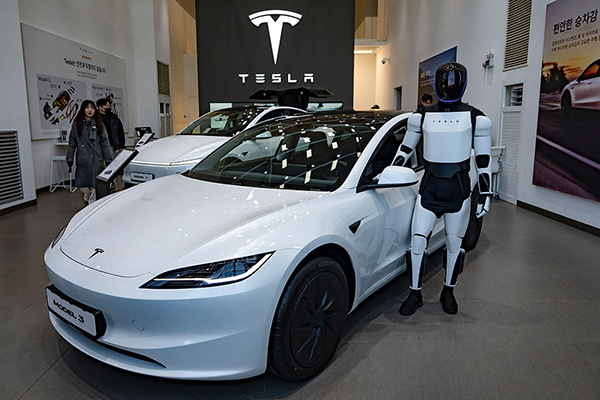
The Tesla Model 3 at a showroom in Seoul in January. Photo: Chris Jung/NurPhoto via Getty Images.
First-quarter results to 31 March
- Total revenue up 16% $22.4 billion
- Auto revenue up 16% to $16.2 billion
- Energy generation and storage revenue down 12% to $2.4 billion
- Services and other revenue up 42% to $3.7 billion
- Adjusted earnings up 52% to $0.41 per share
- Cash and investments held up 21% to $44.7 billion
ii round-up:
Tesla Inc (NASDAQ:TSLA) raised expected annual capital expenditure by $5 billion to $25 billion as the Elon Musk run company looks to increase investment in AI-aided self-driving vehicles and the rollout of its Robotaxi.
First-quarter revenues up 16% to $22.4 billion and relief about US tariffs helped drive a 52% increase in adjusted earnings to $0.41 per share. Wall Street had forecast earnings of $0.37 per share.
Shares in the Nasdaq 100 company fell 1% in post US trading having come into these latest results down 14% so far in 2026, making it the worst performer of the so-called Magnificent Seven companies year-to-date. The Nasdaq 100 is up 7% in 2026 with a rise of 11% for Amazon.com Inc (NASDAQ:AMZN) leaving it as the best performer of the Mag 7 companies.
As well as electric vehicles (EVs), Tesla products and interests include self-driving software, the rollout of robotaxis, solar panels and energy storage systems, as well as humanoid, or Optimus robots.
EV deliveries of 358,023 during the quarter, the nearest number Tesla gives to sales, fell from 418,227 in the prior fourth quarter. Deliveries fell to 1,636,129 in 2025 from 1,789,226 the previous year.
Despite a 12% retreat in solar panels and energy storage related revenues during the quarter, full year deployments of 46.7 Gigawatt-hours (GWh) was up from 31.4 GWh in 2024.
Recent autonomous vehicle developments included government approval for supervised autonomous vehicles in the Netherlands and the launch unsupervised robotaxis in Dallas and Houston.
Preparations for Tesla’s first large-scale Optimus factory are due to begin shortly. A first-generation line, designed to produce one million robots a year will replace its current Model S and Model X lines at the group’s US Fremont factory.
Tesla’s cash and investments held rose by a fifth from a year ago to $44.7 billion. A second-quarter trading update is likely to be announced early July.
ii view:
Founded in 2003 by Martin Eberhard and Marc Tarpenning, Tesla today competes against automotive giants including Ford Motor Co (NYSE:F) and Volkswagen AG (XETRA:VOW). Geographically, the US dominated in 2025 with 50% of all revenues, followed by China at 22% and other markets, including the UK, the balance of 28%.
For investors, Tesla must begin to generate returns on expected annual capital expenditure of $25 billion via products including robotaxis and robots. Rivals like China’s BYD are now actively pushing their own competitively priced EV’s, with BYD sales in 2025 of 2.26 million outpacing Tesla. Competition in the autonomous vehicles sector from Google owner Alphabet Inc Class A (NASDAQ:GOOGL) Waymo business is not the be forgotten, while a forecast price-to-net asset value (NAV) of around 18 times compares to estimates for automotive rivals at under two times, suggesting the shares are not obviously cheap.
On the upside, Elon Musk continues to describe Tesla as a technology company, with developments of self-driving AI-fuelled software, a robotaxi, and humanoid robots all potentially generating significant profits in future. Concerns for global climate change have not gone away, with soaring energy prices following the war in the Middle East potentially underlining the cost benefits of driving EVs. A spread of factories across geographies and innovation in manufacturing techniques are aimed at reducing costs, while revenues away from selling cars of 27% in this latest quarter is up from 14% in early 2023.
For now, falling sales last year at the group’s core automotive product and increased investment in prospects like robotaxis offer caution. But while Tesla continues to divide opinion among investors, growing revenues among other businesses as well as rollout of products like the Optimus robot are likely to keep the company in the spotlight.
Positives:
- Climate change concerns persist
- Expanding network of superfast charging stations
Negatives:
- Rising competition from other manufacturers
- Potential regulatory hurdles for self-driving vehicles
The average rating of stock market analysts:
Strong hold
These articles are provided for information purposes only. Occasionally, an opinion about whether to buy or sell a specific investment may be provided by third parties. The content is not intended to be a personal recommendation to buy or sell any financial instrument or product, or to adopt any investment strategy as it is not provided based on an assessment of your investing knowledge and experience, your financial situation or your investment objectives. The value of your investments, and the income derived from them, may go down as well as up. You may not get back all the money that you invest. The investments referred to in this article may not be suitable for all investors, and if in doubt, an investor should seek advice from a qualified investment adviser.
Full performance can be found on the company or index summary page on the interactive investor website. Simply click on the company's or index name highlighted in the article.