Interest rates cut to 3.75%: the impact on your portfolio
Craig Rickman looks ahead to 2026 and explores how the interest rate-cutting cycle may inform your investment and retirement choices.
18th December 2025 13:51
by Craig Rickman from interactive investor
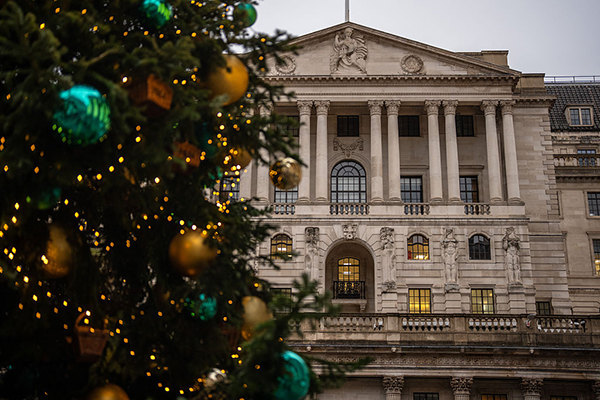
The Bank of England on December 18, 2025. Photo: Carl Court/Getty Images.
Recent economic data appeared to make the Bank of England’s final interest rate decision of 2026 all but a formality. The combination of inflation cooling to 3.2% in November, unemployment rising to 5.1% in the three months to October (a five-year high), and UK Gross Domestic Product (GDP) dropping by 0.1% in both September and October strengthened the case for looser fiscal policy.
- Invest with ii: SIPP Account | Stocks & Shares ISA | See all Investment Accounts
But like many of the other rate decisions this year, it was a tight call. The Bank’s Monetary Policy Committee (MPC) at noon today revealed that it had voted by a slim majority of 5 to 4 to cut the Bank Rate 0.25 percentage points to 3.75%, its lowest level in almost three years.
This will bring some festive cheers for borrowers and business, as lower interest rates should reduce the cost of loans, including mortgages, offering protection against inflation, which despite easing remains above than the Bank’s 2% target. The MPC has cut rates six times since August 2024, falling 1.50 percentage points in the process, and further reductions could arrive next year although at a slower pace.
Whenever interest rates change, the future trajectory of your portfolio could be impacted in some shape or form. Let’s run through the inflation expectations for next year, examine which areas of the investing landscape benefit from lower rates and flag two key tasks to investors in response to today’s news.
What can we expect from inflation and interest rates next year?
It seems the current interest rate-cutting cycle isn’t over but might not be far away.
Alpesh Paleja, deputy economist at CBI, said: “If inflation continues to fall in line with the Bank’s forecasts, we expect one further cut early next year, taking rates to a terminal level of 3.5%. But given the level of disagreement around the table, it wouldn’t take much for that final move to be pushed further into 2026.”
A dominant factor in the speed of future rate cuts is inflation. In short, if price rises continue to cool, the odds of rate reductions will increase.
According to the National Institute of Economic and Social Research (NIESR), November’s sharper than expected fall has lowered the expected path of inflation. It suggests that while price rises are expected to remain slightly above 3% until April 2026, the possibility of falling below 3% is increased.
“A large drop in April 2026 - when the sharp rise in April 2025 drops out - should push inflation down to around 2% in the medium scenario, and well below 3% even in the high scenario. Inflation would then likely remain close to 2% in the medium scenario and below 3% in the high scenario for the rest of the year.
“Possible upward pressures include indirect tax increases in the Budget or energy price rises, but these are unlikely to be as significant as those seen in April 2025,” NIESR said, adding that persistently high wages and services inflation may slow the fall.
Which investment sectors and assets are benefiting from falling interest rates?
UK funds that focus on value shares or dividend-paying companies have emerged as the winners so far from declines in UK interest rates.
While rates have been falling, the expectation that the UK base rate will not be returning to the days of ultra-cheap borrowing, means that it’s still a favourable backdrop for both those styles of investing.
Value fund managers seek out companies that appear to be trading at prices lower than their true value, including how much money they make and how much excess cash is generated.
- The great investment strategies: value investing
- Ian Cowie: my investment trust winners and losers in 2025
Dividend strategies have performed well since the rate-cutting cycle kicked off due to the switch in market direction to companies making profits today, rather than those promising growth.
The question going forward is whether today’s reduction, and indeed potential future ones, will provide a much-needed boost to two areas that have been harmed by higher interest rates: UK smaller companies and renewable energy infrastructure.
Outside equities, lower interest rates make bonds more attractive. As Madhushree Agarwal, portfolio manager on the multi-manager team at Nedgroup Investments, noted in a recent feature in which multi-asset investors named the bond funds they are favouring this is “primarily due to the inverse relationship between bond prices and yields - as yields fall, bond prices rise, creating the potential for capital gains in addition to income”.
Bonds, which are defensive investments that complement exposure to equities, act as ballast in portfolios, with the income on offer a key attraction. Bond yields are at appealing levels relative to the past 15 years, which points to potentially healthy total return in the coming years.
Two key steps for investors as rates fall
- Review your cash holdings
When interest rates come down, the returns on your cash savings typically follow suit. The good news is the top savings rates are in pretty good shape right now, offering around 4.5% a year, higher than the rate of inflation.
If you’re looking for defensive assets within your portfolio, either as a temporary home or to provide some short-term stability, it’s important to secure the best rates possible to lessen performance drag. Things such as money market funds aim to deliver a cash-like return, with the level of income generated linked to the UK Base Rate, and present a better chance of keeping pace with inflation.
However, while there will be a short-term lag, today’s interest rate cut will make money market funds less attractive, with yields likely to fall towards 3.75%. This is still an inflation-beating return, but with higher yields available in other parts of the bond market, investors may be incentivised to take on a bit more risk and look elsewhere.
- Bond Boss: are money market funds still a good deal?
- Sign up to our free newsletter for investment ideas, latest news and award-winning analysis
When it comes to your longer-term goals, history tells us that the stock market should be a better horse to back, provided you have five years or more on your side and can ride out the potential volatility.
- Revisit your options and strategy if retirement is approaching
With fears that an artificial intelligence (AI) bubble could cause markets to careen downwards, many investors may be tempted to adopt a more cautious stance within their portfolios. Aside from accurately predicting the future path of markets, which obviously isn’t feasible, whether taking volatility off the table next year is a sensible move depends on a few factors. Chief among them is your investment time frame for the money in question.
If you aim to retire next year, now is a good time to review your retirement plans, especially if you plan to secure a guaranteed, lifelong income through an annuity with a portion of your savings. Falling interest rates, if this translates to lower 15-year gilt yields, could see annuity rates drop from their current highs, although they should remain far more attractive than in previous years.
Although you might be tempted to lock in the current high rates, you should always think carefully before committing to a guaranteed income. That’s because with a lifetime annuity the terms you choose from the outset are fixed for life – the decision is irreversible – so make sure you weigh up your options, select the most appropriate features for your personal circumstances and retirement goals and shop around for the best deal.
Those eyeing up an annuity may also need to consider how their portfolio is positioned. If you’re heavily weighted to equities, a sharp market slump could reduce the pot available to secure a guaranteed income, meaning you may have to choose between retiring with less than expected, continuing to work or temporarily taking a flexible income. Switching to more cautious assets as retirement approaches may limit the potential upswing but can shield your savings from market turbulence.
- The first five years of retirement: are you prepared?
- Is 4.7% the new magic number for sustainable pension withdrawals?
If you plan to keep your money invested in retirement and plump for income drawdown, the need to reduce investment risk is less pressing, but doesn’t disappear entirely. The early years of managing a retirement pot are arguably the most important as selling shares to generate income in poorly performing markets can harm how long your money lasts.
To guard against this risk, which is known as sequencing of returns, maintain a defensive buffer in cash or cash-like assets as it can enable you to temporarily pause encashing shares, helping your portfolio to recover more quickly once markets rebound.
These articles are provided for information purposes only. Occasionally, an opinion about whether to buy or sell a specific investment may be provided by third parties. The content is not intended to be a personal recommendation to buy or sell any financial instrument or product, or to adopt any investment strategy as it is not provided based on an assessment of your investing knowledge and experience, your financial situation or your investment objectives. The value of your investments, and the income derived from them, may go down as well as up. You may not get back all the money that you invest. The investments referred to in this article may not be suitable for all investors, and if in doubt, an investor should seek advice from a qualified investment adviser.
Full performance can be found on the company or index summary page on the interactive investor website. Simply click on the company's or index name highlighted in the article.