A big bet that WH Smith will double in value
After a long period of underperformance, the retail chain has brought in a highly incentivised new leader charged with turning the business around. City writer Graeme Evans reports.
7th April 2026 13:43
by Graeme Evans from interactive investor
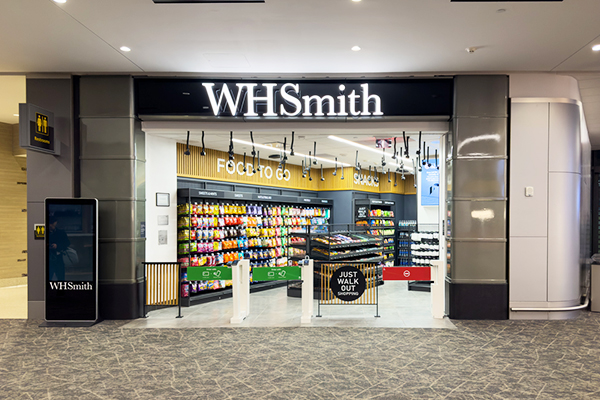
Entrance to WH Smith at LaGuardia airport, New York. Credit: Khosrork.
A mission to double the value of WH Smith (LSE:SMWH) within the next five years is under way after highly regarded boss Leo Quinn today launched his latest turnaround challenge.
An incentive structure means Quinn, who overhauled Balfour Beatty during a decade at the infrastructure group, stands to generate a total of £24.5 million should he succeed in getting WH Smith shares back to 1,300p.
- Invest with ii: Open an ISA | ISA Investment Ideas | Transfer a Stocks & Shares ISA
Quinn’s first day in the job saw shares open at 591p, which compares with 699p after his surprise appointment as executive chair was announced in January. The stock had been as low as 537p last month amid fears that the company’s extensive global airport estate faces a prolonged period of reduced passenger demand.
The Middle East events have added to the retailer’s challenges, after last August’s disclosure of a £30 million profit overstatement in North America caused shares to slide from 1,100p.
The issues relating to the accelerated recognition of supplier income were later blamed on the division’s target-driven performance culture and decentralised structure.
Bank of America regards Quinn’s arrival as a key catalyst in the retailer’s self-help turnaround story, having recently highlighted an upside of 38% on mid-March’s share price to 758p.
The bank expects that Quinn’s focus will be on North America as its own estimate suggests that the £700 million invested there since 2019 has generated a cash-on-cash return below 1%. Acquisitions have included InMotion in 2019 and Marshalls for £316 million in 2020.
BofA said: “We believe our measure of ROCE (return on capital employed) demonstrates how poorly the acquisitions have performed and add weight to the likely need for more dramatic restructuring.”
- Insider: heavy buying of FTSE 100 stock at nine-year low
- Five AIM growth shares for your ISA in 2026
- FTSE 100: big winners and losers in worst month since Covid
While attention has been focused on the problems in North America, the City’s expectations for UK profits have drifted lower by 10% compared with 12 months ago.
The UK estate last year generated revenues of £834 million from a portfolio of 593 stores across airports, railways stations, motorway service areas and hospitals.
This compares with £413 million from 362 North American outlets and £306 million from 325 stores in a further 29 countries worldwide.
The downturn in UK expectations follows a period of intensive development activity, which has led to temporary store closures at Heathrow airport. However, BofA believes the current consensus fails to capture the payback and uplift from the 2027 financial year onwards.
WH Smith recently disclosed that UK sales rose 2% on a like-for-like basis in the six months to 28 February, with a 2% decline at its rail stores blamed on the backdrop of continuing consumer headwinds.
Last month’s trading update and Middle East uncertainty prompted City bank Berenberg to trim its growth estimates for the UK division, as well as its price target from 657p to 634p.
Peel Hunt, which has a price target of 800p, added: “It is a decent update in isolation, but the Middle East situation and its potential impact on global travel cannot be ignored.
“We continue to believe that there is strong fundamental value here, but geopolitics may win the share price argument for the time being.”
WH Smith’s market capitalisation peaked at £3 billion when shares were 2,600p just before the pandemic.
The incentive structure put in place at Quinn’s appointment targets the creation of additional shareholder value of £800 million compared to the share price on 16 January.
His £12.25 million of options will vest subject to an annual performance test measured over a turnaround period of up to five years. The first test commences on or around November 2027.
If the share price increases to 1,300p, then full vesting would deliver an equivalent value of £24.5 million. Quinn, who receives a base salary of £360,000, also bought £2 million of shares out of his own funds when his appointment was announced.
- Shares for the future: a FTSE 100 firm whose qualities will prevail
- Sign up to our free newsletter for investment ideas, latest news and award-winning analysis
- eyeQ: Intertek, Shell, Merck, Standard Chartered
The arrangements were approved at a special meeting of WH Smith shareholders last month, when more than a fifth of votes were cast against the resolution relating to the grant of one-off share options.
Quinn has over 20 years’ experience as a CEO of UK publicly quoted companies, most recently at Balfour Beatty.
He joined the infrastructure group shortly before KPMG completed a review of the group that covered an assessment of its contract accounting and poor operational performance. From this stemmed a focus on cost reduction and improved cash generation.
Bank of America said in last month’s note: “Given WH Smith’s US challenges and weak cash flow, we see the starting points as potentially similar.”
It added that during Quinn’s tenure there was an 19% uplift in revenues between 2014 and 2024.
More critically, an improvement of 320 basis points (bps) in operating profit margin and 710 bps in operating cash-flow margin drove a near 80% uplift in cash returns to shareholders.
These articles are provided for information purposes only. Occasionally, an opinion about whether to buy or sell a specific investment may be provided by third parties. The content is not intended to be a personal recommendation to buy or sell any financial instrument or product, or to adopt any investment strategy as it is not provided based on an assessment of your investing knowledge and experience, your financial situation or your investment objectives. The value of your investments, and the income derived from them, may go down as well as up. You may not get back all the money that you invest. The investments referred to in this article may not be suitable for all investors, and if in doubt, an investor should seek advice from a qualified investment adviser.
Full performance can be found on the company or index summary page on the interactive investor website. Simply click on the company's or index name highlighted in the article.