India stock market outlook 2026: a worthwhile consideration
There have been many positive changes under prime minister Narendra Modi, but much still needs to be done. Analyst Rodney Hobson studies the odds of it happening over the next year.
29th December 2025 08:37
by Rodney Hobson from interactive investor
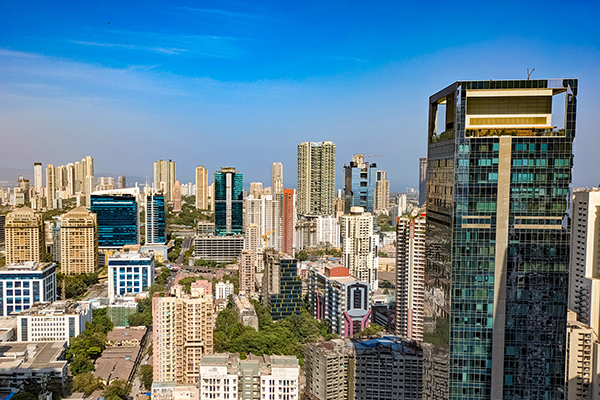
A view of downtown Mumbai. Credit: Deven Dadbhawala via Getty Images.
A place at the world’s top table awaits India. The trouble is that it always looks to be next year when it happens, never this year. It is not quite a case of jam tomorrow because India has come such a long way already, but the confiture could and should be dolloped out a little more generously.
- Learn with ii: How to Buy Shares| Top UK Shares | Cashback Offers
India has vied with China as the sleeping giant that has woken up belatedly, but of these two most populated countries it is India that has been caught napping. Its population may have overtaken that of China, the former now at around 1.4 billion and the latter 1.3 billion with the gap widening, but for now Chinese leader Xi Jinping has better cards to play than Indian prime minister Narendra Modi. India does not have anything that developed nations desperately need except a growing workforce that constitutes nearly 60% of the population.
While Xi leads a unified albeit dictatorial government that simply renews itself, Modi must face an electorate that could just as easily take away the considerable power it has given him and his Bharatiya Janata Party since 2014. After all, Congress, which ruled for decades after independence in 1947, once seemed unassailable. Now it is reduced to a shadow of its former self.
Modi has made changes since he assumed power more than a decade ago. His policy of unabashed promotion of Hindus has further marginalised Muslims in a country where they were already an underprivileged minority, but the policy has secured his power base. His resulting control of parliament has brought a considerable degree of stability to a once-fragile nation that he has built up to be the fourth or fifth-largest economy in the world. Alas, the continuing rise in population means that GDP per capita is still way down the rankings.
- Fund Battle: are there alternatives to Jupiter India?
- Two UK funds I’d own in 2026
- Five macro themes tipped to shape markets in 2026
However, there is much to admire in the Indian economy, which comprises a mixture of widespread public ownership, especially on the railways, and private enterprise that includes international companies. Modi has helped India move away from protectionism and strict economic regulation into a more liberal economy, building on a move that began in the 1990s. Modi has even encouraged some public/private projects, notably in the road system.
The consumer society has taken root under Modi, with nearly 70% of GDP now arising from domestic consumption, helped by a surge in the number of Indian billionaires but also by a rise in incomes for the least well off. He has also overseen an increase in India’s trade, both in imports and exports. Leading industries include space and satellites, computer technology, generic pharmaceuticals and shipping. Modi now needs to find a way to step up productivity from that of an emerging country to that of an advanced nation.
- Around the world in ETFs: single-country funds to add spice
- Biggest fund winners and losers of 2025
- Sign up to our free newsletter for share, fund and trust ideas, and the latest news and analysis
The more liberal approach combined with a stable economy has attracted increasing amounts of investment from overseas from a wide range of countries, particularly into banking, finance, insurance and research and development.
Manufacturing is also moving up the gears, although not without a cost. Like so many countries that have gone through industrialisation in the past, most recently near-neighbour China, the appetite for coal to produce electricity has led to dreadful smogs lasting days on end, leaving residents of major cities, particularly the capital New Delhi, unable to see more than a few yards in front of them. The situation is particularly acute in winter, and fumes from traffic add to the problem. Balancing economic growth and individual health is a tough calculation.
The scope for further economic success, whatever the costs, makes India a worthwhile consideration for any investor interested in overseas stock markets, and it carries less risk than most, with great possibilities on the upside. This is one foreign market where a combination of investment trusts and personal selections could literally pay dividends.
Rodney Hobson is a freelance contributor and not a direct employee of interactive investor.
These articles are provided for information purposes only. Occasionally, an opinion about whether to buy or sell a specific investment may be provided by third parties. The content is not intended to be a personal recommendation to buy or sell any financial instrument or product, or to adopt any investment strategy as it is not provided based on an assessment of your investing knowledge and experience, your financial situation or your investment objectives. The value of your investments, and the income derived from them, may go down as well as up. You may not get back all the money that you invest. The investments referred to in this article may not be suitable for all investors, and if in doubt, an investor should seek advice from a qualified investment adviser.
Full performance can be found on the company or index summary page on the interactive investor website. Simply click on the company's or index name highlighted in the article.