Stockwatch: should you jump on the rebound in this UK share?
Analyst Edmond Jackson examines a company where you must judge what matters most: an apparently capable CEO or possibly dark clouds on the horizon.
27th November 2026 10:52
by Edmond Jackson from interactive investor

Last month, I wondered whether a rally among UK retail shares might be approaching an inflection point given the challenge to exact further margin gains if revenues stall when you adjust for rising inflation.
Diesel, widely significant for transport prices, had hit record highs, and last Wednesday came news of a 26% rise in the average domestic energy bill from January. With gas supply apparently unlikely to improve for two to three years, can consumer spending defy this latest challenge?
- Invest with ii: SIPP Account | Stocks & Shares ISA | See all Investment Accounts
Two mid-caps declaring interims this week certainly did, as if begging the question: can capable management simply navigate through? Halfords Group (LSE:HFD) declared strong progress across all key financial metrics, at least to 2 October, with like-for-like revenue up 7%, underlying earnings per share (EPS) by 62%, and the dividend up 17%, said to be reflecting effective delivery of strategic proprieties, plus favourable weather.
Moreover and despite October/November returning to more typical rates of sales growth, guidance for the end of March 2027 year is raised to the upper end of estimates. The shares closed up 16% at 282p versus my tempering stance to “hold” at 256p, and I continue to feel more cautious than the market.
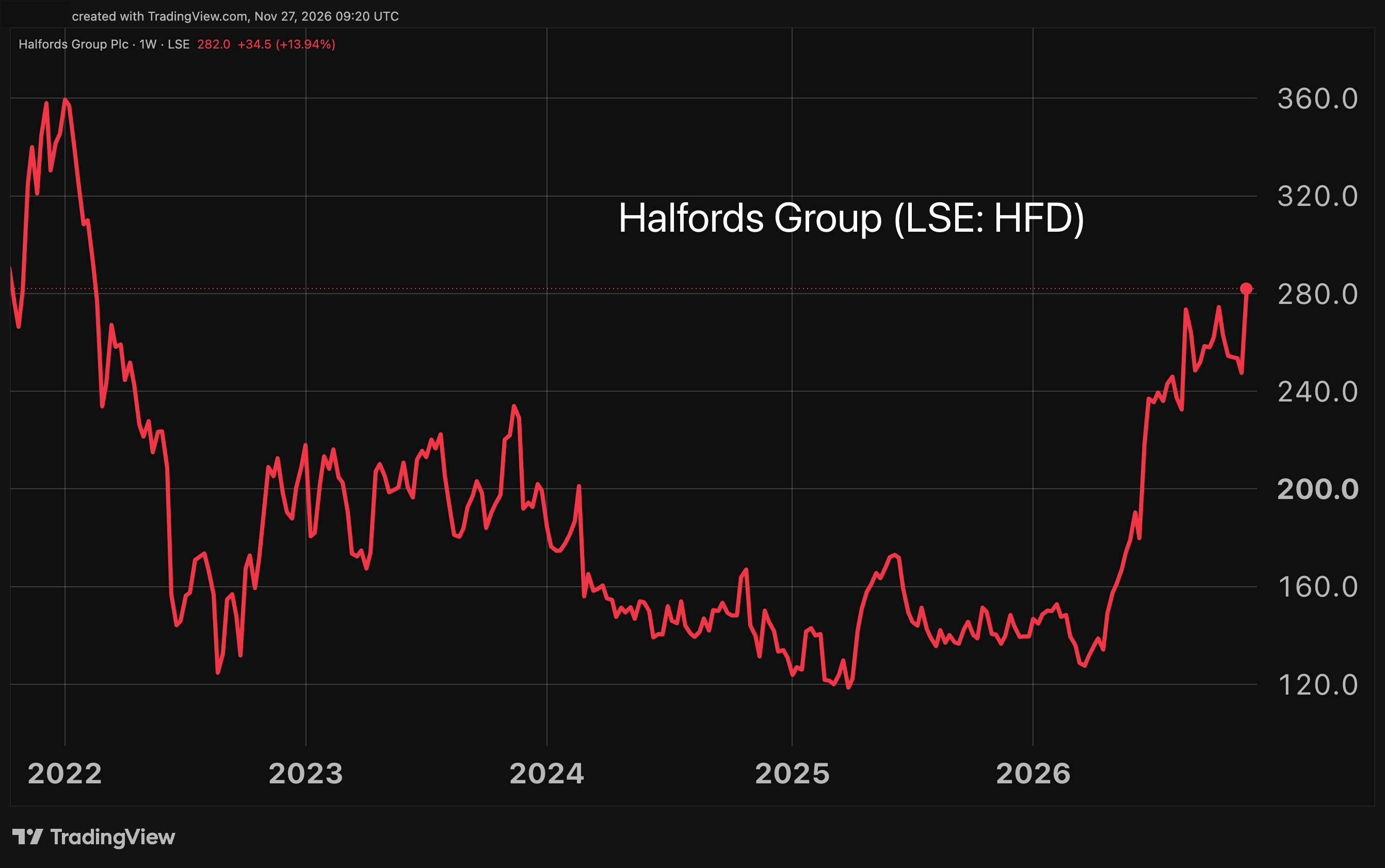
Source: TradingView. Past performance is not a guide to future performance.
Pets at Home is benefiting from a new CEO, and cats
It was a similar story from Pets at Home Group (LSE:PETS), where new CEO James Bailey arrived only last March after three profit warnings in two years. This compares with a new CEO at Halfords from April 2025.
Bailey left Waitrose at the end of September 2025 having served as managing director for more than five years. The supermarket is the financial engine for John Lewis Partnership. For example, in the year to January 2026, there was a 7% rise in sales with adjusted operating profit up 13% to £256 million.
Given weak prelims to 26 March – albeit the new boss proclaiming “material progress stabilising the retail business” – Pets’ shares did not begin to rise until mid-June from a seven-year low of 177p, possibly assisted by a £50 million buyback programme. The rally has been sharp, like various other UK retailers:
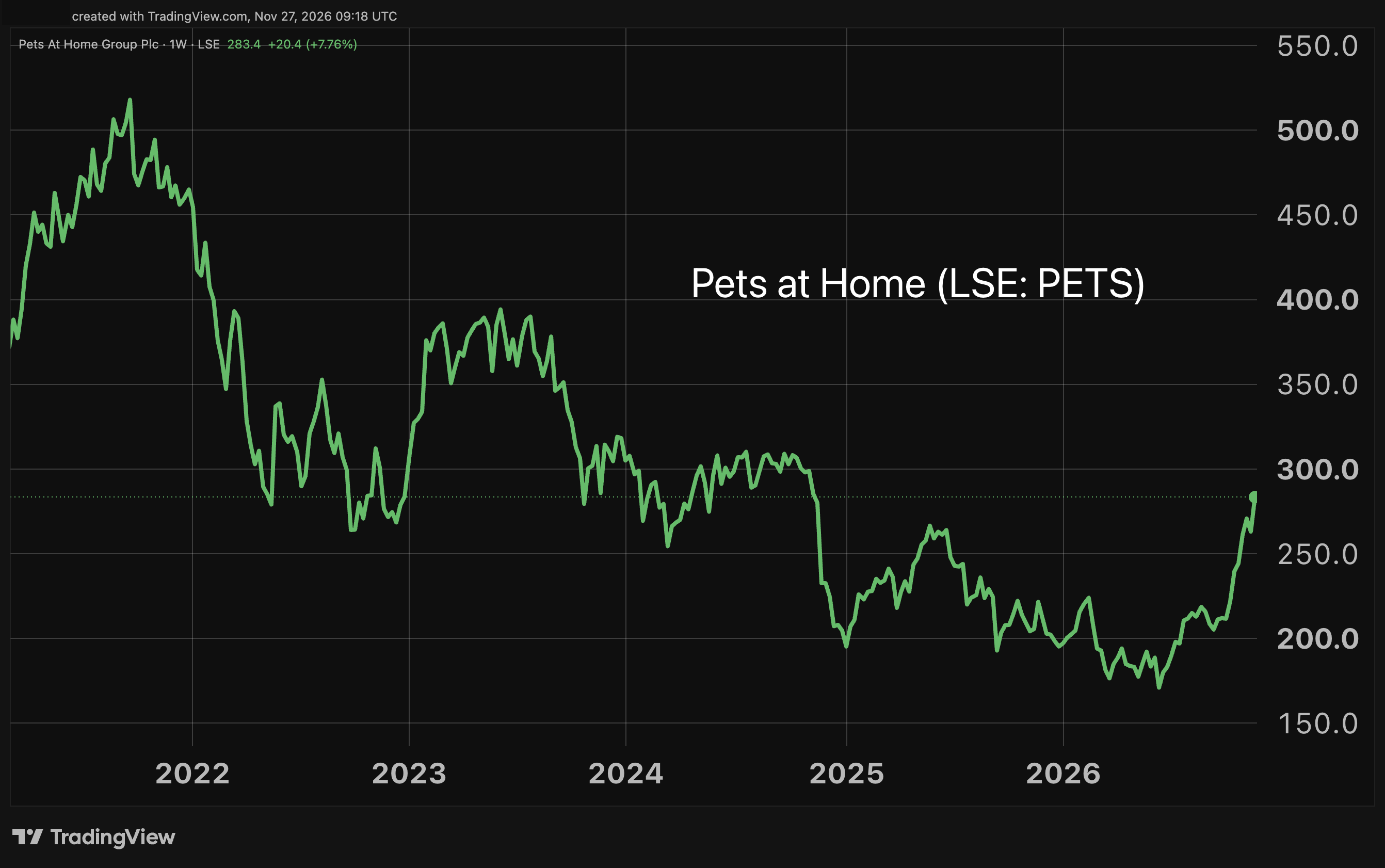
Source: TradingView. Past performance is not a guide to future performance.
The group essentially has two legs: just over half of revenue deriving from retail, where Pets’ enjoys a 25% market share, albeit over 90% of operating profit coming from veterinary care. An end of July first-quarter update cited retail revenue up 4.9% to £399 million helped by category resets. For example, dog and cat food/treats alongside a comprehensive effort to refresh the store estate, improve product availability, and in-store order collection. The vets’ side rose just 1.9% to £644 million.
I have been cautious about high vets’ costs leading to hikes in insurance premiums in terms of whether the public can keep taking on pets. A Competition and Markets Authority (CMA) investigation exonerated Pets’ partnering approach with vets, but overall inflation in pet care makes it hard to square with a “cost-of-living crisis”. Ownership experienced a boost during Covid and, maybe, after six years dogs and cats are at some kind of high in terms of treatment demand, but what thereafter?
Anyway, for now, cat ownership is soaring, said to be due to new renters’ rights from last May enabling tenants to request a pet and it being harder for landlords to refuse. The number of UK cats is up from 10.2 million in 2025 to 11.7 million. Bailey also cites younger people being higher spending and preferring cats, with Pets being attuned to this trend and reallocating shop-floor space towards cat products.
- Festive payday: BP, Shell and HSBC promise dividend windfall
- The hidden traps in consolidating pensions, ISAs and GIAs
An overall turnaround was flagged by the 2020-appointed chair buying £49,500 worth of shares at 199.7p on 30 September after another non-executive director, who joined in mid-2023, bought £5,000 worth at 197.6p on 20 July.
What can now look like a bullish pattern of events is affirmed by the shares rising 11% to 286p after Wednesday’s interim results guided full-year underlying pre-tax profit at the top end of a £90-101 million range.
Consensus has recently been £73.7 million net profit and EPS of 16.7p, with a 13% rise pencilled in for the end of March 2028. If the newish CEO can sustain initiatives’ momentum, then possibly an implied 16 months’ forward price/earnings (PE) of 15x will reduce, also as committed pet owners prove to be sticky revenues.
The shares seem to be in a delicate area where you are required to judge what matters most: an apparently capable CEO or possibly dark clouds on the consumer horizon. It applies a lot more widely than at Halfords and Pets at Home.
Pets at Home Group - financial summary
Year-end 31 Mar
| 2015 | 2016 | 2017 | 2018 | 2019 | 2020 | 2021 | 2022 | 2023 | 2024 | 2025 | 2026 | |
| Revenue (£ million) | 729 | 793 | 834 | 899 | 961 | 1,059 | 1,143 | 1,318 | 1,404 | 1,477 | 1,482 | 1,470 |
| Operating margin (%) | 13.3 | 12.2 | 12 | 9.3 | 5.5 | 9.8 | 10.9 | 12.4 | 9.7 | 8.1 | 9.2 | 7.0 |
| Operating profit (£m) | 96.8 | 97.1 | 99.9 | 83.9 | 53.1 | 104 | 125 | 163 | 137 | 119 | 136 | 103 |
| Net profit (£m) | 72.2 | 72.8 | 75.4 | 62.8 | 30.5 | 67.4 | 90.4 | 125 | 101 | 79.2 | 88.2 | 62.5 |
| Reported EPS (p) | 14.4 | 14.5 | 15.0 | 12.5 | 6.0 | 13.2 | 17.7 | 24.5 | 20.2 | 16.4 | 18.8 | 13.6 |
| Normalised EPS (p) | 13.5 | 15.4 | 15.1 | 13.5 | 14.0 | 14.7 | 11.6 | 20.9 | 23.1 | 21.9 | 21.9 | 16.6 |
| Operating cashflow/share (p) | 18.3 | 22.1 | 22.0 | 21.4 | 21.4 | 42.2 | 38.1 | 48.9 | 50.4 | 43.5 | 46.5 | 41.6 |
| Capital expenditure/share (p) | 6.1 | 7.3 | 8.1 | 8.3 | 7.4 | 7.8 | 6.9 | 11.0 | 15.6 | 10.0 | 10.5 | 9.3 |
| Free cashflow/share (p) | 12.2 | 14.8 | 13.9 | 13.1 | 14.0 | 34.5 | 31.2 | 37.9 | 34.8 | 33.5 | 36.0 | 32.3 |
| Dividend/share (p) | 5.4 | 7.5 | 7.5 | 7.5 | 7.5 | 7.5 | 8.0 | 11.8 | 12.8 | 12.8 | 13.0 | 7.4 |
| Earnings cover (x) | 2.7 | 1.9 | 2.0 | 1.7 | 0.8 | 1.8 | 2.2 | 2.1 | 1.6 | 1.3 | 1.5 | 1.8 |
| Return on capital (%) | 9.4 | 8.9 | 8.8 | 7.3 | 4.7 | 7.0 | 8.8 | 11.2 | 9.2 | 8.9 | 10.4 | 7.8 |
| Cash (£m) | 133 | 40.0 | 56.3 | 59.8 | 60.5 | 79.1 | 101 | 166 | 178 | 57.1 | 39.8 | 39.6 |
| Net debt (£m) | 188 | 161 | 155 | 138 | 119 | 548 | 407 | 314 | 364 | 369 | 340 | 357 |
| Net asset value (£m) | 797 | 844 | 883 | 906 | 903 | 931 | 977 | 1,050 | 1,025 | 989 | 993 | 973 |
| Net asset value/share (p) | 159 | 169 | 177 | 181 | 181 | 186 | 195 | 210 | 212 | 211 | 216 | 217 |
Source: historic company REFS and company accounts.
Some matters of balance sheet concern
This has been another factor stalling my rushing to upgrade Pets’ this year. For example, and referencing the latest 8 October balance sheet, the ratio of current assets to current liabilities is an unsatisfactory 0.63 due to £309.1 million trade payables versus £101.1 million trade receivables.
While plenty of businesses can and do sustain this kind of disparity, it means profit effectively benefits from delayed payment. The key is what rate of change, as expressed by trade payables as a percentage of turnover where Pets’ has gone from 37.2% to 38.2% in 12 months; not much but it may have marginally aided profit.
- The two UK housebuilder shares tipped to rally in 2027
- Trading Strategies: a FTSE 100 defensive play with growth prospects
Intangible assets are slightly over 100% of £977.6 million net assets, and despite only £36.3 million financial debt versus £36.8 million cash, unsurprisingly for a retailer it has £342.3 million lease liabilities. This all meant a net interest charge of £9.8 million taking 15.8% of operating profit and although rising interest rates may only have an indirect and delayed effect on leasing costs, they seem unlikely to fall.
So, there is plenty to do in terms of “leveraging our competitive advantages” like Bailey proclaims, to out-balance macro challenges – be they consumer disposable income or interest rates.
Can insurance provide a financially material third leg?
Interims pitch it in terms of “scaling a highly complementary offer...insurance will leverage our unique strengths and capabilities, including our trusted brand, large, engaged member base and our wealth of data”.
Pets’ already has over a million monthly pet care plan subscriptions towards periodic checks and basic care into which recently launched insurance products can be sold. There is also a loyalty scheme, Pets Club,withover seven million members, to market.
It is, however, a start-up operation that generated only £0.3 million revenue in Pets’ first half and a £3.9 million pre-tax loss, with losses expected for two to three years. Success would appear to hinge on pricing in a circa £2 billion market and whether the offering dovetails with existing care owners are satisfied with.
Future of UK pet ownership looks to be the crux
If the UK is such a nation of animal-lovers, it can withstand consumer financial pressures, and Pets’ is a “buy” for the ex-Waitrose boss honing a similar good-quality operation for those who are sufficiently affluent.
- Retiring soon? Here’s how to ride out the AI sell-off
- Sign up to our free newsletter for investment ideas, latest news and award-winning analysis
Quite like with Halfords, the market’s very perky response to interims keeps me sceptical about whether the mood will be same towards UK retail in the first half of 2027. Is the sector currently also benefiting from fears over AI-related shares and growth ratings generally, if interest rates ratchet up?
We have to hope that US President Donald Trump’s reinstating of Jensen Huang at NVIDIA Corp (NASDAQ:NVDA) was a masterstroke to avoid an AI industry meltdown pushing the US into a recession that then spreads.
At 286p, I retain “hold” given that I am not so convinced pet ownership can withstand rising costs for consumer budgeting; there might be a tipping point.
Edmond Jackson is a freelance contributor and not a direct employee of interactive investor.
These articles are provided for information purposes only. Occasionally, an opinion about whether to buy or sell a specific investment may be provided by third parties. The content is not intended to be a personal recommendation to buy or sell any financial instrument or product, or to adopt any investment strategy as it is not provided based on an assessment of your investing knowledge and experience, your financial situation or your investment objectives. The value of your investments, and the income derived from them, may go down as well as up. You may not get back all the money that you invest. The investments referred to in this article may not be suitable for all investors, and if in doubt, an investor should seek advice from a qualified investment adviser.
Full performance can be found on the company or index summary page on the interactive investor website. Simply click on the company's or index name highlighted in the article.
Disclosure
We use a combination of fundamental and technical analysis in forming our view as to the valuation and prospects of an investment. Where relevant we have set out those particular matters we think are important in the above article, but further detail can be found here.
Please note that our article on this investment should not be considered to be a regular publication.
Details of all recommendations issued by ii during the previous 12-month period can be found here.
ii adheres to a strict code of conduct. Contributors may hold shares or have other interests in companies included in these portfolios, which could create a conflict of interests. Contributors intending to write about any financial instruments in which they have an interest are required to disclose such interest to ii and in the article itself. ii will at all times consider whether such interest impairs the objectivity of the recommendation.
In addition, individuals involved in the production of investment articles are subject to a personal account dealing restriction, which prevents them from placing a transaction in the specified instrument(s) for a period before and for five working days after such publication. This is to avoid personal interests conflicting with the interests of the recipients of those investment articles.