Stockwatch: time to by Relx shares after fresh plunge?
This FTSE 100 giant has had a nightmare six months and now trades at a three-year low, but what should investors do with this otherwise high-quality company? Analyst Edmond Jackson gives his view.
3rd February 2026 11:41
by Edmond Jackson from interactive investor

RELX Strand office in London. Source: RELX.
Has the plunge in RELX (LSE:REL) gone too far or are we due a mean-reversion of an overvalued share in light of artificial intelligence (AI) challenging its business space?
- Invest with ii: Open a Stocks & Shares ISA | ISA Investment Ideas | Transfer a Stocks & Shares ISA
A 43% fall from almost 4,200p last spring to below 2,400p takes the market price back to February 2023 levels, versus the FTSE 100 which is up 33% over the same period.
Even so, at around £47 billion, this publisher formerly known as Reed International then Reed Elsevier as it diversified into scientific, financial and legal data, remains one of the largest FTSE 100 companies.
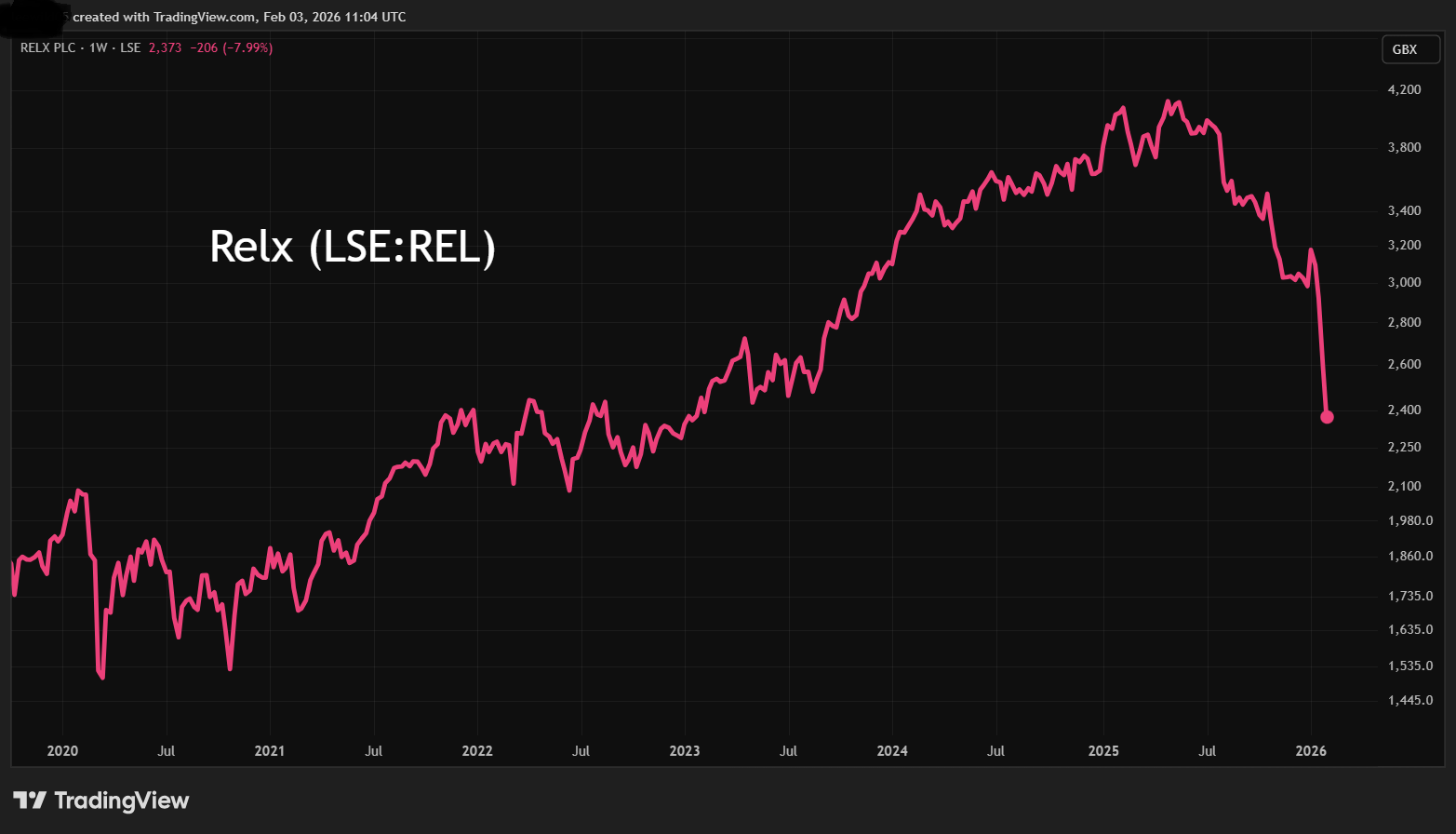
Source: TradingView. Past performance is not a guide to future performance.
There have been no downgrades to profit guidance, July’s interim results pointing to “higher-quality” growth with at least two of four main divisions improving momentum. A nine-month update affirmed 7% revenue growth, with adjusted underlying operating profit growth slightly exceeding underlying revenue growth.
Still arithmetically overvalued
Admittedly, this is a snapshot view and the last six years does include three with single-digit earnings per share (EPS) growth, plus a 13% fall in 2020 due to Covid. But when comparing 10% expected earnings growth for 2026 with a 17.x forward price/earnings (PE) ratio, the PEG (PE/EPS growth) is 1.76, where classically you are looking for below 1.0, although you might make exceptions up to 1.5.
However, this is based on normalised EPS, which is fair given the kind of businesses involved, plus Relx’s acquisitive history meaning significant amortisation charges to reported profit. The 30 June balance sheet had £8.1 billion of goodwill and £3.2 billion intangible assets, 354% of the £3.2 billion of net assets.
- Geopolitical risk: what to focus on when picking stocks
- As goes January, so goes the year: trading signal or noise?
Yet June’s ratio of current assets to current liabilities was also poor, below 0.5, due to trade payables at 1.7x trade receivables and £1.8 billion near-term debt.
While City analysts will always stress pre-amortisation earnings, at the interim stage investors saw negligible growth in reported EPS. Consensus expects £2,370 million net profit for 2025, rising to near £2,560 million this year. In normalised EPS terms it implies a 21% advance on 2024, easing to 10% in 2026.
In due respect, the last six years show operating margins sustained at least in a high 20% range, thereby boosting returns on capital employed and equity. With consensus anticipating a 72.5p dividend in respect of this year, the prospective yield is 2.9% covered twice by normalised earnings.
RELX - financial summary
Year-end 31 Dec
| 2019 | 2020 | 2021 | 2022 | 2023 | 2024 | |
| Turnover (£m) | 7,874 | 7,110 | 7,244 | 8,553 | 9,161 | 9,434 |
| Operating margin (%) | 27.3 | 23.3 | 26.8 | 27.1 | 28.5 | 30.3 |
| Operating profit (£m) | 2,152 | 1,655 | 1,939 | 2,314 | 2,610 | 2,855 |
| Net profit (£m) | 1,505 | 1,224 | 1,471 | 1,634 | 1,781 | 1,934 |
| Reported earnings/share (p) | 77.2 | 63.9 | 75.8 | 84.7 | 93.6 | 103 |
| Normalised earnings/share (p) | 78.6 | 68.4 | 75.0 | 87.6 | 98.8 | 106 |
| Operating cashflow/share (p) | 107 | 82.4 | 104 | 124 | 129 | 139 |
| Capital expenditure/share (p) | 19.4 | 18.7 | 17.4 | 22.6 | 25.1 | 25.8 |
| Free cashflow/share (p) | 87.4 | 63.7 | 86.6 | 102 | 104 | 113 |
| Dividend/share (p) | 45.7 | 47.0 | 49.8 | 54.6 | 58.8 | 63.0 |
| Covered by earnings (x) | 1.7 | 1.4 | 1.5 | 1.6 | 1.6 | 1.6 |
| Return on capital (%) | 27.4 | 16.9 | 19.2 | 21.7 | 27.7 | 30.3 |
| Return on equity (%) | 63.2 | 58.1 | 55.2 | 46.6 | 49.2 | 55.7 |
| Cash (£m) | 138.0 | 88.0 | 113 | 334 | 155 | 119 |
| Net debt (£m) | 6,276 | 7,035 | 6,054 | 6,396 | 6,342 | 6,425 |
| Net assets/share (p) | 112 | 109 | 168 | 198 | 184 | 188 |
Source: company accounts.
Fearing challenge of AI start-ups
I find it somewhat nebulous and difficult to verify the possible challenge from AI start-ups to Relx’s data and analytics businesses. Can AI upstarts really achieve similar depth and reach of information as Relx? While I have not engaged detailed research, I would expect Relx has substantive proprietary information that is almost impossible for AI to poach. It’s not like it has copyright, but it appears to me a strong moat.
It looks as if such fears represent “the straw that broke the camel’s back” and, while not fully justified, have triggered an inevitable mean-reversion in Relx shares on valuation grounds.
A business group of this size also faces a dilemma over how acquisitions can no longer provide a material boost to EPS, unless on a major and riskier scale. In the first half of 2025, management cited three acquisitions for a total £262 million, plus two disposals, it being hard to include the “earnings enhancing” tag even if slightly so.
Sum-of-parts valuation might favour bull case
It would be a mammoth task, possibly requiring inside information, but if management wanted to do a series of teach-ins on its various divisions, or simply invite its corporate broker to spend a month doing visits, it is possible to envisage a lengthy note proclaiming a break-up value well above market price.
- 10 shares to give you a £10,000 annual income in 2026
- Insider: more big deals part of director stakebuilding
Management obviously could be shooting itself in the foot were a proactive hedge fund to take a stake, lobby frustrated shareholders and hassle management for change.
Interestingly, there have never been any disclosed short positions in Relx since September 2018 – as if hedge funds ruled out trading against a high-quality business – although with the disclosure threshold at 0.5%, going above could have been high risk for a fund versus a £50 billion-plus company.
Even so, the normal rule is never to go short on an overvalued share until there’s sign of a deterioration in fundamentals, this also being relevant to long-only investors wondering whether to lock in gains.
An apparently weak technical position in Relx is shown by a 1.2% advance with the market yesterday trimmed to 0.2% by the close, despite the FTSE 100 closing up 1.2%. With the fall continuing by 8% this morning, the normal rule is not to catch a falling knife.
Who else would own these businesses?
Notionally, I’m unconvinced a break-up on this scale can work, but certainly it’s worth noting as a possibility.
Group history involves the old Reed Elsevier business originating in 1993 from the merger of publisher Reed International and Elsevier, a Netherlands-based scientific publisher. A re-branding to Relx happened in 2015.
One third of revenue constitutes “Risk” – tools that help banks spot money laundering and, for insurers, fraudulent claims. LexisNexis Risk Solutions provides data and analytic services to 85% of the Fortune 500, nine of the world’s top 10 banks and 23 of the world’s 25 leading insurers. It is fair to expect that Relx will refine such services with AI anyway.
That also applies to another third of revenue deriving from Scientific, Technical & Medical – services that improve scientific and healthcare outcomes. Longstanding titles such as The Lancet have also defied predictions of disruption from the internet although Relx’s tools are nowadays provided almost exclusively in electronic format, print having reduced from 64% to 4% over the last 25 years.
- Stockwatch: an exciting share off the radar of most investors
- Sign up to our free newsletter for investment ideas, latest news and award-winning analysis
Legal provides around 20% of revenue, the LexisNexis database containing 119 billion documents and records. There are also elements such as Butterworthsand Tolley.
The fourth main division is Exhibitions, formerly Reed Exhibitions, the world’s largest exhibitions company where events have improved growth, helped by digital initiatives. However, such a business can be cyclical with the economy.
Directors indulge options-exercising and share sales
In my last article, I engaged ASA International Group (LSE:ASAI), saying how refreshing it was to see a firm track record of directors buying in the cash market. Relx is a prime example of what I dislike: one modest share purchase a year, the last three by non-executive directors, while executives exercise options and overall sell most of the shares they receive.
The de-rating exposes how such schemes result in executives and outside shareholders facing risk differently. Interests are hardly aligned.
The buyback programme - which rose 50% in 2024 and has persisted throughout the de-rating - can now hardly be described as “a return of value”.
Consensus is a ‘buy’
I agree with analysts who say Relx is shifting towards AI-driven, high-value digital subscriptions. Effectively, the threat from AI is a misnomer.
Yet I believe this de-rating is justified on PE and yield criteria. Upside would, however, exist if, say, a US predator saw virtue in relative valuations or break-up potential, albeit that is highly speculative.
Behavioural economics can still apply in the short term. If this plunge can appear to find a floor, then I would expect at least one of the brokers – even if red-faced – to firmly re-iterate “buy”, with any upturn maybe attracting chart buyers.
Relx is thus intriguing right now for active traders. With the shares having just lost another 222p at 2,363p, the best I can say from an investment view, however, is “hold”.
Edmond Jackson is a freelance contributor and not a direct employee of interactive investor.
These articles are provided for information purposes only. Occasionally, an opinion about whether to buy or sell a specific investment may be provided by third parties. The content is not intended to be a personal recommendation to buy or sell any financial instrument or product, or to adopt any investment strategy as it is not provided based on an assessment of your investing knowledge and experience, your financial situation or your investment objectives. The value of your investments, and the income derived from them, may go down as well as up. You may not get back all the money that you invest. The investments referred to in this article may not be suitable for all investors, and if in doubt, an investor should seek advice from a qualified investment adviser.
Full performance can be found on the company or index summary page on the interactive investor website. Simply click on the company's or index name highlighted in the article.
Disclosure
We use a combination of fundamental and technical analysis in forming our view as to the valuation and prospects of an investment. Where relevant we have set out those particular matters we think are important in the above article, but further detail can be found here.
Please note that our article on this investment should not be considered to be a regular publication.
Details of all recommendations issued by ii during the previous 12-month period can be found here.
ii adheres to a strict code of conduct. Contributors may hold shares or have other interests in companies included in these portfolios, which could create a conflict of interests. Contributors intending to write about any financial instruments in which they have an interest are required to disclose such interest to ii and in the article itself. ii will at all times consider whether such interest impairs the objectivity of the recommendation.
In addition, individuals involved in the production of investment articles are subject to a personal account dealing restriction, which prevents them from placing a transaction in the specified instrument(s) for a period before and for five working days after such publication. This is to avoid personal interests conflicting with the interests of the recipients of those investment articles.