Why NatWest shares sell-off is overdone
The high street lender has come in for a pounding in recent sessions, and one City analyst thinks the share are cheap.
11th February 2026 15:17
by Graeme Evans from interactive investor
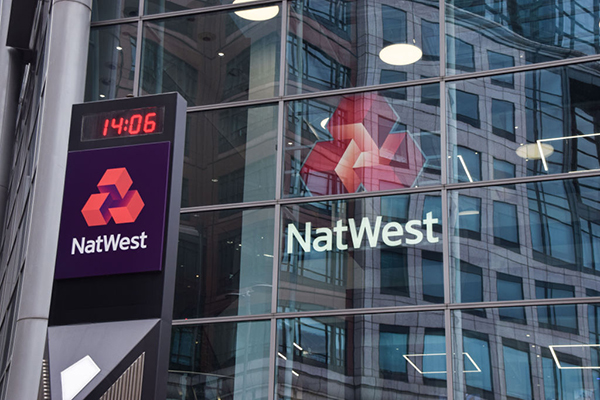
NatWest building in the City of London. Photo: Vuk Valcic/SOPA Images/LightRocket via Getty Images.
The underperformance of NatWest Group (LSE:NWG) shares since a £2.7 billion deal to expand in wealth management has been questioned after a City bank reiterated a price target of 780p.
The lender today traded at 606p, which compares with 660p prior to Monday’s swoop for Evelyn Partners and the disclosure that share buybacks are to go on hold until next year.
- Invest with ii: Top UK Shares | Share Tips & Ideas | Cashback Offers
UBS notes that the gap in share price performance versus Lloyds Banking Group (LSE:LLOY) has been the equivalent of the transaction’s value, with Lloyds down by a much smaller percentage after shares dipped from Friday’s 106.75p to today’s 103.1p.
It said: “While we think most UK domestic bank price moves this week are linked to political uncertainty, we think the additional weakness at NatWest overdone.”
UBS added that Friday’s fourth-quarter results and strategic update will provide an opportunity to fine-tune comparisons between the deal’s return on invested capital and share buybacks.
The Swiss bank’s analysis concludes that a broader wealth and investment offering will make NatWest a faster-growing higher returning bank.
- City view: Rolls-Royce and Legal & General
- Sign up to our free newsletter for investment ideas, latest news and award-winning analysis
- The secrets of the silver market explained
It has previously named NatWest as its favoured large-cap domestic lender, alongside Shawbrook Group (LSE:SHAW) as top mid-cap and Standard Chartered (LSE:STAN) as preferred international bank.
NatWest shares and the wider sector have re-rated over the past year, meaning the focus of the current results season is increasingly on price discipline and longer-term growth potential.
UBS added recently: “While we think the risk of ‘travel and arrive’ is real, we remain of the view that the stocks remain attractive overall even if we're now mostly holding the banks for earnings per share growth rather than a large re-rating.”
This week’s acquisition has created a £127 billion wealth platform after the Coutts owner added £69 billion of assets under management or administration to its own £59 billion.
The deal is expected to lift fee income by about 20% prior to synergies, deliver £100 million of run-rate cost savings and be accretive to growth and return on tangible equity in year one. It will be funded from existing resources, reducing the capital buffer ratio by about 130 basis points.
The rebuilding of the capital position to the management’s target range of 13%-14% means the next announcement on share buybacks will not be until next year’s interim results.
- eyeQ: a share for optimists to consider
- Wild’s Winter Portfolios 2025: a half-time round-up
- Results reflect Barratt Redrow's Budget hangover
Shore Capital said the City had expected more than £2.7 billion of buybacks across the fourth quarter and 2026, implying a £2 billion shortfall when factoring in the £750 million announced alongside the Evelyn acquisition.
It said on Monday: “While expanding in wealth management is strategically logical, we remain cautious on the deal economics, which rely heavily on synergy delivery to justify the price.
“Moreover, the willingness to pursue an acquisition on these terms over buying back shares reflects management’s view of its own valuation.”
Shore intends to carry out a valuation appraisal following Friday’s results, but for now retains a “somewhat cautious” Hold recommendation.
These articles are provided for information purposes only. Occasionally, an opinion about whether to buy or sell a specific investment may be provided by third parties. The content is not intended to be a personal recommendation to buy or sell any financial instrument or product, or to adopt any investment strategy as it is not provided based on an assessment of your investing knowledge and experience, your financial situation or your investment objectives. The value of your investments, and the income derived from them, may go down as well as up. You may not get back all the money that you invest. The investments referred to in this article may not be suitable for all investors, and if in doubt, an investor should seek advice from a qualified investment adviser.
Full performance can be found on the company or index summary page on the interactive investor website. Simply click on the company's or index name highlighted in the article.