The Analyst: AI stocks, trusts and funds still worth buying
Long-term returns are likely to depend on how successfully companies turn AI spending into sustainable earnings. Analyst Dzmitry Lipski looks at the options.
4th March 2026 09:30
by Dzmitry Lipski from interactive investor

Artificial intelligence
The artificial intelligence (AI) theme has continued to dominate market headlines this year, with Al stocks volatile as investors balance strong earnings with valuation concerns. NVIDIA Corp (NASDAQ:NVDA) reported strong results, showing continued demand for Al chips, while some software stocks came under pressure. There is ongoing debate about whether parts of the Al market are becoming overheated. Overall, investors remain positive on the long-term potential but cautious in the short term.
- Invest with ii: Open an ISA | ISA Investment Ideas | ISA Offers & Cashback
AI is often compared to transformative technologies such as the internet. While these innovations reshaped economies and improved productivity, investment outcomes were uneven. Companies that built the core infrastructure often faced heavy competition and high spending, while some of the most durable profits went to businesses that used the technology effectively.
AI may follow a similar path. It has the potential to transform industries, but long-term returns are likely to depend on how successfully companies turn AI spending into sustainable earnings.
Capital spending and the AI investment cycle
Major technology companies are investing heavily in AI data centres, advanced chips and AI networking infrastructure. Hyperscale technology groups such as Microsoft Corp (NASDAQ:MSFT), Amazon.com Inc (NASDAQ:AMZN), Alphabet Inc Class A (NASDAQ:GOOGL) and Meta Platforms Inc Class A (NASDAQ:META) have significantly increased capital spending to expand computing capacity.
AI-related capital expenditure across major technology companies is expected to exceed $250-300 billion (£187-225 billion) in 2026, compared with roughly $150-180 billion before the launch of ChatGPT in 2022. Much of this spending is funded by strong cash generation, although some companies have also raised debt.
To understand how this investment may translate into returns, it helps to look at the AI value chain:
Enabling layer: companies providing semiconductors, cloud platforms, data centres and power infrastructure
Intelligence layer: software companies developing large language models and integrating AI into products
Application layer: businesses using AI to improve productivity or deliver services such as automated customer support or coding assistants.
At present, most spending is focused on the enabling layer, where demand for computing power has been strongest and earnings growth most visible. However, for AI investment to be sustainable, businesses in the application layer need to generate reliable revenue growth from using AI tools. While there are many potential use cases, including advertising, customer service, and cybersecurity, revenue models are still evolving.
The key question for investors is whether revenue growth and productivity gains will justify the scale of current infrastructure investment.
- Ian Cowie: are you braced for AI apocalypse or buying into AI optimism?
- ii Tech Focus: Nvidia, software stocks, Crowdstrike, Broadcom
If revenues grow in line with spending, capital investment may gradually become more balanced relative to company sales. If growth disappoints, markets may reassess valuations, particularly where spending has reduced profit margins or increased debt levels. Recent volatility in software shares shows how quickly sentiment can change when expectations shift.
Recent performance and market concentration
AI-related stocks delivered very strong returns over the past few years, particularly in the US. More recently, parts of the sector, especially higher-growth software companies, have experienced periods of weakness as investors reassess how quickly companies can convert AI investment into profits.
This suggests the market may be moving from a phase driven mainly by optimism toward one more focused on earnings delivery and financial discipline.
A relatively small group of large US technology companies, including Nvidia, Microsoft, Amazon, Apple Inc (NASDAQ:AAPL), Meta Platforms and Alphabet, has accounted for a significant share of global equity market gains since late 2022. This concentration means overall market performance has become more sensitive to developments within a handful of companies.
Periods of major technological change like AI often make it difficult for investors to identify long-term winners in the early stages.
Risks to consider
AI is changing quickly and competition between companies is intense. Investors should be aware that this brings a number of important risks.
Valuations in parts of the sector remain elevated, particularly where expectations for future growth are too optimistic. At the same time, large amounts of capital are being committed to infrastructure projects that may take years to generate returns.
Regulation is also evolving. Governments are increasing scrutiny around data privacy, intellectual property and competition. Rapid technological change can quickly alter competitive dynamics, making it harder to predict which companies will succeed over the long term.
- Investing in themes: what investors need to know
- Sign up to our free newsletter for investment ideas, latest news and award-winning analysis
Market returns have also been concentrated in a small number of large companies, increasing the risk that a setback in one area could affect broader indices.
Concerns about a potential AI-driven bubble highlight the importance of diversification.
Any exposure should be proportionate to an investor’s risk tolerance and aligned with broader portfolio objectives and time horizon.
The role in a portfolio
AI is widely viewed as a long-term structural trend that is likely to remain influential across markets and industries.
Over time, investor focus may shift from building infrastructure to generating profits from AI products and productivity improvements. This could broaden opportunities beyond chipmakers and data-centre providers to include software providers and companies embedding AI into everyday operations.
For investors who understand the risks and are comfortable with higher volatility, AI exposure may offer long-term growth potential within an equity allocation.
However, given recent volatility, elevated valuations in parts of the market and high levels of capital expenditure, AI may be more suitable as a satellite allocation rather than a core holding for many investors.
Diversifying across different segments of the value chain can help reduce company and sector-specific risk. As with any thematic investment, position sizing and alignment with overall asset allocation remain important.
How to gain exposure
More experienced investors may choose to invest directly in individual shares, which offers greater control but introduces higher company-specific risk. Examples include:
Nvidia: supplies high-performance chips used in AI training and data centres
Microsoft: integrates AI into enterprise software and cloud platforms
Alphabet: combines AI capabilities across search, advertising and cloud
TSMC: manufactures advanced semiconductors essential for AI hardware.
Before diving in however, it’s worth being aware that many investors will already be exposed to areas of the AI value chain simply via their global equity allocations – whether active or passive – given that many of the world’s largest technology companies are key players in the AI ecosystem.
Nvidia, for example, is the largest holding of the MSCI World Index (around 5.5%), which many passive investors are allocated to, while active funds or investment trusts may target AI-related companies as part of their wider growth allocations.
An example of this is the large and popular Scottish Mortgage Ord (LSE:SMT) Investment Trust, which allocates to enablers of AI compute (such as ASML Holding NV (EURONEXT:ASML), Nvidia and Taiwan Semiconductor Manufacturing Co Ltd ADR (NYSE:TSM)) and even has a small allocation to the unlisted Anthropic – provider of ChatGPT rival, Claude.
- Is Scottish Mortgage too reliant on the AI boom?
- AI software sell-off: will FTSE 100 losers bounce back?
For those seeking more targeted exposure, who are comfortable with higher risk, there are specialist strategies. The Landseer Global Artificial Intelligence I GBP Bs Acc fund (formerly Sanlam) is an actively managed global growth fund investing in companies developing or applying AI technologies. Top holdings include Nvidia, Alphabet, Taiwan Semiconductor Manufacturing Company, Microsoft, Meta Platforms, Amazon and Tesla Inc (NASDAQ:TSLA). The ongoing charge is 0.45%.
Alternatively, exchange-traded funds (ETFs) can provide diversified exposure across multiple AI-related companies and sub-sectors, typically at lower cost. For example, the L&G Artificial Intelligence ETF GBP (LSE:AIAG) tracks an index of companies deriving revenue directly from AI and AI-enabling technologies.
As with all thematic investing, AI exposure can be volatile, and investors should ensure it aligns with their broader asset allocation and long-term objectives.
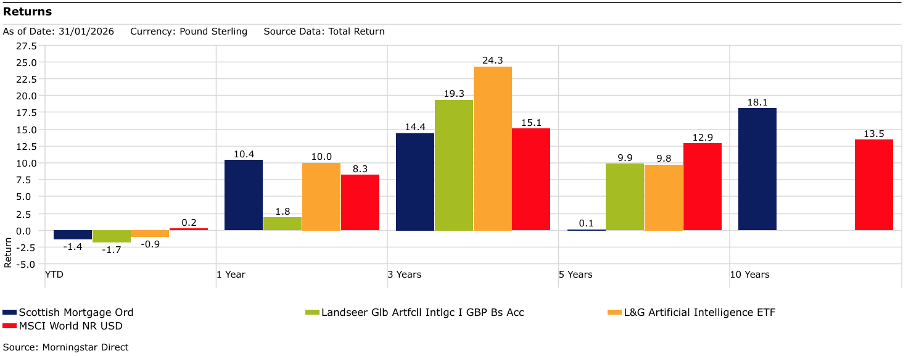
Past performance is not a guide to future performance.
These articles are provided for information purposes only. Occasionally, an opinion about whether to buy or sell a specific investment may be provided by third parties. The content is not intended to be a personal recommendation to buy or sell any financial instrument or product, or to adopt any investment strategy as it is not provided based on an assessment of your investing knowledge and experience, your financial situation or your investment objectives. The value of your investments, and the income derived from them, may go down as well as up. You may not get back all the money that you invest. The investments referred to in this article may not be suitable for all investors, and if in doubt, an investor should seek advice from a qualified investment adviser.
Full performance can be found on the company or index summary page on the interactive investor website. Simply click on the company's or index name highlighted in the article.