Bank of England holds rates but prospect of hikes loom
Policymakers aren’t changing tack just yet but the noise around higher interest rates to tame elevated inflation is slowly cranking up.
30th April 2026 13:42
by Craig Rickman from interactive investor
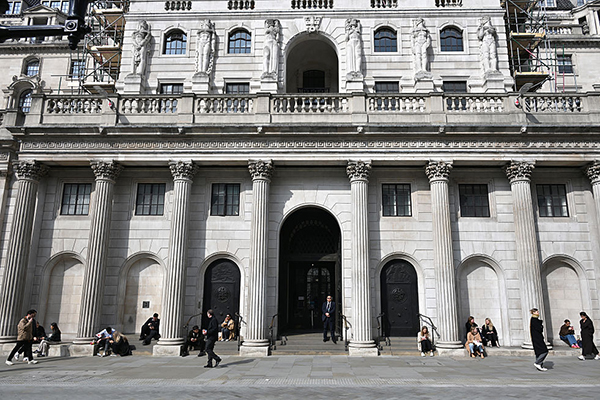
The Bank of England in the spring sunshine. Photo: John Keeble/Getty Images.
Members of the Bank of England’s Monetary Policy Committee (MPC) are rarely united when choosing whether to cut, hold or hike interest rates. By contrast, four out of the five meetings held between August 2025 and February 2026 were determined by wafer-thin margins, with the first of this run needing an unprecedented second round of voting to achieve a majority.
- Our Services: SIPP Account | Stocks & Shares ISA | See all Investment Accounts
The nine-person strong MPC has found more harmony since, although global events have forced their hand. Following last month’s unanimous result, policymakers announced at noon today that they had voted by a majority of 8 to 1 to maintain the Bank Rate at 3.75%, stressing the need to keep things steady until the economic fallout from events in the Middle East becomes clearer.
The energy price shock triggered by the war has already seeped through to these shores, with soaring petrol prices shunting the consumer prices index (CPI), the UK’s main measure of inflation, to 3.3% in March.
Concerns mount that inflation will continue speeding up during 2026, triggering the prospect of rate hikes in what would be a hammer blow to borrowers. Mortgage deals have already worsened since the crisis started, and despite marginally improving recently, are less attractive than they were a few months ago.
The MPC therefore has some big choices to make at future meetings. Recent history tells us that the rate setters have disparate views when it comes to their preferred path of monetary policy. As such, we can expect future calls to run closer than the most recent two.
Discord was evident yesterday across the Atlantic, as the US Federal Reserve (Fed), in what could be Jerome Powell’s final meeting as chair, kept rates in the benchmark range of 3.50% to 3.75%. Markets had expected this outcome, but what raised eyebrows was that four out of the 12 dissented, the most divisive vote in 34 years.
- Seraphim Space’s share issue: all you need to know
- How to avoid government’s workplace pension ‘power grab’
Returning to these shores, the looming threat of elevated inflation has caused the MPC to pause for thought. The group needs richer data before shifting rates in either direction. Although we should note that one member, Huw Pill, felt raising interest rates now was the right move.
In the MPC’s summary of today’s decision, Pill said: “Events in the Gulf have left the outlook for global energy prices elevated and more uncertain. That uncertainty is unlikely to dissipate soon, but it is nonetheless clear that higher energy prices represent an inflationary shock to the UK economy.”
Can we learn anything from MPC members’ voting records?
As investors are regularly reminded, the past is not necessarily a guide to the future, but when gauging how future interest rate votes might play out, rate setters’ track records may offer some clues and patterns.
The table below shows how the nine MPC members have voted in the 14 meetings since 19 September 2024, when the most recent recruit, Alan Taylor, cast his inaugural vote.
Current members | Andrew Bailey | Sarah Breeden | Swati Dhingra | Megan Greene | Clare Lombardelli | Catherine L Mann | Huw Pill | Dave Ramsden | Alan Taylor | |
First vote: | First vote: | First vote: | First vote: | First vote: | First vote: | First vote: | First vote: | First vote: | ||
Voted to increase | 14 | 0 | 2 | 4 | 0 | 18 | 14 | 16 | 0 | |
Voted to maintain | 29 | 12 | 10 | 15 | 10 | 18 | 21 | 41 | 3 | |
Voted to reduce | 7 | 8 | 17 | 3 | 4 | 1 | 2 | 14 | 10 | |
Meetings | 50 | 20 | 29 | 22 | 14 | 37 | 37 | 71 | 13 | |
Bank Rate | ||||||||||
19-Sep-24 | 5.00% | 5.00% | 5.00% | 4.75% | 5.00% | 5.00% | 5.00% | 5.00% | 5.00% | 5.00% |
07-Nov-24 | 4.75% | 4.75% | 4.75% | 4.75% | 4.75% | 4.75% | 5.00% | 4.75% | 4.75% | 4.75% |
19-Dec-24 | 4.75% | 4.75% | 4.75% | 4.50% | 4.75% | 4.75% | 4.75% | 4.75% | 4.50% | 4.50% |
06-Feb-25 | 4.50% | 4.50% | 4.50% | 4.25% | 4.50% | 4.50% | 4.25% | 4.50% | 4.50% | 4.50% |
20-Mar-25 | 4.50% | 4.50% | 4.50% | 4.25% | 4.50% | 4.50% | 4.50% | 4.50% | 4.50% | 4.50% |
08-May-25 | 4.25% | 4.25% | 4.25% | 4.00% | 4.25% | 4.25% | 4.50% | 4.50% | 4.25% | 4.00% |
19-Jun-25 | 4.25% | 4.25% | 4.25% | 4.00% | 4.25% | 4.25% | 4.25% | 4.25% | 4.00% | 4.00% |
07-Aug-25 | 4.00% | 4.00% | 4.00% | 4.00% | 4.25% | 4.25% | 4.25% | 4.25% | 4.00% | 4.00% |
18-Sep-25 | 4.00% | 4.00% | 4.00% | 3.75% | 4.00% | 4.00% | 4.00% | 4.00% | 4.00% | 3.75% |
06-Nov-25 | 4.00% | 4.00% | 3.75% | 3.75% | 4.00% | 4.00% | 4.00% | 4.00% | 3.75% | 3.75% |
18-Dec-25 | 3.75% | 3.75% | 3.75% | 3.75% | 4.00% | 4.00% | 4.00% | 4.00% | 3.75% | 3.75% |
05-Feb-26 | 3.75% | 3.75% | 3.50% | 3.50% | 3.75% | 3.75% | 3.75% | 3.75% | 3.50% | 3.50% |
19-Mar-26 | 3.75% | 3.75% | 3.75% | 3.75% | 3.75% | 3.75% | 3.75% | 3.75% | 3.75% | 3.75% |
30-Apr-26 | 3.75% | 3.75% | 3.75% | 3.75% | 3.75% | 3.75% | 3.75% | 4.00% | 3.75% | 3.75% |
Source: Bank of England
Given Pill, the Bank’s chief economist, has been particularly hawkish during his tenure on the committee, today’s hike vote draws little surprise. In the previous 37 meetings he attended, Pill only voted for a cut on two occasions. And he isn’t the only one who believed a guarded approach was needed during this period.
American economist Catherine L. Mann, who’s also taken part in 38 MPC decisions, has only favoured lowering rates on one occasion when she, completely off brand, voted for an aggressive 0.50 percentage point cut. On that occasion, seven members voted for a 0.25% percentage point reduction, while Swati Dhingra, associate professor of economics at the London School of Economics, agreed with Mann.
Dhingra’s broader record, however, is in stark contrast to Mann’s, voting for cuts at 17 consecutive meetings between 1 February 2024 and 5 February 2026, with the streak only broken last month. Dave Ramsden and Taylor have also favoured looser monetary policy, while Sarah Breedon is another who on occasion has voted for cuts when the majority has opted to hold.
Something else really sticks out, which is that four members – Megan Greene, Clare Lombardelli, Mann, and Pill – haven’t mustered a vote cut between them since 8 May 2025, a period that’s involved eight meetings and the Bank Rate falling from 4.25% to 3.75%.
Which direction will rates move next?
Prior to today’s decision, economists believed a prolonged period of holds to be the most likely outcome. But financial markets reckoned hikes are in offing, with two quarter-point increases – one in July and another in September - predicted during 2026.
Whether this comes to pass will hinge on how the economic situation unfolds. Inflation is the main measure that the Bank seeks to control, aiming to keep it around the 2% mark, but there are other factors too. Notably, how the economy is performing and the speed that wages are rising.
- Pensions and IHT: the countdown to new tax rules has started
- Sign up to our free newsletter for investment ideas, latest news and award-winning analysis
As the Resolution Foundation think tank noted in its Macroeconomic Policy Outlook Q2 2026, the typical central bank response to the kind of global shocks we’ve seen recently is to ignore the first-round effects of inflation. The reason is that it “would require a sharp monetary tightening that, once its full effects had played through, would crush growth and push inflation well below target”.
Instead, it is often argued that policymakers should focus on the second-round effects (workers demanding higher wages and businesses increasing prices to protect profits). The think tank said the big question for the Bank is how aggressive to be in anticipating these.
There’s a case for a forceful response, it claims, as the UK has had only one month of below-target inflation in nearly five years. But its view is that policymakers should resist the temptation to act forcefully and instead heed caution. “This is not 2022: the shock is smaller, there is more slack in the economy, and before the war the Bank was forecasting rising unemployment and at-target inflation from June,” the Resolution Foundation said.
Pill, once again in the Bank’s summary of today’s decision, holds a different view, justifying his vote to hike by saying: “The second-round effects in price and wage-setting stemming from this shock have the potential to raise UK inflation beyond the near term in a persistent manner.”
How should investors react to what’s going?
Investors may harbour concerns about the future trajectories of inflation and interest rates, given the impact these can have on both nominal and, most crucially, “real terms” portfolio returns.
Nerves won’t have settled last week when MPC member Breedon, the Bank’s head of stability, warned that a stock market crash might not be far away. “There’s a lot of risk out there and yet asset prices are at all-time highs. We expect there will be an adjustment at some point,” she said.
interactive investor’s SIPP index highlights that people are indeed heeding caution in their portfolios, with cash-like alternatives garnering notable appeal. The Royal London Short-Term Money Market fund is the most popular holding for investors in both accumulation and decumulation, while another money market fund, Fidelity Cash, is also finding favour.
- The highest-yielding money market funds to park your cash in
- Three corporate bonds make first move to appeal to DIY investors
But while short-term plays can bring some precious security, it’s important to keep focused on the bigger picture.
We can’t know for sure how the future will play out, but that’s familiar territory for experienced investors who’ll appreciate that no matter the economic conditions and outlook, the principles of building wealth remain consistent: make sure that any short-term holdings attract the best interest rates, diversify longer-term wealth across various regions, assets classes and sectors to avoid too much risk concentration, drip-feed money into the market regularly if you’re trying to accumulate wealth, and maximise tax-wrapped accounts and tax-free exemptions to keep more of the money you make.
These articles are provided for information purposes only. Occasionally, an opinion about whether to buy or sell a specific investment may be provided by third parties. The content is not intended to be a personal recommendation to buy or sell any financial instrument or product, or to adopt any investment strategy as it is not provided based on an assessment of your investing knowledge and experience, your financial situation or your investment objectives. The value of your investments, and the income derived from them, may go down as well as up. You may not get back all the money that you invest. The investments referred to in this article may not be suitable for all investors, and if in doubt, an investor should seek advice from a qualified investment adviser.
Full performance can be found on the company or index summary page on the interactive investor website. Simply click on the company's or index name highlighted in the article.