Gold and silver prices: what the City thinks will happen next
There’s been a rebound in the price of precious metals, but will it last? City writer Graeme Evans looks at predictions and comments from analysts on future direction.
3rd February 2026 13:37
by Graeme Evans from interactive investor
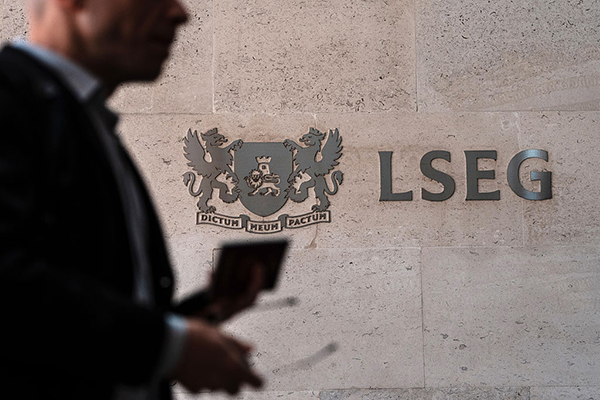
A man passes the London Stock Exchange in Paternoster Square, London. Photo: Carl Court/Getty Images.
Optimism that gold remains in a bull market cycle today enticed investors back to precious metals in a session when the likes of Hochschild Mining (LSE:HOC) and Fresnillo (LSE:FRES) regained lost ground.
- Invest with ii: Open an ISA | ISA Investment Ideas | Transfer a Stocks & Shares ISA
Gold rose by more than 5% to $4,900 an ounce as calmer conditions returned following the biggest two-day reverse for bullion since 2013 and the second biggest since the 1980s.
The price, which stood near $5,600 at one point last week, found its floor at $4,450 on Monday morning before staging its recovery.
UBS believes that the two-day correction will be healthy for the market in the long run and that there is no reason to think the gold rally is over.
The slide for silver was even more pronounced, having jumped by 250% over a year to $120 an ounce due to a mixture of physical shortages and speculative buying in China.
- Gold, silver and defence: reasons to be bullish and bearish
- Market snapshot: calm and relief prevail
- eyeQ: the commodities playing catch-up to metals
It slid by an unprecedented 31.5% across the two days, returning to an $80 level that City bank Berenberg said felt more sensible for a commodity that is still very tight on a supply/demand basis. The price rallied 10% to $87.06 an ounce earlier today.
Mexico-based silver miner Fresnillo benefited with a rise of 135p to 3,585p, which compared with last week’s peak of 4,316p and just 700p a year ago. West Africa-based gold miner Endeavour Mining (LSE:EDV) put back 222p to 4,332p, still a long way short of Thursday’s 4,826p.
UBS said that a clear-out in short-term speculative positions during the two-day sell-off had created breathing space, as well as the room for long-term investors with low or zero gold allocations to build positions.
The bank, which has a $6,200 price target, added that portfolio diversification remains relevant in the current macro environment and that gold should continue to benefit from this trend.
It said: “We don’t think much has changed materially from a fundamental standpoint. We expect demand to resume across the board, from retail, institutional, as well as official sector buyers.
“This should eventually allow gold to resume its uptrend and see new highs in the coming quarters.”
- Geopolitical risk: what to focus on when picking stocks
- DIY Investor Diary: ‘quant’ approach goes big on gold and bonds
- 10 shares to give you a £10,000 annual income in 2026
Falling interest rates have reduced the opportunity cost of holding the zero-yielding asset, while geopolitics, higher government debts and persistent inflation reinforce gold’s status as a long-term portfolio diversifier.
The profit-taking was triggered by the nomination of Kevin Warsh as the new Federal Reserve chair, which eased recent concerns about central bank independence.
UBS believes gold is currently in the mid-to-late stage of its present bull market.
It said it was significant that there has been no change in policy direction by the US Federal Reserve, given that this was the reason bull markets ended in 1980 and 2013.
The bank said: “Gold bull markets typically don’t conclude simply because fears diminish or prices become too high - they end when central banks establish their credibility and pivot to a new monetary policy regime.”
Deutsche Bank reiterated its $6,000 target over the weekend as it said the sudden adjustment in prices was not in keeping with the catalysts involved.
It said current conditions do not appear primed for a sustained reversal in gold prices: “Gold’s thematic drivers remain positive and we believe investors’ rationale for gold (and precious) allocations will not have changed.”
- Stockwatch: time to buy Relx shares after fresh plunge?
- Sign up to our free newsletter for investment ideas, latest news and award-winning analysis
- Investment outlook: expert opinion, analysis and ideas
In reference to the 1980s decline, it said that gold investors’ concerns were substantially about ongoing inflation peaking at 14% in the 1970s.
It said: “Consequently the Fed’s eventual hard-won disinflation success was likely pivotal in establishing gold weakness, with the additional kicker of a 77% rise in the dollar index between 1981-1984.”
The bank pointed out that today’s concerns are more about future possible inflation rather than ongoing inflation above target.
In relation to gold’s decline in 2013, it said this was set off by the so-called taper tantrum involving an unexpected reduction in the pace of Federal Reserve quantitative easing.
“Today, Fed policy begins from a much less accommodative setting, reducing the scope for a potential hawkish shock.”
These articles are provided for information purposes only. Occasionally, an opinion about whether to buy or sell a specific investment may be provided by third parties. The content is not intended to be a personal recommendation to buy or sell any financial instrument or product, or to adopt any investment strategy as it is not provided based on an assessment of your investing knowledge and experience, your financial situation or your investment objectives. The value of your investments, and the income derived from them, may go down as well as up. You may not get back all the money that you invest. The investments referred to in this article may not be suitable for all investors, and if in doubt, an investor should seek advice from a qualified investment adviser.
Full performance can be found on the company or index summary page on the interactive investor website. Simply click on the company's or index name highlighted in the article.