ii view: Dr Martens recovery plan takes big step
Now headed by a former Apple exec and with its shares having fallen by more than 80% over the last five years. We assess prospects.
19th May 2026 11:45
by Keith Bowman from interactive investor
Full-year results to 29 March
- Currency adjusted revenue down 1.4% to £765 million
- Adjusted pre-tax profit up 61% to £55 million
- Final dividend of 1.7p per share
- Total dividend for the year unchanged at 2.55p per share
- Net debt down 14% to £214 million
Chief executive Ije Nwokorie
“In FY26 we returned the business to profit growth, delivering a 61% increase in adjusted PBT, with revenue in line with guidance, and made good progress pivoting the business to a consumer‑first operating model. Shoes were the standout performer, up 19%.
“Our focus on execution is paying off: we are improving the quality of revenues whilst strengthening margins, cash generation, the Balance Sheet and overall model resilience.”
- Our Services: SIPP Account | Stocks & Shares ISA | See all Investment Accounts
ii round-up:
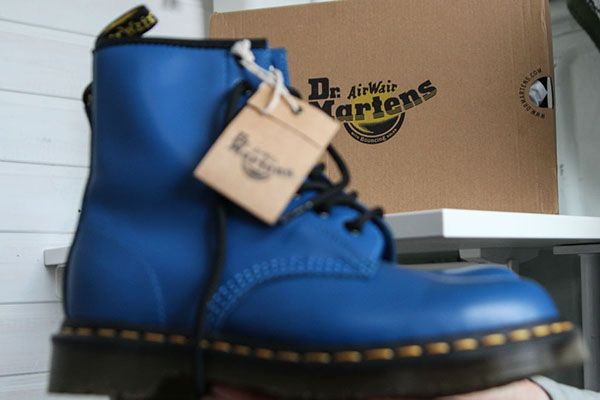
Dr. Martens Ordinary Shares today reported a strong recovery in profits as CEO and former Apple Inc executive Ije Nwokorie continued to execute a recovery plan.
The maker of the iconic DM boots pointed to a pivot in the business during the year to late March, with a focus on expanding the product range and reducing product price discounting. Tight cost control helped gross profit margin increase 1.2% to 66.2%, pushing adjusted pre-tax profit up 61% year-over-year to £55 million.
Shares in the FTSE 250 company rose as much as 6% in UK trading having come into these latest results down by close to a fifth so far in 2026. That’s similar to fellow luxury goods maker Burberry Group. The FTSE 250 index is up almost 2% year-to-date.
Dr Martens operates in more than 60 countries globally, with Ije Nwokorie taking charge in January 2025.
Sales of the Lowell, Buzz and Zebzag brands tripled during this latest financial year, with new distribution partnerships across the product range achieved in Latin America, the UAE and the Philippines.
Discounted boot sales for the core US wholesale business were down almost a third on the prior year, while a reorganization of the business now leaves it led by a streamlined executive team.
Looking ahead, the next phase of the recovery plan is to scale the business, with the focus moving towards investments in areas such as a new innovative sandals range and selective store upgrades.
A trading update accompanying the group’s AGM is likely to be announced late June to early July.
ii view:
Started in Northamptonshire in 1960, Dr Martens today employs around 3,600 people across both the UK and overseas. Direct-to-Consumer (DTC) sales continued to dominate during this latest year at close to two-thirds. Sales within DTC were split relatively evenly between its own stores and e-commerce sales. Wholesale revenues, or sales made via other retailers accounted for the remaining one-third.
Geographically, the wider European or EMEA region (Europe, the Middle East, and Africa) generated most sales over this latest year at almost a half. The Americas came next at just over a third, with Asia Pacific the balance of just over a tenth.
For investors, high energy prices following the war in the Middle East are now likely to pressure disposal consumer incomes going forward. Ongoing US trade tariffs given the making of its products elsewhere are not to be forgotten. The high fashion nature of the group’s products needs to be remembered, while broader costs for retailers in its home UK market now include higher employee taxes such as national insurance.
- 10 hottest ISA shares, funds and trusts
- Results upgrade sparks Currys rally
- Watch our video interview with Aberdeen UK Smaller Companies Growth Trust: UK smaller companies yielding more than FTSE 100
More favourably, a reinvigorated strategy continues to be progressed, with stabilisation and pivot largely behind it and the final phase of scale now the focus this year. Cost savings were previously highlighted as offsetting some US trade tariff impacts. A focus on lowering group debt remains, while a prospective dividend yield of close to 4% is not to be ignored.
In all, the backdrop for a high-fashion retailer remains extremely tough, and while a reinvigorated strategy and consensus analyst fair value estimate of 100p per share is attractive, Dr Martens remains a stock for investors comfortable with a higher element of risk.
Positives:
- Geographical diversity
- Refreshed strategy
Negatives:
- Pressured consumer spending
- Exposure to currency movements
The average rating of stock market analysts:
Buy
These articles are provided for information purposes only. Occasionally, an opinion about whether to buy or sell a specific investment may be provided by third parties. The content is not intended to be a personal recommendation to buy or sell any financial instrument or product, or to adopt any investment strategy as it is not provided based on an assessment of your investing knowledge and experience, your financial situation or your investment objectives. The value of your investments, and the income derived from them, may go down as well as up. You may not get back all the money that you invest. The investments referred to in this article may not be suitable for all investors, and if in doubt, an investor should seek advice from a qualified investment adviser.
Full performance can be found on the company or index summary page on the interactive investor website. Simply click on the company's or index name highlighted in the article.