Japan stock market outlook 2026: future looks bright
Not only has another change in political leadership been historic, but it also brings hope that Japan can get back on track. Analyst Rodney Hobson looks at the consequences for investors.
31st December 2025 08:37
by Rodney Hobson from interactive investor
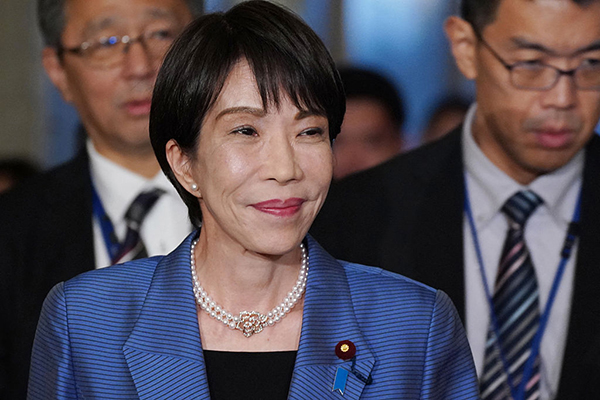
Japan’s Prime Minister Sanae Takaichi in Tokyo in November 2025. Photo: Kazuhiro NOGI/AFP via Getty Images.
That most male-oriented of countries, Japan, has finally got its first female prime minister. Is this a breath of fresh air, or is she being set up to fail? The early indications are encouraging, especially on the stock and bond markets.
- Invest with ii: Buy International Shares | Most-traded US Stocks | Top UK Shares
The lucky lady in question is Sanae Takaichi, who was elected leader of the Liberal Democrat Party (LDP) at the beginning of October. Despite its name, the LDP is in fact a Conservative party and it has ruled Japan almost exclusively for the past 70 years, usually as a majority government.
The party has been quite ruthless with those leaders who have been perceived as failing, increasingly so as Japan moved from the rapidly developing stage during the 1960s and 1970s to a period of comparative stagnation as first the Asian tigers of Singapore, South Korea and Taiwan bit into its export markets, and then as China emerged as a world superpower. Various strategies have been tried, from stimulating the economy to encouraging savings to government thrift, with limited success, followed by another change of leadership.
No leader has quite managed to get Japan back on track, though, and the country’s ageing population has become an increasing drag. Now the country faces a future of sharply falling population, especially in the working-age demographics.
There is also something of a national identity crisis, as outgoing prime minister Shigeru Ishiba indicated when he announced his resignation at the beginning of September. He warned that Japan was in danger of a lurch to the right unless the LDP can unify and reform itself. Although the party has ruled for all but four years since it was formed in 1955, it is under serious threat from the far-right Sanseito, which is anti-foreigners in a country not particularly known for welcoming temporary or permanent overseas settlers – less than 3% of the population are resident foreigners – but has seen increasing numbers of foreign workers necessarily stepping in to fill the growing gap in the indigenous workforce.
- Investment outlook: expert opinion, analysis and ideas
- One theme and fund for the next decade
- Ian Cowie: two of my most exciting investment trust holdings
Campaigning under a Japanese first slogan, Sanseito came second in seats allocated under proportional representation in elections to the upper house in July.
Ishiba had been in office for less than a year, during which time the LDP suffered repeated election setbacks that had left the party without a majority in either house of the Japanese parliament for the first time since it was founded.
Ishiba left of his own accord, but he must have known that his days were numbered. He leaves his successor running a minority government in a state of crisis with the economy, national security and trading relations with the United States all under the spotlight. Ishiba did manage to sign a trade treaty with US President Donald Trump but only after tough negotiations.
Takaichi, at the age of 64, can hardly be considered a new broom, though. She is a staunch supporter of going back to Abenomics, the creed of Shinzo Abe, a highly regarded prime minister both at home and internationally, who was nonetheless eventually ousted in yet another round of LDP in-fighting. Abenomics means ramping up government spending and loosening monetary policy in the hope of stimulating the stagnant economy quickly enough to boost tax income before the state runs out of money.
This is a risky strategy at the best of times, but it comes as inflation, which has largely remained under control for decades, hit a two-year high of 4%. Even Abe himself found the policy of limited benefit with the downside of causing serious economic harm. Meanwhile, Japan’s chronic labour shortages have got worse, an inevitable consequence of the fall-off in the nation’s birth rate alongside an unwelcoming attitude towards incoming foreign migrants.
Nor does the policy tackle government debt. Indeed, it will, at least in the short term, exacerbate a situation in which gross government debt has reach double the size of the country’s entire economy and the net debt-to-GDP ratio is over 100%.
Takaichi is also running the risk of undermining the status of the Bank of Japan, the country’s central bank, which like its counterparts in the UK, the US and Europe has independence in setting interest rates. The new prime minister has expressed her wish for lower interest rates. One of her first statements after the LDP election was to stress the importance of Bank of Japan policy to be consistent with the government’s economic policy.
- Is this country a must-have in any portfolio?
- Sign up to our free newsletter for investment ideas, latest news and award-winning analysis
This stance had an immediate effect on the Tokyo Stock Exchange, where the key Nikkei 225 Index promptly rose 4.75% to nearly 48,000 points. Drug companies, car manufacturers and defence suppliers were the main beneficiaries as they are exporting companies that stand to gain most from a weaker yen. Alas, not all markets were impressed. The yen slid 1.8% against the dollar, breaching the Yen 150 barrier, and long-term yields on Japanese government bonds edged higher.
In terms of international diplomacy, Takaichi has angered Chinese premier Xi Jinping with tacit support for Taiwan, but she has at least found a useful friend in US President Donald Trump. Given the importance to Japan of its security treaty with the United States, this has won early plaudits. Trump was a big fan of Takaichi’s mentor Abe so this is a case of deja vu.
At company level though, there is change in the air. Japanese prime ministers have for many years been trying to persuade companies to stop hoarding cash and assets as a way to stimulate the economy by increasing profitability and share prices, but the companies themselves have rather regarded the cash and assets as belonging to them rather than the shareholders.
Japanese firms have been extremely cautious about taking risks since property and share prices crashed in the 1990s, and the decades of low economic growth since then have encouraged this attitude of keeping back enough for a rainy day.
Attitudes are changing slowly but surely as institutional investors have engaged more with company directors to seek ways of increasing value for shareholders by using cash to invest in the business, raise dividends, conduct share buybacks and sell unwanted or underperforming parts of the business.
The future looks quite bright for overseas investors to move into Japan, but the best way for most is through funds specialising in the country where managers have had the time and built the experience to understand how the Far East works.
Rodney Hobson is a freelance contributor and not a direct employee of interactive investor.
These articles are provided for information purposes only. Occasionally, an opinion about whether to buy or sell a specific investment may be provided by third parties. The content is not intended to be a personal recommendation to buy or sell any financial instrument or product, or to adopt any investment strategy as it is not provided based on an assessment of your investing knowledge and experience, your financial situation or your investment objectives. The value of your investments, and the income derived from them, may go down as well as up. You may not get back all the money that you invest. The investments referred to in this article may not be suitable for all investors, and if in doubt, an investor should seek advice from a qualified investment adviser.
Full performance can be found on the company or index summary page on the interactive investor website. Simply click on the company's or index name highlighted in the article.