Paramount or Netflix: who’ll win fight for Warner Bros?
The battle for one of the most iconic film companies of all-time has the makings of its own Hollywood blockbuster. Analyst Rodney Hobson picks a winner and gives a view on all the players.
10th December 2025 09:10
by Rodney Hobson from interactive investor

The Warner Brothers logo on the water tower at Warner Bros Studio in Burbank, California. Photo: Mario Tama/Getty Images.
Hollywood has gone through many game changers over 100 years or so: talkies, colour, the arrival of television, the threat of competition from bingo, the introduction of multiple screens in cinemas. With customary bravado as typified by many of its productions over the decades, it has adapted and taken everything in its stride. Now the challenge is the arrival of streaming services delivering on demand to an impatient young generation.
- Invest with ii: Buy US Stocks from UK | Most-traded US Stocks | Cashback Offers
The Walt Disney Co (NYSE:DIS)has already met this phenomenon by running its film studios and television channel side by side, in many ways getting the best of both worlds. It can hold back the bigger pictures for the bigger screen and rerun them later ad nauseam on television. When there are the inevitable expensive flops, all is not lost as these can at least be switched to streaming. It makes economic sense.
Now streaming giant Netflix Inc (NASDAQ:NFLX) proposes to take over one of the Hollywood greats, Warner Bros. Discovery Inc Ordinary Shares - Class A (NASDAQ:WBD), in an agreed dealto create a rival blockbuster. This is a somewhat tangled deal and it will take at least a year, possibly 18 months, to push through.
That is, if it happens at all. Film maker Paramount Skydance Corp Ordinary Shares - Class B (NASDAQ:PSKY)has stepped in as a rival but hostile suitor in the finest traditions of an old silent movie. As the film slogan might well have put it: it’s complicated.
Warner has already proposed to spin off its Discovery Global arm into a new listed company, a move that itself is taking more than a year to complete. It was first put forward last June and will not happen until the third quarter of 2026. Discovery Global will absorb television brands including CNN, TNT Sports and Discovery, as well as digital products such as the Discovery+ streaming service. Netflix wants the main bit, which includes the company’s film and television studios and its cable TV services HBO Max and HBO.
Warner shareholders would get cash and Netflix shares worth a total of $27.75 for each Warner share, mostly in cash. Even before Paramount’s dramatic intervention, there was no certainty that it would go through. Such a large deal will have to be approved by shareholders in both companies, and it will inevitably come under the scrutiny of the competition regulator in the United States, where President Donald Trump has already expressed doubts accompanied by threats of interference in any decision making.
- ARK Invest’s Cathie Wood: why we’re betting big on Tesla
- ii Tech Focus: crypto, Intel, Anthropic, Snowflake, Strategy, Oracle
- Five top share trades for 2026
Competition authorities elsewhere, particularly in Europe, could also become involved but are likely to leave it mainly or entirely to their American counterparts, given that both companies are based in the US.
It looked likely, however, that it would eventually happen, although probably with minor adjustments and possibly a slight increase in the price offered.
The market reacted adversely, with Netflix shares down 2.7% immediately the proposal was unveiled. However, it is quite usual for the shares of the bidder to slip on fears that it is overpaying, so this reaction was quite subdued. Of greater concern was that Warner slipped 1%, a suggestion that the deal is not especially attractive given that the stock was already trading around $25.
Now for something quite, although not completely, different. Paramount’s bid is for the whole of Warner as it exists now, which makes comparisons between the two proposals quite difficult because we cannot be sure at what price the Discovery shares would trade at as a separate company.
Paramount actually put Warner in play in the first place, and it has made half a dozen offers, all of which have been rejected by the Warner board. It is now going directly to shareholders with an offer of $30 a share. One big attraction is that Warner shareholders get the certainty of cash now. Also, it seems likely that this plan would be easier to get past the regulators.
It is virtually impossible to compare the value of the two rival proposals as they are for different things, but the greater certainty of the Paramount plan just about tips the scales in its favour.
- Sign up to our free newsletter for investment ideas, latest news and award-winning analysis
- Poster child for this investment theme is cheap
Warner shares slipped below $8 last April after a series of poor results, but a better financial performance and the possibility of a takeover have propelled them to $28. Netflix peaked above $130 in June but is currently on the slide. Paramount is also slipping, from nearly $20 in September to under $15.
Disney shares have shrugged off the possible competition, sticking around $105 where a floor seems to be forming, although there is no guarantee it will hold. The stock has been below $100 for much of the past three years, with $80 as rock bottom. The price/earnings (PE) ratio is only around 15 but there is not much of a yield at just under 1%.
You can read about Disney’s most recent and slightly underwhelming results in Keith Bowman’s latest analysis.
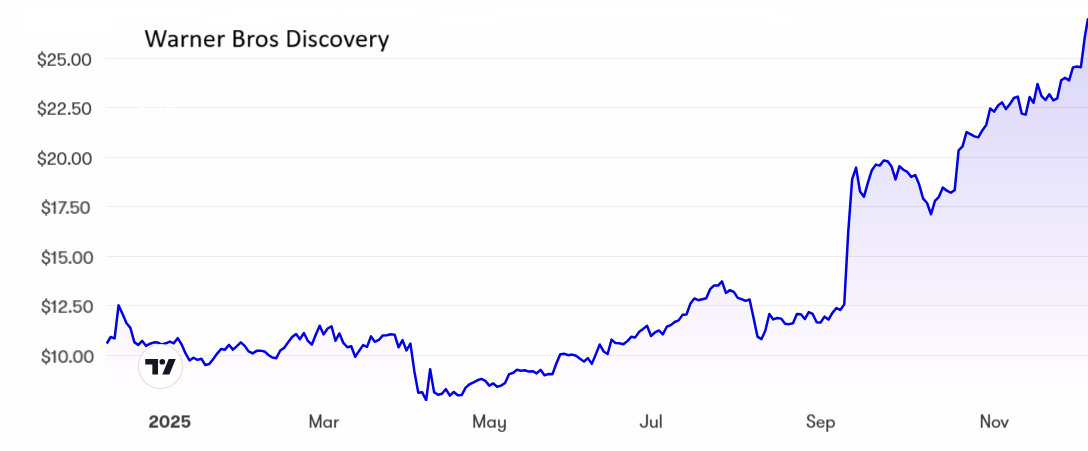
Source: interactive investor. Past performance is not a guide to future performance.
Hobson’s choice: Disney could surprise on the upside next year so just about merits a buy recommendation. At least it will not be going through the upheaval that will disrupt its potential mega-rival and the downside looks limited.
Warner shareholders should hold on. It generally pays to do so while a deal is pending and especially so when there are competing bids. There could yet be a sweetener to get their approval of the Netflix deal. I had recommended selling before the bidding war emerged, but the events of the past few days have changed everything.
Be particularly careful of buying into either of the two bidders. Their shares could fall heavily if they are seen to be overbidding. With that in mind, Netflix would be transformed if it eventually prevails and, despite its lack of a dividend and its hefty rating with a PE above 40, it is worth considering as a buy below $100. It should not fall below $80 at worst. Paramount needs this deal more and may get desperate, especially as it has the financial backing to fund its bravado. It looks to be a sell for now.
Rodney Hobson is a freelance contributor and not a direct employee of interactive investor.
These articles are provided for information purposes only. Occasionally, an opinion about whether to buy or sell a specific investment may be provided by third parties. The content is not intended to be a personal recommendation to buy or sell any financial instrument or product, or to adopt any investment strategy as it is not provided based on an assessment of your investing knowledge and experience, your financial situation or your investment objectives. The value of your investments, and the income derived from them, may go down as well as up. You may not get back all the money that you invest. The investments referred to in this article may not be suitable for all investors, and if in doubt, an investor should seek advice from a qualified investment adviser.
Full performance can be found on the company or index summary page on the interactive investor website. Simply click on the company's or index name highlighted in the article.
Disclosure
We use a combination of fundamental and technical analysis in forming our view as to the valuation and prospects of an investment. Where relevant we have set out those particular matters we think are important in the above article, but further detail can be found here.
Please note that our article on this investment should not be considered to be a regular publication.
Details of all recommendations issued by ii during the previous 12-month period can be found here.
ii adheres to a strict code of conduct. Contributors may hold shares or have other interests in companies included in these portfolios, which could create a conflict of interests. Contributors intending to write about any financial instruments in which they have an interest are required to disclose such interest to ii and in the article itself. ii will at all times consider whether such interest impairs the objectivity of the recommendation.
In addition, individuals involved in the production of investment articles are subject to a personal account dealing restriction, which prevents them from placing a transaction in the specified instrument(s) for a period before and for five working days after such publication. This is to avoid personal interests conflicting with the interests of the recipients of those investment articles.