Stockwatch: can former FTSE 100 share recover after a fall of 99%?
This company’s latest warning came as a huge shock, and investors might be wondering if now is a good time to buy cheap stock. Analyst Edmond Jackson gives his view.
24th November 2026 12:28
by Edmond Jackson from interactive investor

Is this an all-time global record in equities for a company’s share price performance, short of going bust? Having just tested a 60p low, outsourcing services group Capita (LSE:CPI) is down to a £75 million capitalisation having been £8.8 billion in July 2015 and a FTSE 100 company as recently as 2017.
Yesterday, its small-cap shares plunged 75% in response to shock news of its CEO’s immediate departure and a problematic civil service pension scheme contract leading to a big fall in 2027 profit. Consensus previously had looked for about £48 million net profit and adjusted earnings per share (EPS) of 42p.
- Invest with ii: SIPP Account | Stocks & Shares ISA | See all Investment Accounts
The story goes that 2027 will effectively be an interrupted year after 2026 is expected in line with expectations – close to £20 million net profit and EPS near 15p. Capita’s board proclaims, “a material recovery in profitability from 2028 onwards, reflecting stability of the revenue base from total contract value secured in 2026, no material contracts up for renewal in the near term, and the strength of the order book”.
Yet exceptional costs have continued being reported this year, and a strained balance sheet means a circa £190 million equity raise in the first half of 2027, and even bigger dilution than 50% in 2018.
Kissing a toad that continues to croak?
The 30 June balance sheet had only £5.6 million net assets albeit £300 million goodwill and £82.5 million intangibles. It would seem the goodwill can be written off. There is questionable value in “contract fulfilment assets” given that two large contracts have been lost and the UK civil service pension scheme has continued to generate exceptional costs.
Financial liabilities at £363 million and £31 million of leases were mitigated by £266 million cash. The ratio of current assets to current liabilities was, however, a poor 0.53.
Between the US president allegedly intervening in a Sunday board meeting for NVIDIA Corp (NASDAQ:NVDA) and the UK prime minister supposedly gagging to get control of Thames Water, I wonder if the “early 2027 equity raising” is designed (or required) to allow government to sort out the mess if it decides to go ahead, given UK public services constitute 81% of Capita’s revenue.
Recalling over-indebted companies amid early 1990s economic strains, I recall shares in Ashtead Group AHT, now part of Sunbelt Rentals Holdings Inc (LSE:SUNB), and WPP (LSE:WPP) down to single penny status and being written off, but to take a contrarian stance you really do need good reasons.
The chart affirms a sense of ongoing difficulties and no clear indication of where they might stop.
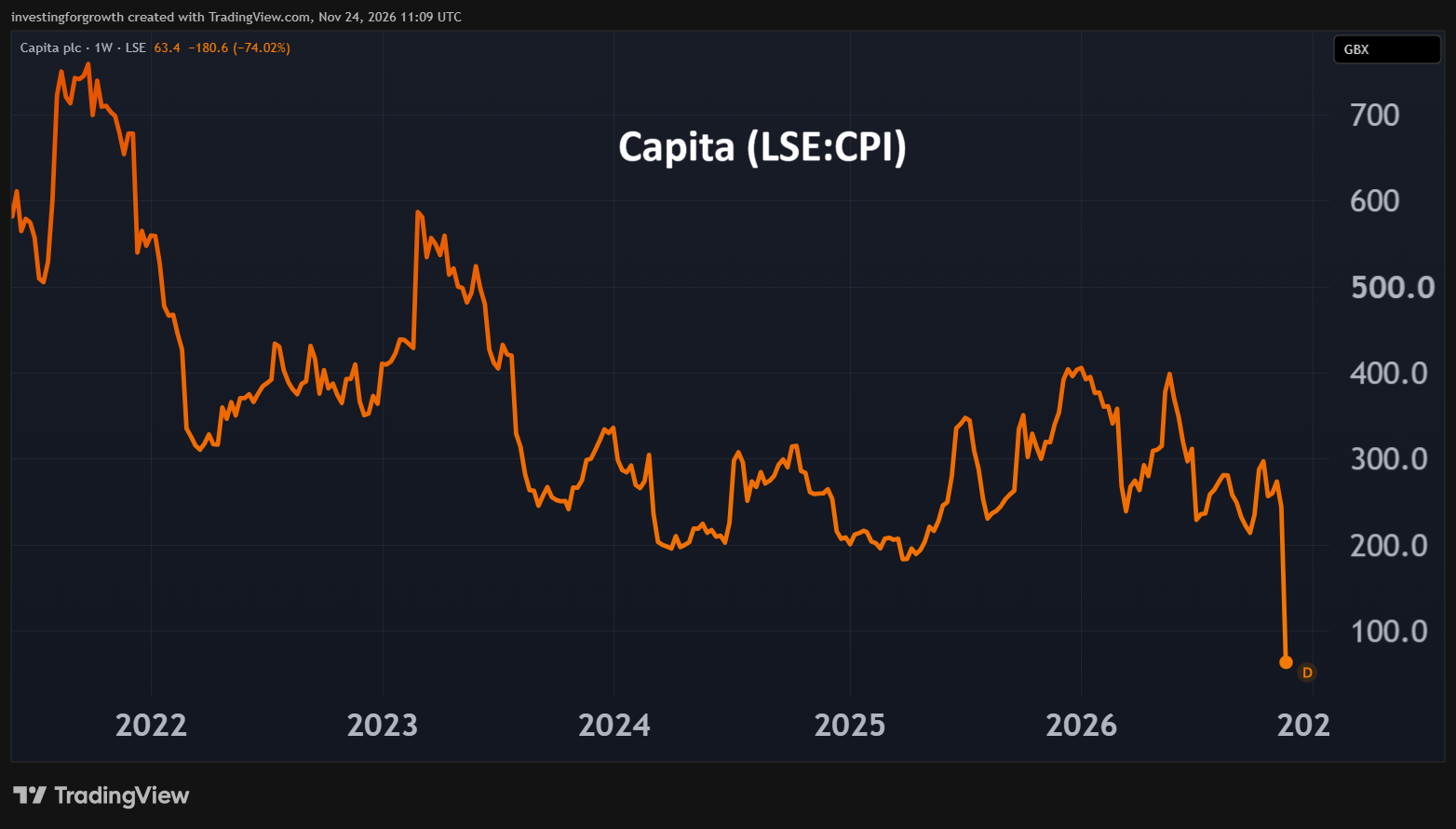
Source: TradingView. Past performance is not a guide to future performance.
Immediate issues are whether the £190 million fundraising will be supported – or if the underwriting fee further cripples Capita – then whether there genuinely is substance for a turnaround. Or, as Warren Buffett would say, it all amounts to kissing a toad that continues to croak.
Capita’s largest shareholder is supportive
Well, it would be, wouldn’t it? Hoping to retrieve much if any value from their 15% holding. Oasis Management, which also has a nominee director on Capita’s board (so much for that offering protection) says it intends to participate in the equity raise “at least in line with its pro-rata entitlement”.
If others can also be convinced, then it improves the odds of getting this over the line. A behavioural question is whether fund managers want to keep or remove this blot on their record as the year-end approaches. Selling probably would be tough, but “special situation” types exist who might pay, say, 40-50p a share to a distressed seller.
- Investing for Christmas: ii Community’s verdict on gifting £500
- eyeQ: a good entry level for a stock with a strong story
- Experts predict another great year for stock markets in 2027
Next is Schroder Investment Management with an 11.2% stake, reduced from 11.9% on 10 September. Yet Harwood Capital, manager of the widely revered Rockwood Strategic Ord (LSE:RKW) investment trust, raised its stake from 5.1% to 7.1% in August and early October.
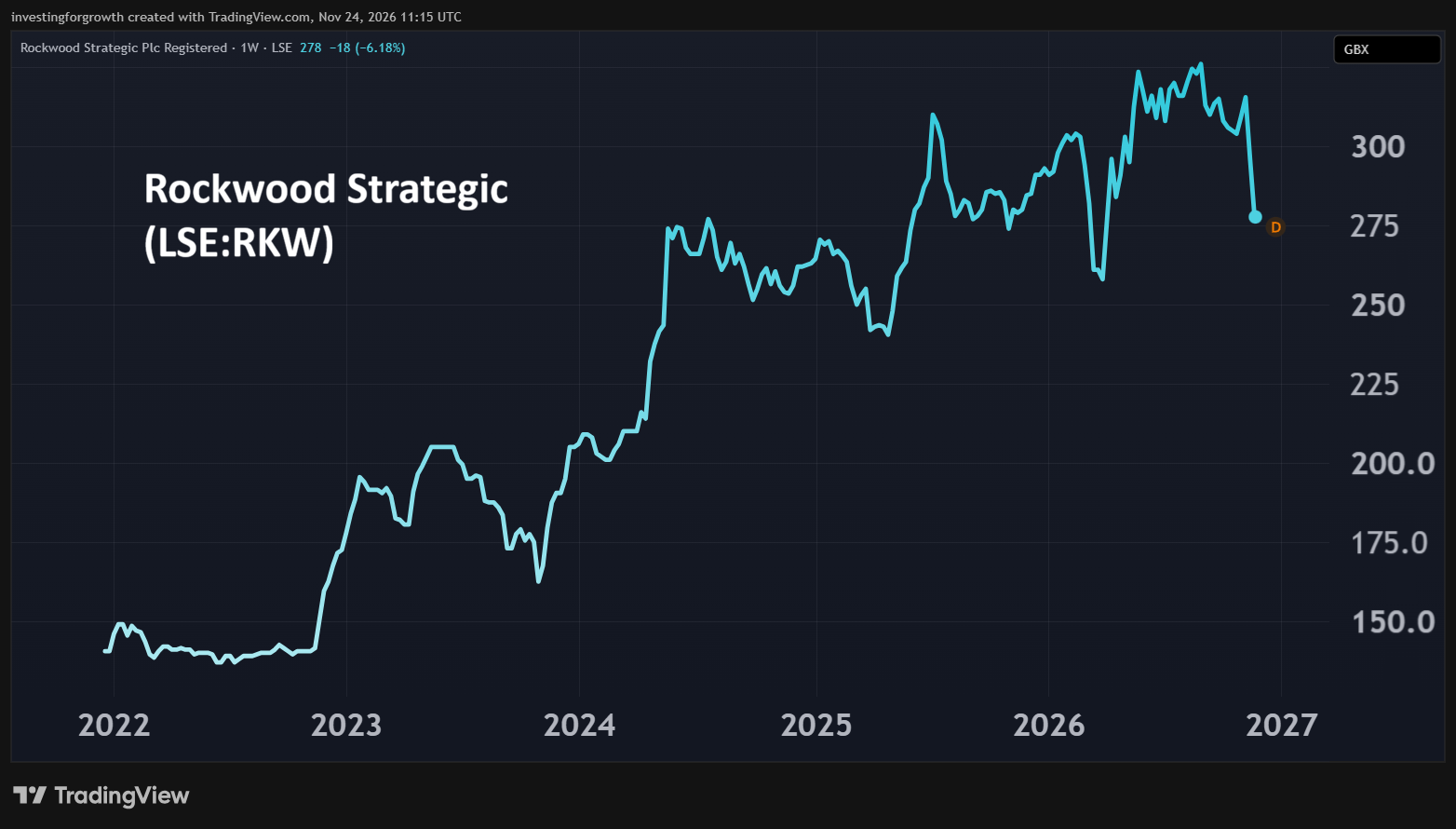
Source: TradingView. Past performance is not a guide to future performance.
Does Rockwood’s buying – with an otherwise good record of picks – improve the odds that Capita has some worthwhile businesses and, chiefly, faces an unexpected crisis? Three of its directors did buy £99,000 worth of shares last May at about 404p, with a fourth adding £8,500 worth at 344p in June.
In September 2025, a “buy” note from Canaccord – albeit the company’s broker – had targeted 900p, “with conservative assumptions”, pointing to strength in AI being able to exact efficiencies and competitive advantage.
Perhaps in hindsight it shows how company brokers are more “sell side” than providing objective analysis. At that time, and when Capita was 325p, I made a comparison of indebted companies preferring Saga (LSE:SAGA) at 277p, which did re-rate to 880p. I was, however ,intrigued by Canaccord proclaiming an inflection point and concluded with a “hold” stance until Capita could further derisk.
- 10 hottest ISA shares, funds and trusts
- Sign up to our free newsletter for investment ideas, latest news and award-winning analysis
Could that finally be happening by way of a refinancing? If that is the case, Capita is at least intriguing to assess ahead of possibly taking a speculative position as and when the equity raise is sorted.
Can culture of persistent exceptional costs finally end?
Not unreasonably, investors like Harwood might have thought this year’s financial reporting involved “kitchen-sinking” from which Capita could move on.
Annual results in March cited a low single-digit per cent revenue reduction according to reported or adjusted figures. But the 2025 operating loss leapt from £10 million to £130 million due to a £74 million goodwill impairment for contact centres plus £56 million of upfront costs as part of a cost-reduction programme that delivered £250 million of annualised cost savings, which remains attractively relevant.
There was, however, additionally £16 million of costs from a cyber incident, and closing businesses in pensions, mortgage servicing and corporate ventures added a further £97 million of costs.
Capita - financial summary
Year-end 31 Dec
| 2019 | 2020 | 2021 | 2022 | 2023 | 2024 | 2025 | |
| Turnover (£ million) | 3,679 | 3,325 | 3,183 | 3,015 | 2,815 | 2,422 | 2,312 |
| Operating profit (£m) | 0.4 | -0.6 | 333 | 87.3 | -54.4 | 175 | -131 |
| Net profit (£m) | -64.2 | 14.0 | 225 | 74.8 | -178 | 76.7 | -164 |
| Operating margin (%) | 0.01 | -0.02 | 10.5 | 2.9 | -1.9 | 7.2 | -5.7 |
| Reported earnings/share (p) | -62.7 | -6.2 | 197 | 65.9 | -159 | 66.1 | -144 |
| Normalised earnings/share (p) | 280 | 199 | 200 | 130 | -21.4 | 50.0 | -165 |
| Operational cashflow/share (p) | -23.8 | 359 | -159 | 63.4 | -36.0 | -21.7 | 4.1 |
| Capital expenditure/share (p) | 165 | 79.2 | 51.7 | 42.2 | 55.0 | 43.2 | 41.9 |
| Free cashflow/share (p) | -189 | 280 | -211 | 21.2 | -90.9 | -64.9 | -37.8 |
| Return on total capital (%) | 0.02 | -0.04 | 29.1 | 8.4 | -6.8 | 22.6 | -22.2 |
| Cash (£m) | 409 | 461 | 318 | 397 | 155 | 254 | 264 |
| Net debt (£m) | 1,431 | 1,143 | 923 | 507 | 566 | 426 | 459 |
| Net assets (£m) | -127 | -134 | 275 | 330 | 113 | 200 | 47.4 |
| Net assets per share (p) | -114 | -121 | 244 | 294 | 99.6 | 176 | 39.5 |
Source: company accounts.
Last year was proclaimed as “a pivotal year for Capita on our transformation to become the first AI-led business process outsourcer”, as if affirming the sense of an inflection point. Total contract value rose an impressive 36% to £2,055 million and the ratio of orders received versus those billed rose from 0.6x to 0.9x, albeit still needing to get over 1.0 to signal an expanding business.
Capita was said to be “a leaner business, focused on delivering scalable and repeatable solutions...in 2026 we will be launching further AI-powered products which will make us more competitive...”
There was the prospect of “good growth in public service and pension solutions, offset by contact-centre challenges,” but the UK civil service pension side has proved a bugbear. Only last month, Capita was criticised by the UK National Audit Office (NAO) for leaving civil servants struggling to access information, with delays to payments forcing changes to retirement plans. A recovery plan has been agreed albeit at additional costs of £15 million to £25 million in 2027.
Annual results were interpreted as including a profit warning given a caution about a small decrease in the adjusted operating margin (which had been expected to rise) due to contact-centre challenges plus higher costs in pensions and public services.
- Insider: FTSE 100 boss trousers £4m from well-timed share sale
- Shares for the future: promotion creates new top 10 stock
- Why buy-and-hold still wins when crash fears strike
Yet guidance was maintained at the August half-year results, anticipating positive free cash flow in 2027. Also, and regarding the civil service pension scheme, [it said] “we are confident we have the right processes, technology and leadership in place...” You get why the CEO is now gone.
The 23 November update cited “additional costs in relation to the civil service pension scheme contract and near-term related headwinds” – to the huge extent of an £85 million to £95 million downgrade to 2027 adjusted operating profit.
Obviously, the refinancing is going to mean exceptional items continue that will be reported in March 2028.
Situation too strained to go looking for new CEO
The chief financial officer is stepping directly into a permanent CEO role rather than as an interim measure, with a financial controller who’s been with Capita since 2001 becoming CFO. This makes practical sense given no outsider is likely to want to leave their assured job right now for the hot potato at Capita.
Events show why investors should be aware of short positions as disclosed by the Financial Conduct Authority (FCA), Capita having been actively shorted. However, the extent of issued share capital involved fell from 14.5% at end-July to 11.8% in mid-October and was 9.25% when last reported on 11 November versus a 276p share price.
I would not make predictions here purely reacting to what has unfolded. As a potential speculative “buy”, the intelligent point for risk/reward would be once the refinancing is complete and the extent of dilution known. In the first half-hour of dealings today, the shares rose 12% to 70p before drifting back, as if yesterday’s shock element is ebbing, and a current “hold” stance is justified.
Edmond Jackson is a freelance contributor and not a direct employee of interactive investor.
These articles are provided for information purposes only. Occasionally, an opinion about whether to buy or sell a specific investment may be provided by third parties. The content is not intended to be a personal recommendation to buy or sell any financial instrument or product, or to adopt any investment strategy as it is not provided based on an assessment of your investing knowledge and experience, your financial situation or your investment objectives. The value of your investments, and the income derived from them, may go down as well as up. You may not get back all the money that you invest. The investments referred to in this article may not be suitable for all investors, and if in doubt, an investor should seek advice from a qualified investment adviser.
Full performance can be found on the company or index summary page on the interactive investor website. Simply click on the company's or index name highlighted in the article.
Disclosure
We use a combination of fundamental and technical analysis in forming our view as to the valuation and prospects of an investment. Where relevant we have set out those particular matters we think are important in the above article, but further detail can be found here.
Please note that our article on this investment should not be considered to be a regular publication.
Details of all recommendations issued by ii during the previous 12-month period can be found here.
ii adheres to a strict code of conduct. Contributors may hold shares or have other interests in companies included in these portfolios, which could create a conflict of interests. Contributors intending to write about any financial instruments in which they have an interest are required to disclose such interest to ii and in the article itself. ii will at all times consider whether such interest impairs the objectivity of the recommendation.
In addition, individuals involved in the production of investment articles are subject to a personal account dealing restriction, which prevents them from placing a transaction in the specified instrument(s) for a period before and for five working days after such publication. This is to avoid personal interests conflicting with the interests of the recipients of those investment articles.