Stockwatch: have equity bulls become complacent?
Stock markets could get lively this week, depending which way the US data goes, believes analyst Edmond Jackson. Here’s what he thinks you should pay attention to.
10th February 2026 11:16
by Edmond Jackson from interactive investor

Volatility has eased lately as US President Donald Trump cooled on tariff threats and his gunboat diplomacy versus Iran is yet to show fire.
Things could still get lively this week if US jobs on Wednesday and Friday’s inflation data surprise.
- Invest with ii: Buy US Stocks & Shares | US Earnings Season | Interactive investor Offers
Why is the data special this time?
January’s jobs report was delayed due to the late 2025 government shutdown, and one measure of private payrolls last week fell short. That is not necessarily a problem, or indication that the US economy is weakening. I believe the greater risk is inflation surprising on the upside chiefly due to the delayed effect of tariffs. Weaker jobs would temper the need for interest rates to either remain at or rise from a current Federal Funds rate of 3.64%.
A robust jobs report followed by higher-than-expected inflation would cause jitters. An ongoing equities bull market assumes inflation eases gradually towards the Federal Reserve’s 2% target, as if this dragon is slain after its post-Covid breakout.
A Goldilocks-type scenario is a reasonably firm jobs report with inflation broadly in line. Expectations are for January to show a gain of about 55,000 jobs after a 50,000 increase in December, and for US consumer price inflation (CPI) to edge lower to 2.5% for January, down from 2.7% reported last December. Core CPI (excluding volatile food and energy) is seen stuck around 2.6%, indicating underlying inflationary pressures above the Fed’s target. Anything over 2.6% would be bearish for equities because inflation raises company costs, constrains consumer spending, and limits scope for lower interest rates.
- Insider: directors pounce after software stock slump
- Shares for the future: reconsidering two rejects
Investors learned last year not to fear doom-mongers who predicted inflationary disaster when the Trump administration ramped up tariff threats. Despite the average effective rate in the US having risen to 17-18%, there is no material inflation showing through yet.
Risk of inflationary upside
A median view would be with respect to a lag-effect, and other factors conflating such as a tighter employment market amid the crackdown on immigration. There’s also current monetary conditions possibly tending towards stimulus, thereby pushing up demand and with it inflation.
US businesses may finally need to raise prices once inventory stockpiled ahead of tariff implementation is depleted. A mitigating factor is if they have taken sufficient actions to shift resources, secure exemptions and reduce imports – as implied by government tariff revenues declining from a November 2025 peak. This affirms the libertarian economics view on how penal taxes are self-defeating, as when wealth taxes drive wealth-creators elsewhere.
Various Federal Reserve regional banks now estimate the monthly job gains needed to keep US unemployment stable plunged from around 150,000 to below 90,000 over 18 months to mid-2025, chiefly due to lower immigration.
- Are high fees chipping away at your investment returns?
- Sign up to our free newsletter for investment ideas, latest news and award-winning analysis
Deportations are liable to result in labour shortages in sectors reliant on migrant labour, such as agriculture, food processing, construction, health and childcare. To sustain these services, wages are liable to rise and push up prices, for example, home healthcare is currently up 10% on an annualised basis.
If Wednesday’s jobs numbers are strong it would point towards wage inflation amid constrained supply, with a medium-term follow-through to wider inflation.
Monetary conditions are also significant for inflation, potentially more so than interest rates. US households appear pretty well set up: debt service costs relative to incomes are near record lows, according to Fed data, and household net worth hit a record high over $180 trillion (£132 trillion) in the third quarter of 2025 on the back of AI-driven stocks and higher home prices. Stock portfolios accounted for a $5.5 trillion rise in this quarter.
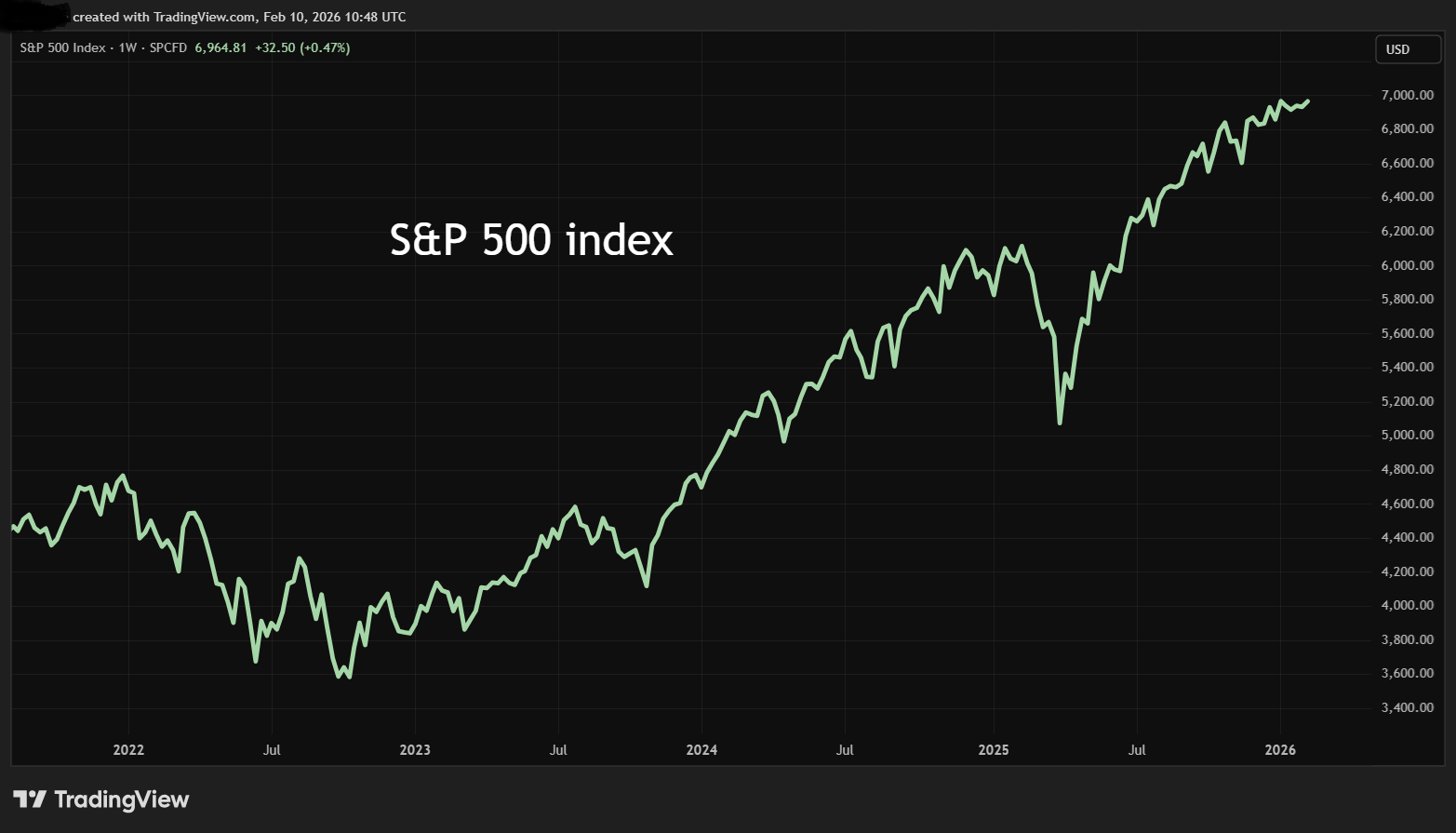
Source: TradingView. Past performance is not a guide to future performance.
Yet the US is split between consumers whose confidence benefits from rising shares and property, and those struggling versus inflation to make ends meet. Overall consumer wealth is up, for as long as equities remain up.
Trump’s One Big Beautiful Bill Act did introduce significant, broad-based tax cuts effective for the 2025 tax year – such as a larger standard deduction and higher child tax credits – which also helped consumers and can be seen as monetary stimulus.
Surely Trump will get his way on interest rates?
President Trump has been serially critical of the Fed’s “failure” to lower rates, and at the end of January, he nominated Kevin Warsh as governor, who has been outspoken in his calls for “regime change” at the central bank.
I respect Warsh in the sense that as a conservative (small “c”) on monetary policy, in late 2010 he clashed with chair Bernard Bernanke over continuing extraordinarily easy monetary policy post the 2008 crisis, as if a hawk on long-term inflation risk.
Recently, however, his stance has been more subtle, as if appealing to Trump in career terms. As a conservative, he has continued to advocate a smaller balance sheet but also lower interest rates. Inherent to investors’ current optimism for US equities is Warsh being more likely to deliver than current chair Jerome Powell’s indifference to Trump. Warsh takes the chair from mid-May.
- Bond Watch: what’s the market impact of Trump’s Fed chair choice?
- 10 hottest ISA shares, funds and trusts: week ended 6 February 2026
Yet the Federal Open Markets Committee will decide policy, and it’s already split over priorities for employment and growth (cut rates) versus checking inflation (hold steady).
It’s unclear whether Warsh’s rhetoric will shift once in the chair, especially if inflation data runs hotter than expected. Markets have a strong track record at forcing the agenda anyway.
Why so relevant for equities?
Growth shares especially, tend to be more sensitive to changes in interest rates given a low-rate environment prizes shares with faster-growing and high returns on capital. If you expect rates to fall, buy growth shares.
Currently, the concern would be that expectations for rate cuts get dashed by inflation, hence the Fed capitulates to hold at around 3.6%. This could prompt some reallocation to higher-yield, lower price/earnings (PE) shares (for what you can find among US equities). Since the US stock market has been very substantially driven by big tech growth plays, it could imply a period of volatile adjustment.
Not to conclude firmly bearish
I say pay attention to these two aspects of US data this week because there is scope for markets to move either way. However, I’m inclined to feel the consensus on inflation and interest rates is complacent.
Bulls can currently take heart how last week the University of Michigan’s consumer sentiment index survey showed a 0.9-point rise to 57.3 in February, marking a third consecutive monthly increase and beating market expectations of 55.
Mind you, sentiment remains around 20% below its January 2025 level, with consumers divided between those enjoying large equity holdings and those who are not. US consumers generally have been subdued amid price rises and a relatively weak labour market.
Edmond Jackson is a freelance contributor and not a direct employee of interactive investor.
These articles are provided for information purposes only. Occasionally, an opinion about whether to buy or sell a specific investment may be provided by third parties. The content is not intended to be a personal recommendation to buy or sell any financial instrument or product, or to adopt any investment strategy as it is not provided based on an assessment of your investing knowledge and experience, your financial situation or your investment objectives. The value of your investments, and the income derived from them, may go down as well as up. You may not get back all the money that you invest. The investments referred to in this article may not be suitable for all investors, and if in doubt, an investor should seek advice from a qualified investment adviser.
Full performance can be found on the company or index summary page on the interactive investor website. Simply click on the company's or index name highlighted in the article.
Disclosure
We use a combination of fundamental and technical analysis in forming our view as to the valuation and prospects of an investment. Where relevant we have set out those particular matters we think are important in the above article, but further detail can be found here.
Please note that our article on this investment should not be considered to be a regular publication.
Details of all recommendations issued by ii during the previous 12-month period can be found here.
ii adheres to a strict code of conduct. Contributors may hold shares or have other interests in companies included in these portfolios, which could create a conflict of interests. Contributors intending to write about any financial instruments in which they have an interest are required to disclose such interest to ii and in the article itself. ii will at all times consider whether such interest impairs the objectivity of the recommendation.
In addition, individuals involved in the production of investment articles are subject to a personal account dealing restriction, which prevents them from placing a transaction in the specified instrument(s) for a period before and for five working days after such publication. This is to avoid personal interests conflicting with the interests of the recipients of those investment articles.