Why this asset class belongs in an income portfolio
The roller-coaster ride of REIT share prices over the past few years contrasts with steady rental growth, argues one Kepler analyst who makes the case for commercial property in a diversified portfolio.
13th March 2026 14:06
by Alan Ray from Kepler Trust Intelligence

This content is provided by Kepler Trust Intelligence, an investment trust focused website for private and professional investors. Kepler Trust Intelligence is a third-party supplier and not part of interactive investor. It is provided for information only and does not constitute a personal recommendation.
Material produced by Kepler Trust Intelligence should be considered a marketing communication, and is not independent research.
“Normal market conditions” is a phrase that is often used but rarely with any real meaning. A bit like that annoying but incredibly useful phrase “it is what it is”, the line can have its uses in conversation when accompanied by a kind of shoulder-shrugging body language, acting as a shortcut for what might otherwise be a much longer discourse. But as a written phrase that seems to hint at a rigorous legal definition, we think it’s much less useful.
To illustrate this, we would start by making the slightly bold claim that the last five or six years in commercial property have been entirely normal. How can we say this, given the wild roller-coaster ride of REIT share prices since 2020?
Well, let’s start by thinking about some of the fundamental characteristics of property as an investment. One of these is that property is an interest-rate-sensitive asset class. This is an asset class that is all about the income, and so when the risk-free rate changes, property values are highly likely to change too.
Further, like almost any other asset class one cares to name, prices can be influenced by supply and demand. The insertion of the word “almost” in that previous sentence is, for the record, a way of covering ourselves, as “supply and demand” seems like a universal truth we can apply to any asset class. Perhaps meme coins are the exception, though.
So, looking at interest rates first. At the start of this decade, interest rates fell to the floor. What happened? Property values went up about 20%, and this happened even though there was a global pandemic that seemed, at the time, to be upending everything we knew. Then, as inflation began to bite, interest rates rose quite rapidly, starting in 2022. What happened? Property valuations promptly fell back down to more or less where they’d started. This seemed painful and protracted at the time, but looking back, the peak to trough took only about two years. At this point, interest rates began to ease, and guess what? In 2024, property values began, ever so slightly, to increase.
Today, it’s hard to find anyone who thinks interest rates are returning to 2020’s levels, but still, they have eased off, and property has responded, with share prices of REITs often back to where they were before 2022. So, the last few years have provided confirmation that property is, indeed, an interest-rate-sensitive asset class. So far, so normal.
UK commercial property peer group share price total return
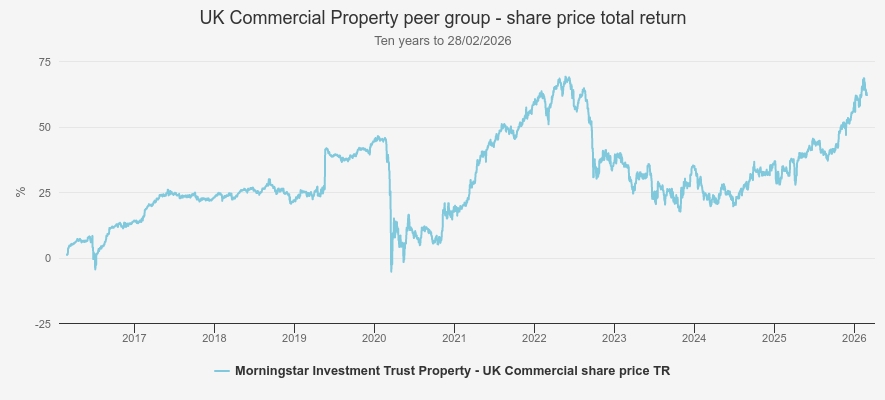
Source: Morningstar. Past performance is not a reliable indicator of future results.
Now let’s think about supply and demand. To simplify things a bit, let’s not drill into every single sector of property but take two examples, starting with the catch-all ‘industrial’, which covers a multitude of uses from, ahem, industrial, all the way through to supply chains and logistics. This is the largest sector in commercial property and tells us a lot about the UK economy. Industrial assets are, essentially, metal boxes with lots of flexible space and which are, ideally, well connected to transport and power infrastructure.
At the start of the decade, supply was relatively tight, but bearable. The UK, in common with many other developed markets, had been gradually rewiring itself around the online economy, and as we know, the online economy needs an awful lot of bricks and mortar logistics to function smoothly, meaning demand for these simple structures grew steadily. This, however, came on the back of a long period of investor indifference, with yields on industrial assets often in double digits, and values well below replacement cost. In other words, it was cheaper to buy a building than to build a new one. New supply was, and still is, also hampered by planning, and because, as is so often the case in property, location matters. Not many developers are willing to take the speculative ‘build them, and they’ll come approach’. So, while demand was, and still is, positive, speculative oversupply has not occurred.
In 2020, that process of rewiring suddenly accelerated as the pandemic took hold. Brits are particularly enthusiastic in their embrace of the online, and demand for ‘industrial’ buildings spiked. And of course, the pandemic shone a light on the fragility of supply chains. Thus, as interest rates fell and the investment case rose, so did values for industrial assets. All the way up to that peak in mid-2022 and then back down again once the rate cycle turned. However, since the trough, this sector has performed well, driven by rental growth. Supply chain fragility was highlighted during the pandemic, but with the world moving from the era of globalisation, it has become more than a passing concern, and many corporates are focused on more robust supply chains. Sadly, at the time of writing, this could not be a more topical issue, with the Strait of Hormuz closed to shipping for reasons we are all too familiar with. Once again, while we struggle to know what ‘normal market conditions’ are, we can expect the property’s response to this to be ‘normal’, with demand continuing for assets in this sector.
Meanwhile, the script for offices was also being rewritten in 2020, and there have been several revisions to the script since. But ultimately, and not really all that surprisingly, the number of people working in offices has recovered. True, working patterns are different, and Mondays and Fridays can be a bit quiet on the trains, but people are still sitting at a desk, drinking two or three cups of indifferent coffee and occasionally even talking to each other. Although many of them aren’t quite sure what that mysterious device called a desk phone is for. The situation is more complex in the office space, and as we’ll come on to look at, some REITs have done well from repurposing offices for retail or even student accommodation, with Picton Property Income Ltd Shs GBP (LSE:PCTN) having some notable successes. This has also helped to keep a lid on speculative development, with much less certainty about what kind of office tenants will want. Overall, offices have also experienced an interest-rate-sensitive valuation cycle, a lack of new supply and the removal of some supply due to repurposing.
Again, while we don’t really know what ‘normal market conditions’ means for the office sector, we do know that, with some supply removed and the discovery that people still work in offices, the right offices in the right locations are still seeing rental growth. So again, behaving as one might expect given the circumstances.
M&A: is this normal?
One of the defining characteristics of the last few years is just how many REITs have undergone some form of M&A. There have been some ‘take privates’ or gradual sales of assets and a return of cash to shareholders, but a characteristic of this cycle has been the number of REITs that have merged. This is notable because a merger doesn’t always provide an immediate uplift in the share price all the way back to net asset value, and neither does it provide a swift exit opportunity. One of the things this tells us is that investors are interested in ‘scale’, and we’ll come to look at that in a moment. But it also tells us a few other things. First, it says that investors have not abandoned property as an asset class. The large discounts that developed in 2022 might have implied otherwise, but the fact that many of the same assets remain listed today, even if the name above the door has changed, says that investors still see a future. Second, it’s yet another demonstration that the sector is behaving normally.
One of the great advantages of the REIT structure, in contrast to open-ended property funds, is that the shares are tradeable. As a seller, one might not like the price at the bottom of the cycle, but at least there is one. And that means that, if prices stay low for a while, M&A activity can start to occur, providing an alternative exit or, at least, a catalyst for discounts to eventually narrow. Third, it tells us that REIT management teams feel confident about property as an asset class. Much of the M&A over the last few years has favoured the internally managed REIT, where management are employees of the company rather than, as many readers will be more familiar, the investment trust style external management. One key difference is that internal management teams are incentivised more by earnings growth and less by assets under management than their external counterparts, so they are less likely to take on a merger if the result is a dilution to earnings.
And so, once again, what we sometimes describe as an ‘extraordinary pace’ of M&A in recent years is, taking a step back, quite a normal and expected response from the REIT sector.
Scale matters
Parking property for a moment, Investment trust sector followers will know that ‘scale’ has become an ever more important factor across the sector, with several mergers, or more accurately ‘combinations’ of investment trusts citing scale as the principal reason for the transaction. While this is often fair enough, we take a slightly cautious view, as consolidation also leads to a lack of choice and competition, and the constituents of many sub-sectors of the investment trust universe are, by number at least, quite small. Like ‘sustainability’, which we will look at further on, in property terms, it’s easier to see why ‘scale’ matters. Across the spectrum of commercial property, individual assets can cost tens or even hundreds of millions of pounds, and to be truly diversified across different types of tenants, sectors and locations, a REIT really needs access to several £bn. There are many REITs that have gone down the sector-specialist route, and this can make a great deal of sense for investors with a strong sense of an individual sector’s characteristics. But the broad diversification that an investor seeking more steady returns and a dependable income might find more desirable, can be much better achieved at scale.
One of the biggest winners from consolidation is LondonMetric Property (LSE:LMP). In the roller coaster of M&A, LMP even, and we promise this is the first and last time we say this, acquired its own rollercoaster through its merger with LXi REIT, owner of Alton Towers. LXi is just one of several REITs that have merged into LMP, and with a market cap of about £4.6 billion and a dividend yield of over 6%, LMP offers enough scale to satisfy even the most demanding investor, while giving LMP the firepower to access assets that a smaller REIT would struggle to buy.
Sustainability also matters
One thing we have learned in the last few years is that, whereas ‘sustainability’ or ‘ESG investing’ more generally can be a polarising topic, property is an area where sustainability’s link to investment returns is less controversial. A more energy-efficient building, for example, is something a tenant might feel more inclined to occupy and pay a higher rent for. Put solar panels on the roof, and again, the building might be more attractive. Those simple industrial metal boxes we mentioned above are particularly good for this and can help shift at least some energy generation close to where it is used.
In recognition of this, Schroder Real Estate Invest Ord (LSE:SREI) adopted an explicit sustainability element to its investment strategy. This is not about simply going out and buying the best, most energy-efficient buildings, but about thoughtful expenditure on upgrades to existing assets. A pattern has developed across SREI’s portfolio where buildings that see efficiency upgrades tend to achieve higher rents, longer lease lengths and better-quality tenants. SREI has also long followed a higher yield strategy, and its current yield of 7%, on a covered dividend and plenty of reversionary potential, looks very attractive.
The one-stop shop
TR Property Ord (LSE:TRY) is unique in the investment trust sector in offering investors a readymade portfolio of property shares and REITs from across the UK and Europe. Thus, while TRY itself has tended to maintain quite a narrow discount over the past few years, its underlying portfolio of REITs has seen the full effect of discounts widening, then narrowing, and TRY has benefitted on several occasions from M&A activity both in the UK and Europe.
TRY’s UK exposure covers the large sectors of industrial, offices and retail, but also takes in more specialist niches such as hotels or student accommodation. European exposure generally favours the larger European economies and prime markets such as Paris and Berlin. Although many of the same growth drivers exist, e.g. industrial, logistics, and retail warehouses, the pan-European approach gives investors exposure to niches that a UK-only focus would not. For example, German residential property is much more institutionalised than in the UK, and some of the largest-listed REITs own vast portfolios of German residential assets. This highly regulated market lends itself to higher levels of gearing, making it quite interest-rate sensitive. After a few years of higher interest rates, it’s easy to focus on the negative aspects, but as rates fall, the reverse is true, and gearing can play a very positive role.
Proving the point that property income has grown over the very difficult period property went through, TRY’s own dividend yield has grown steadily and is now c. 5%. TRY’s approach should be considered more ‘total return’ than a REIT, which owns physical property, but nevertheless, 5% is a significant premium to UK equities and beats most UK equity income trusts.
Situation normal?
While it’s very difficult to define what ‘normal market conditions’ are, it’s much easier to know when they aren’t normal. At the time of writing, it is clear, and rather sad, that this is where we are today. REIT share prices, like all other equities, are falling as investors move into ‘risk off’ mode and try to grapple with what a war in Iran means for the global economy.
But listed property’s significant shake-up over the last few years has masked the fact that, on the ground, much of the work of property fund managers has been business as usual. Yes, M&A has dominated the headlines, yes, some sectors have faced a more uncertain future, but a lack of speculative development, hampered by higher borrowing costs, combined with the reshaping of the UK and global economy, has helped drive strong demand and rental growth for the right assets.
REIT share prices are, just like any other equity, susceptible to big macro changes, but over the longer term, rental growth is what matters most for property investing. Behind all of the noise generated by market conditions since 2020, REIT share prices have returned to more or less where they started, but often with higher dividends. The structural drivers behind that remain in place, and what does remain normal is that, over the long-term, REITs can play an important role in a diversified income portfolio.
Kepler Partners is a third-party supplier and not part of interactive investor. Neither Kepler Partners or interactive investor will be responsible for any losses that may be incurred as a result of a trading idea.
These articles are provided for information purposes only. Occasionally, an opinion about whether to buy or sell a specific investment may be provided by third parties. The content is not intended to be a personal recommendation to buy or sell any financial instrument or product, or to adopt any investment strategy as it is not provided based on an assessment of your investing knowledge and experience, your financial situation or your investment objectives. The value of your investments, and the income derived from them, may go down as well as up. You may not get back all the money that you invest. The investments referred to in this article may not be suitable for all investors, and if in doubt, an investor should seek advice from a qualified investment adviser.
Full performance can be found on the company or index summary page on the interactive investor website. Simply click on the company's or index name highlighted in the article.
Important Information
Kepler Partners is not authorised to make recommendations to Retail Clients. This report is based on factual information only, and is solely for information purposes only and any views contained in it must not be construed as investment or tax advice or a recommendation to buy, sell or take any action in relation to any investment.
This report has been issued by Kepler Partners LLP solely for information purposes only and the views contained in it must not be construed as investment or tax advice or a recommendation to buy, sell or take any action in relation to any investment. If you are unclear about any of the information on this website or its suitability for you, please contact your financial or tax adviser, or an independent financial or tax adviser before making any investment or financial decisions.
The information provided on this website is not intended for distribution to, or use by, any person or entity in any jurisdiction or country where such distribution or use would be contrary to law or regulation or which would subject Kepler Partners LLP to any registration requirement within such jurisdiction or country. Persons who access this information are required to inform themselves and to comply with any such restrictions. In particular, this website is exclusively for non-US Persons. The information in this website is not for distribution to and does not constitute an offer to sell or the solicitation of any offer to buy any securities in the United States of America to or for the benefit of US Persons.
This is a marketing document, should be considered non-independent research and is subject to the rules in COBS 12.3 relating to such research. It has not been prepared in accordance with legal requirements designed to promote the independence of investment research.
No representation or warranty, express or implied, is given by any person as to the accuracy or completeness of the information and no responsibility or liability is accepted for the accuracy or sufficiency of any of the information, for any errors, omissions or misstatements, negligent or otherwise. Any views and opinions, whilst given in good faith, are subject to change without notice.
This is not an official confirmation of terms and is not to be taken as advice to take any action in relation to any investment mentioned herein. Any prices or quotations contained herein are indicative only.
Kepler Partners LLP (including its partners, employees and representatives) or a connected person may have positions in or options on the securities detailed in this report, and may buy, sell or offer to purchase or sell such securities from time to time, but will at all times be subject to restrictions imposed by the firm's internal rules. A copy of the firm's conflict of interest policy is available on request.
Past performance is not necessarily a guide to the future. The value of investments can fall as well as rise and you may get back less than you invested when you decide to sell your investments. It is strongly recommended that Independent financial advice should be taken before entering into any financial transaction.
PLEASE SEE ALSO OUR TERMS AND CONDITIONS
Kepler Partners LLP is a limited liability partnership registered in England and Wales at 9/10 Savile Row, London W1S 3PF with registered number OC334771.
Kepler Partners LLP is authorised and regulated by the Financial Conduct Authority.