Why gold investors have fallen out of bed
Saltydog Investor looks at the challenges facing some of 2025’s top-performing funds.
24th March 2026 08:38
by Douglas Chadwick from ii contributor
This content is provided by Saltydog Investor. It is a third-party supplier and not part of interactive investor. It is provided for information only and does not constitute a personal recommendation.
In times of increased geopolitical uncertainty, it is not unusual for investors to turn to gold as a safe haven. This has been one of the driving forces behind its spectacular growth over the last couple of years.
- Invest with ii: Open an ISA | Top ISA Funds | Transfer an ISA to ii
It first broke through $3,000 an ounce in March 2025, triggered by US President Donald Trump’s aggressive and unpredictable tariff policies. Investors were concerned about disrupted supply chains and the effect on corporate profits and overall global growth. At the same time, central banks, especially in emerging markets, were buying gold to reduce their dependency on the dollar and US Treasuries.
The conflict in Ukraine had just entered its third year, with no signs of an imminent resolution, and Israel and Hamas remained at war. Gold continued to climb throughout 2025 and reached an all-time high above $5,500 an ounce in January 2026.
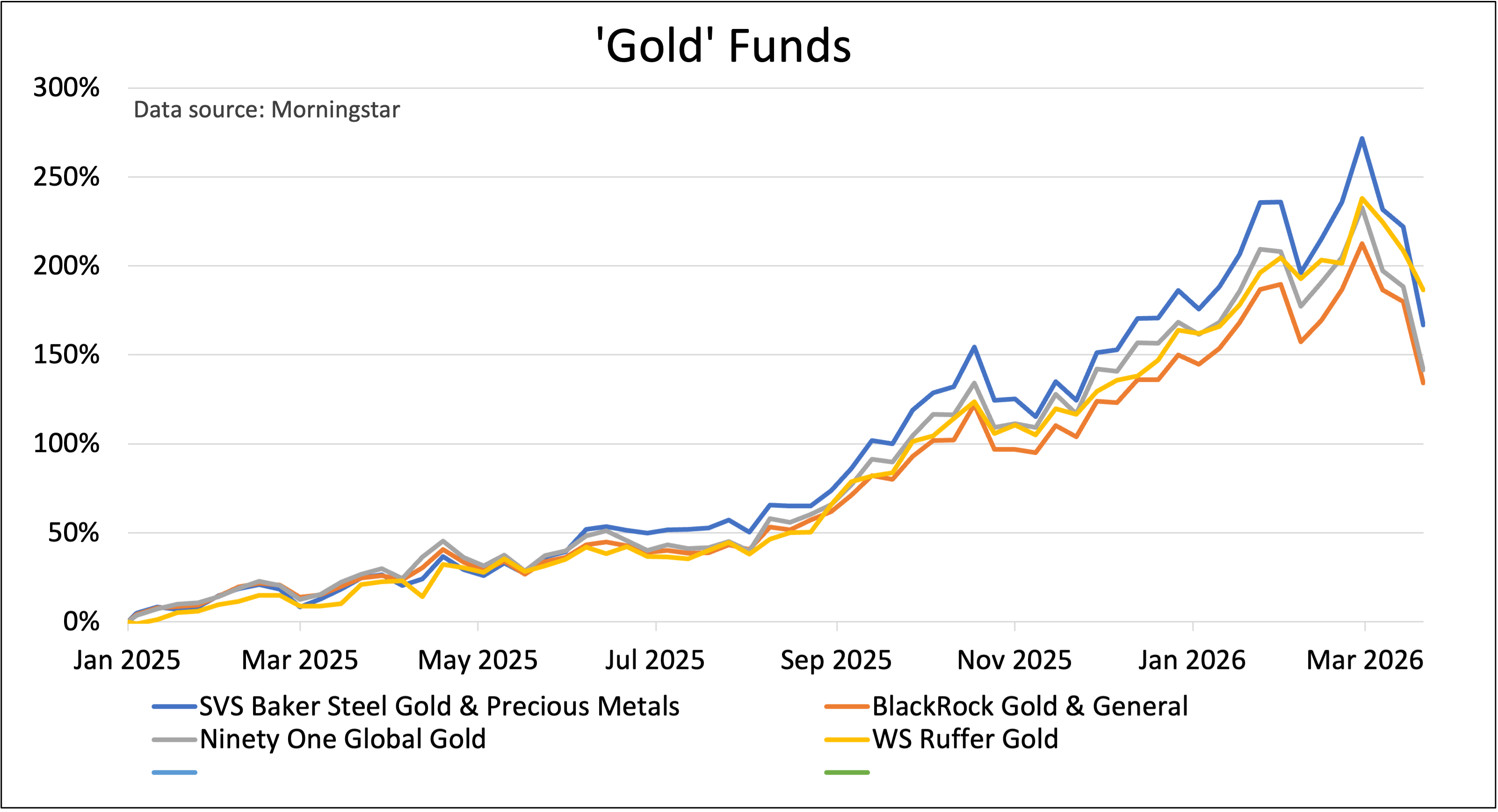
When the gold price rises, companies involved in mining and processing can do even better. This was reflected in the performance of funds such as SVS Baker Steel Gold & Precious Metals B Acc, WS Ruffer Gold C Acc, Ninety One Global Gold I Acc £, and BlackRock Gold and General D Acc, which topped our performance tables in 2025.
Historically, gold has tended to benefit from tensions in the Middle East. This has been the case during previous escalations between Israel and Iran, as well as the wars in Iraq, Libya and Yemen.
- Mining Insights: four small-cap gold stocks
- Sign up to our free newsletter for investment ideas, latest news and award-winning analysis
However, since the recent US–Israeli strikes on Iran, the price of gold has fallen significantly, dropping below $4,300 – a decline of over 20%. This has filtered through to the “gold” funds, which were the worst-performing funds last week.
Past performance is not a guide to future performance.
There are several possible reasons for this sudden reversal. After such a strong run, much of the bad news may already have been priced in. When conflict actually erupted, investors may have taken profits – the classic “buy the rumour, sell the news” response.
With gold looking expensive, the dollar may have appeared a more attractive safe haven. The dollar has strengthened and, alongside rising Treasury yields, this makes gold, as a non-income-producing asset, less appealing.
Disruption to oil supply has pushed up the price of oil, so some safe-haven flows may have been diverted into energy rather than gold. If oil prices remain elevated, that will add to inflation. While gold can act as a long-term hedge, oil may be a more direct short-term beneficiary.
There is also the possibility that, with equity markets falling, traders have sold gold to raise cash or meet margin calls. This is something we saw during the market sell-off in early 2020, at the start of the Covid-19 pandemic.
Gold funds face an additional challenge. The companies they invest in often rely on borrowing to develop and expand mines. If interest rates remain higher for longer, that will weigh on future profitability.
Whatever the reason, the recent fall has been sharp. We will now be watching closely to see whether this is a temporary correction or the start of a more sustained decline.
For more information about Saltydog, or to take the two-month free trial, go to www.saltydoginvestor.com
These articles are provided for information purposes only. Occasionally, an opinion about whether to buy or sell a specific investment may be provided by third parties. The content is not intended to be a personal recommendation to buy or sell any financial instrument or product, or to adopt any investment strategy as it is not provided based on an assessment of your investing knowledge and experience, your financial situation or your investment objectives. The value of your investments, and the income derived from them, may go down as well as up. You may not get back all the money that you invest. The investments referred to in this article may not be suitable for all investors, and if in doubt, an investor should seek advice from a qualified investment adviser.
Full performance can be found on the company or index summary page on the interactive investor website. Simply click on the company's or index name highlighted in the article.