Don’t write off gold after tip to hit $6,000 in 2026
Precious metals prices have come off the boil since the Iran war began, but one City analyst believes another rally is likely this year. Graeme Evans explains.
17th March 2026 15:16
by Graeme Evans from interactive investor
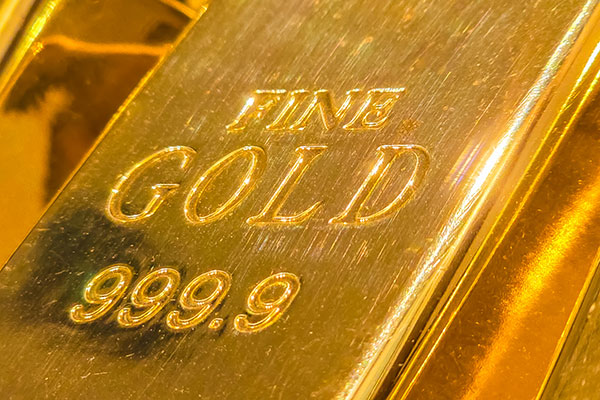
Gold’s diminished safe haven appeal since the start of the Middle East conflict has been countered by a City bank’s forecast that the price could still top $6,000 this year.
The non-yielding asset has reversed from January’s record above $5,400 an ounce to near $5,000 by this afternoon as investors have priced in expectations for interest rates to stay higher for longer. Silver has been on a similar run to trade at a one-month low.
- Learn with ii: How to become an ISA millionaire | ISA Investment Ideas | Top ISA Funds
However, UBS Global Wealth Management believes there are still reasons to hold a positive view on gold and that the yellow metal remains an effective portfolio diversifier. It maintains its estimate that the gold price should rise towards $5,900 and $6,200 an ounce this year.
Such a level would provide support for the likes of Hochschild Mining (LSE:HOC), Pan African Resources (LSE:PAF) and Endeavour Mining (LSE:EDV), having come under selling pressure since the start of the war.
They were previously beneficiaries as a combination of geopolitical risk, higher government debts and persistent inflation helped to lift the gold price by more than 60% in 2025.
UBS said gold’s recent fall back mirrored its historical behaviour during similar events, where investors seek liquidity and consider alternatives such as energy assets.
It notes that gold jumped 15% after the start of the Russia-Ukraine conflict in 2022, but then declined by 15-18% as the Federal Reserve raised rates. The same happened during the Gulf War and Iraq War as prices rose 17% and 19% respectively before decreasing.
- Mining Insights: global trends in critical metals
- What would a longer war in the Middle East mean for investors?
- Stockwatch: have directors bagged a FTSE 100 bargain?
UBS pointed out that gold is more of a hedge against the wider impact of conflicts, rather than direct wartime threats.
Gold primarily insulates against monetary risks like currency devaluation, rising deficits and economic slowdowns, which can result from geopolitical conflicts.
The bank said: “In the short term, higher energy prices and inflation worries have led to a stronger US dollar and concerns over potential rate hikes - both are negative for gold prices.
“But we expect central banks to be watchful of inflation risks without making knee-jerk policy rate hikes.
“In addition, the longer the US-Iran conflict goes on, the higher the risk of negative economic impacts, which should support hedging demand for gold.”
UBS adds that underlying demand remains robust, supported by continued central bank purchases and interest in gold jewellery amid higher incomes in Asia.
- Best-performing funds and sectors since ISA launch in April 1999
- Sign up to our free newsletter for investment ideas, latest news and award-winning analysis
It also highlights the underpin of structural trends such as elevated government debt as well as central banks' and global investors’ efforts to diversify away from the US dollar.
The bank concludes: “Given the macroeconomic and political uncertainties beyond the risks arising from the US-Iran conflict, we continue to hold a positive view on gold and believe that the yellow metal remains an effective portfolio diversifier.”
These articles are provided for information purposes only. Occasionally, an opinion about whether to buy or sell a specific investment may be provided by third parties. The content is not intended to be a personal recommendation to buy or sell any financial instrument or product, or to adopt any investment strategy as it is not provided based on an assessment of your investing knowledge and experience, your financial situation or your investment objectives. The value of your investments, and the income derived from them, may go down as well as up. You may not get back all the money that you invest. The investments referred to in this article may not be suitable for all investors, and if in doubt, an investor should seek advice from a qualified investment adviser.
Full performance can be found on the company or index summary page on the interactive investor website. Simply click on the company's or index name highlighted in the article.