Why investors are returning to India
Overseas investors have already pumped more into Indian equities during November than in any previous before. Saltydog Investor investigates.
23rd November 2026 13:35
by Douglas Chadwick from ii contributor

This content is provided by Saltydog Investor. It is a third-party supplier and not part of interactive investor. It is provided for information only and does not constitute a personal recommendation.
November is proving to be a difficult month for fund investors. At Saltydog Investor, we monitor the performance of thousands of investment funds, and our latest figures show that 85% are currently showing losses for the month.
However, there is one part of the world that has been bucking the trend.
Why investors are returning to India
Our latest Investment Association sector figures show that India/Indian Subcontinent gained 3.8% last week, taking its November return to an impressive 14.2%. At the other end of the spectrum, Technology & Technology Innovation is down 9.1% for the month, while Asia Pacific Excluding Japan has fallen by 6.5% and Global Emerging Markets by 5.8%.
- Our Services: SIPP Account | Stocks & Shares ISA | See all Investment Accounts
The contrast is particularly striking when we look at individual funds.
So far this month, the five best-performing funds in our latest analysis all invest in India. Stewart Inv Indian Sbctnt AllCap B GBP (B1FXTG9) leads the way with a gain of 15.1%, followed by Jupiter India I Acc (B4TZHH9), up 14.8%. GS India Equity R Inc GBP (B99B9F4) has risen 14.1%, Pictet-Indian Equities I GBP (B96TPQ4) 13.7%, and Liontrust India C Acc GBP (B1L6DV5) 11.5%.
The next fund in our rankings, HSBC GIF Turkey Equity BCGBP (B8SFMH3), is some way behind, having gained 5.9%.
The following table shows how the five leading Indian funds performed last week, their November returns and their performance since the beginning of the year.
| Fund | Last week | Nov MTD | 2026 YTD |
| Stewart Inv Indian Sbctnt AllCap B GBP (B1FXTG9) | 4.1% | 15.1% | −1.1% |
| Jupiter India I Acc (B4TZHH9) | 4.6% | 14.8% | −1.7% |
| GS India Equity R Inc GBP (B99B9F4) | 4.1% | 14.1% | 3.5% |
| Pictet-Indian Equities I GBP (B96TPQ4) | 3.3% | 13.7% | −1.3% |
| Liontrust India C Acc GBP (B1L6DV5) | 2.2% | 11.5% | −1.3% |
Data source: Morningstar. Past performance is not a guide to future performance.
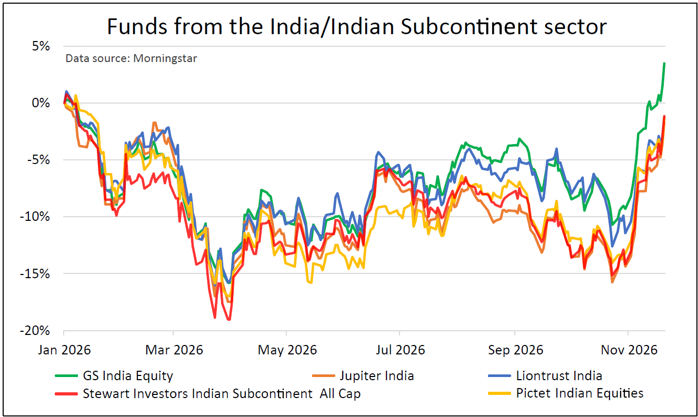
All five continued to make headway last week, despite the widespread falls elsewhere. However, although their November gains have been impressive, the longer-term picture is rather different. The following graph shows how these five funds have performed since the beginning of the year.
Past performance is not a guide to future performance.
All five suffered substantial falls during the first quarter, with their year-to-date losses reaching approximately 16% to 19% at their lowest points.
They recovered some ground during the spring and summer but came under renewed pressure in September and October. November's rally has transformed their recent performance, although four of the five funds are still showing losses for 2026.
The recent gains therefore represent a dramatic recovery after a period of disappointing performance. So, what has changed?
One possible explanation lies in the composition of India's stock market and the investment trends that have dominated global markets over the last couple of years. Artificial intelligence has attracted enormous amounts of investment, particularly into companies developing AI technology, manufacturing advanced semiconductors and supplying equipment to data centres. The enthusiasm has extended well beyond the United States. Taiwan is home to TSMC, one of the world's most important semiconductor manufacturers, while South Korea has Samsung Electronics and SK Hynix. Japan also has significant exposure to companies supplying equipment and materials used in semiconductor production.
India is different. Although it has a substantial technology industry, companies such as Infosys, Tata Consultancy Services and HCL Technologies concentrate primarily on IT services, software development and outsourcing rather than semiconductor manufacturing. Its stock market also has significant exposure to banking, financial services, consumer businesses, healthcare and industrial companies.
- Investment trusts on big discounts: which are bargains?
- Ian Cowie: are income investors missing a trick?
During the AI boom, this difference was not necessarily an advantage. Investors looking for direct exposure to the rapid expansion of AI infrastructure tended to favour markets with large semiconductor industries. More recently, however, concerns have been growing about the enormous sums being invested in AI and how quickly that expenditure will generate adequate financial returns.
Technology shares have consequently come under pressure, and the effects have extended beyond funds in the Technology & Technology Innovation sector. Many global and regional funds have substantial exposure to large technology companies. India's relatively limited exposure to semiconductor manufacturing may now be working in its favour, helping to explain why it has performed so differently from some of its Asian neighbours.
There is another reason why the change in sentiment towards India is particularly interesting. For much of the last two years, international investors had been withdrawing money from the country. According to India's securities regulator, the Securities and Exchange Board of India (SEBI), foreign investors withdrew more than $62 billion from Indian equities between October 2024 and October 2026. Indian shares were considered relatively expensive, while markets with greater exposure to the AI boom were attracting substantial international investment.
However, November has seen a remarkable reversal. By 20 November, overseas investors had put approximately $12 billion into Indian equities, making it the largest monthly inflow on record, with more than a week of November still remaining. After such prolonged selling, many international investment managers were holding less in India than their benchmark allocations would suggest. As they reassess the attractions of different markets, even a partial reversal of those earlier decisions could generate considerable demand for Indian shares.
The renewed foreign interest has also been accompanied by a stronger Indian currency, recently reaching its highest level against the US dollar for around seven months.
There are also signs that the underlying outlook for Indian businesses has been improving. According to research from Indian financial services group Motilal Oswal, aggregate profits among companies in the Nifty 50 index grew by 27% during the September quarter, compared with the same period last year. That was the strongest increase in more than four years, with financial services, metals, oil and gas, and automotive companies contributing to the improvement.
Banks and financial services companies have been particularly prominent in the recent stock market recovery. The Nifty Bank index reached record levels last week, reflecting the strength of some of the country's largest financial institutions. These businesses are important components of India's stock market and are among the most liquid shares available to international investors. Their recent performance suggests that the rally may reflect growing confidence in India's domestic economy, rather than simply a move away from technology companies.
- Why buy-and-hold still wins when crash fears strike
- Sign up to our free newsletter for investment ideas, latest news and award-winning analysis
Falling oil prices will also be providing support. India imports most of the oil it consumes, so lower prices can reduce its import bill, ease inflationary pressures and improve the outlook for businesses and consumers. Cheaper oil can also reduce demand for dollars to pay for energy imports, potentially providing further support for the rupee. Combined with stronger corporate earnings and renewed foreign investment, this could create a more favourable environment for Indian equities.
There have also been some potentially helpful political and regulatory developments. India's securities regulator has proposed simplifying certain requirements for foreign investors, while reports have suggested possible changes to the taxation of capital gains. Meanwhile, negotiations over a trade agreement with the United States have continued. Although these developments may be encouraging investors to reconsider India, several proposals remain subject to approval, and their eventual impact is uncertain.
India's recent performance is a reminder of how quickly investment trends can change. For much of 2026, Indian funds struggled to make headway, but November has seen a remarkable turnaround. Whether this marks the beginning of a more sustained recovery remains to be seen.
At Saltydog Investor, we monitor these changes in fund and sector performance to identify where investors are making gains and where conditions are becoming more difficult. Right now, India is standing out from the crowd.
For more information about Saltydog, or to take the two-month free trial, go to www.saltydoginvestor.com
These articles are provided for information purposes only. Occasionally, an opinion about whether to buy or sell a specific investment may be provided by third parties. The content is not intended to be a personal recommendation to buy or sell any financial instrument or product, or to adopt any investment strategy as it is not provided based on an assessment of your investing knowledge and experience, your financial situation or your investment objectives. The value of your investments, and the income derived from them, may go down as well as up. You may not get back all the money that you invest. The investments referred to in this article may not be suitable for all investors, and if in doubt, an investor should seek advice from a qualified investment adviser.
Full performance can be found on the company or index summary page on the interactive investor website. Simply click on the company's or index name highlighted in the article.