Why Wall Street stock slump could be over
One leading analyst believes there’s growing evidence the S&P 500 correction is getting closer to its ending stages. City writer Graeme Evans explains why.
31st March 2026 13:39
by Graeme Evans from interactive investor

A trader on the floor of the New York Stock Exchange (NYSE) on Wall Street. Photo: ANGELA WEISS/AFP via Getty Images.
A correction for the S&P 500 index that has included a slump for NVIDIA Corp (NASDAQ:NVDA) to its lowest valuation multiple in seven years is showing signs of nearing its end stages, a Wall Street bank has said.
Morgan Stanley’s chief equity strategist notes the S&P’s forward price/earnings (PE) ratio has compressed by 17% since US risk appetite was derailed by the war and artificial intelligence (AI) disruption fears.
- Invest with ii: What is a Managed ISA? | Open a Managed ISA | Transfer an ISA
More than half the wider Russell 3000 index is also down at least 20% from 52-week highs, offering a further sign that the equity market is far from complacent on growth risks.
The bank points out that the decline in the S&P 500 multiple is now at a level similar to previous growth scares where there has been no recession or Federal Reserve interest rate hikes.
Morgan Stanley also highlights key differences between today and other periods when an oil shock ended the business cycle.
The biggest is that earnings per share is accelerating and positive today, compared with negative performances in other periods.
And while oil prices are on course for a record monthly rise in March, the year-on-year move is still about half what it was in previous episodes.
The S&P 500 index has fallen for five consecutive weeks for the first time since 2022, which was the last time the global economy faced a stagflationry shock.
- Stockwatch: is this a special situation amid the macro chaos?
- Artemis Global Income interview: buying some portfolio insurance and bucking trend on US and AI
- Four tips for ISA investors to navigate stock market volatility
The benchmark closed last night within one percentage point of technical correction territory, having fallen 9.1% from January’s record. The benchmark is down by 7.2% so far in 2026, which compares with a rise of more than 2% for the FTSE 100 index.
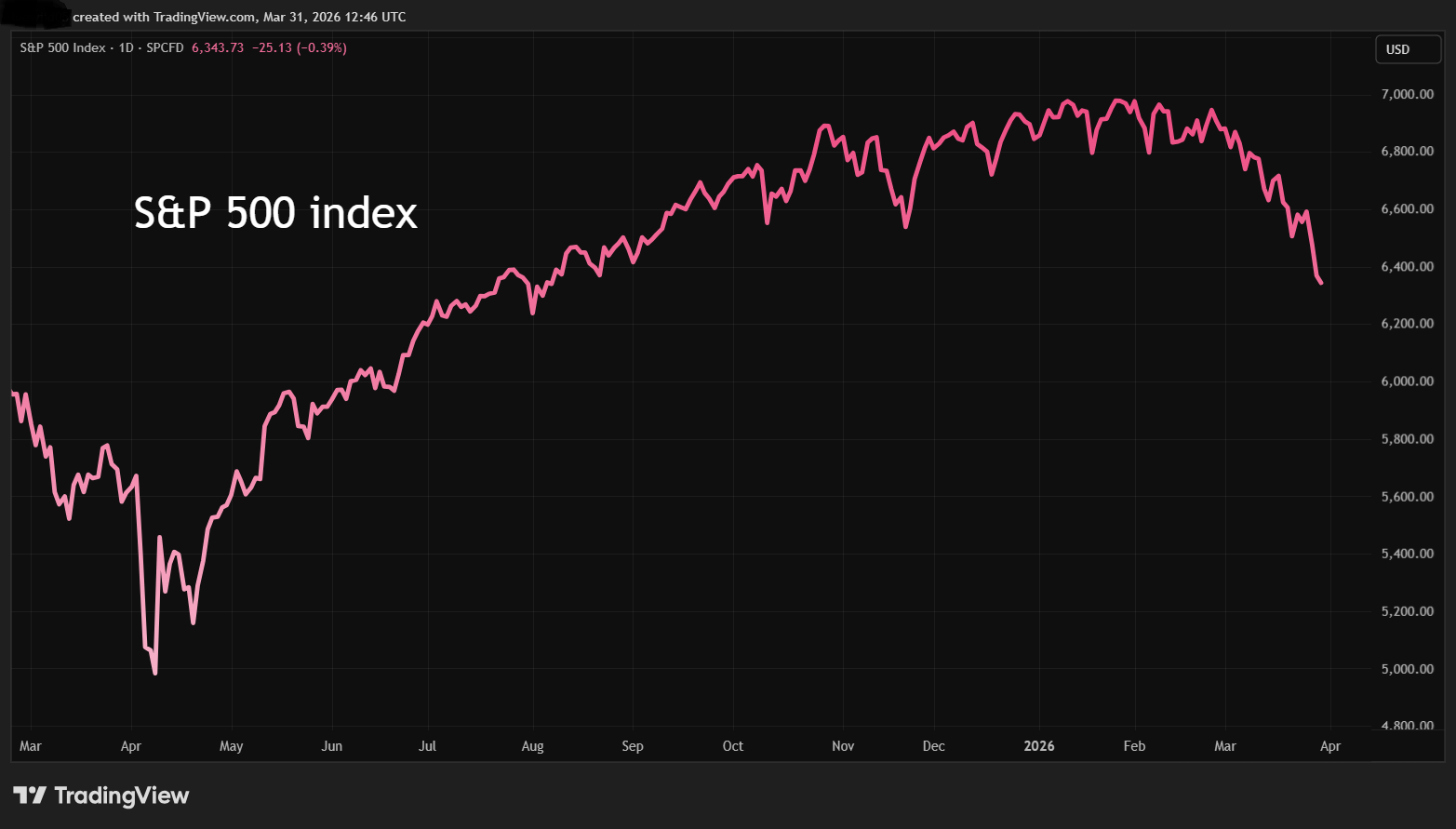
Source: TradingView. Past performance is not a guide to future performance.
Most S&P 500 stocks actually closed higher last night after bond yields fell on Federal Reserve chair Jerome Powell’s assessment that inflation expectations were “well anchored beyond the short term”. The comment helped ease fears of a near-term interest rate hike.
Semiconductor-related stocks were behind last night’s reverse for the S&P 500 index, including Nvidia as the shares lost another 1.4% to stand 11% cheaper in 2026 and about 20% lower than in October.
As well as inflation fears caused by the Iran war, the sell-off has reflected worries that it will take longer for AI infrastructure spending to translate into higher revenues and earnings.
Nvidia now trades at about 19.6 times its expected 12-month earnings, which Reuters pointed out this week is the lowest multiple since 2019. Microsoft Corp (NASDAQ:MSFT) has come down to 20 times from 35 in August last year, the report added.
Nvidia’s multiple is now below the overall forward PE multiple of the wider S&P 500 index, which according to FactSet last week equalled the benchmark’s five-year average at 19.9 times compared with 22 times at the end of December.
- eyeQ: macro clouds gather over this AI toolmaker
- Sign up to our free newsletter for investment ideas, latest news and award-winning analysis
- eyeQ: JD Sports, Legal & General, US banks, BP
The financial data business said it expects S&P 500 first-quarter earnings growth of 13%, which if achieved would represent a double-digit improvement for a sixth straight quarter. It is below the five-year average rate of 15.9% but better than the 10-year 9.9%.
Nine of the 11 sectors are expected to report year-over-year earnings growth, led by the information technology, materials and financials sectors.
These articles are provided for information purposes only. Occasionally, an opinion about whether to buy or sell a specific investment may be provided by third parties. The content is not intended to be a personal recommendation to buy or sell any financial instrument or product, or to adopt any investment strategy as it is not provided based on an assessment of your investing knowledge and experience, your financial situation or your investment objectives. The value of your investments, and the income derived from them, may go down as well as up. You may not get back all the money that you invest. The investments referred to in this article may not be suitable for all investors, and if in doubt, an investor should seek advice from a qualified investment adviser.
Full performance can be found on the company or index summary page on the interactive investor website. Simply click on the company's or index name highlighted in the article.