Investors give verdict on Babcock results
Despite already preparing investors for bad news, there is not enough in these annual results to prevent another negative reaction. ii's head of markets runs through the numbers.
22nd June 2026 08:38
by Richard Hunter from interactive investor
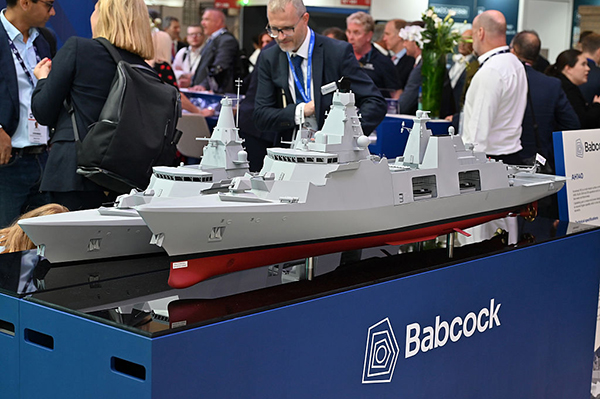
A model of a AH140 Arrowhead 140 frigate at the Babcock exhibition stand during the Defence and Security Equipment International (DSEI) in London in September 2025. Photo: John Keeble/Getty Images.
A detailed trading statement last month has taken much of the sting out of Babcock International Group (LSE:BAB)'s full-year numbers, with an exceptional charge punching a hole in annual profits.
- Our Services: SIPP Account | Stocks & Shares ISA | See all Investment Accounts
The Type 31 frigate programme has resulted in a charge of £140 million for the year ended 31 March 2026, caused by a necessary redesign mid-build which, being towards the end of completion, is more complex and therefore more costly. As a result, revenue growth for the 12 months was limited to 8% at £5.18 billion with underlying operating profit declining by 19% to £293.3 million. Underlying operating margin decreased from 7.5% to 5.7% and the charge is expected to have covered most of the remaining rework.
The numbers excluding the charge paint a totally different picture. Underlying operating profit rose 19% to £433.3 million and operating margin of 8.2% exceeded the 8% target set by the group. In addition, underlying free cash flow rose by 71% to £261.8 million, while net debt was reduced from £373.3 million to £329 million. This cash generation enabled an increase to the dividend, although the projected yield remains at a pedestrian 0.7%. But perhaps more notably, a further £200 million share buyback programme comes hot on the heels of the previous £200 million exercise which is now complete.
- Insider: directors back recovery at two FTSE 250 stocks
- Stockwatch: high stakes for one of UK’s most-shorted shares
By unit, there has been strong progress in the areas which matter most. The largest unit is Nuclear, which accounts for 40% of group revenue, saw sales increase by 14% to £2.07 billion, while the second largest Marine, at 31%, had growth of 2% to £1.59 billion. Land revenues decreased by 3% to £1.08 billion while Aviation saw a hike of 34% to £431 million.
The forward contract is healthy at £9.8 billion given a number of contract wins over the period, albeit a touch shy of the £10.4 billion recorded the previous year. 70% of contracted revenue for the coming year is in the bag, where the general outlook has been reiterated, including mid-single digit revenue growth and an underlying operating margin of 9% or greater.
- Shares for the future: 2026 a low point for very profitable firm?
- The AIM companies involved in new space race
- Week Ahead: Berkeley Group, Babcock, Halfords, Telecom Plus
Quite apart from being a major contractor for the UK government, the group has interests across many jurisdictions within its numerous business units. Babcock revealed that its strong momentum from the first half continued over the year, with some significant strategic developments which included, but were not limited to, being selected as the prime industrial partner in Indonesia’s £4 billion Maritime Partnership Programme and an expansion of Babcock’s partnership with HII, the largest military shipbuilder in the US, to include a nuclear submarine programme.
The pipeline is promising but after a strong run the shares are trading above their longer-term valuation and undoubtedly risks remain, as evidenced by the Type 31 frigate exceptional cost which has had a disproportionate effect on both profits as well as investor confidence.
- AGM alert: BT Group, National Grid, British Land
- DIY Investor Diary: how I mix tech and dividends
- Sign up to our free newsletter for investment ideas, latest news and award-winning analysis
Leading into these results, the Type 31 issue had all but wiped out the year’s progress in terms of the share price, which had fallen by 1% over the last year as compared to a gain of 18% for the wider FTSE100, including a 22% decline over the last three months.
Even so, the shares have risen by 95% over the last two years and, despite another disappointing reaction to the numbers in opening trade, the market consensus of the shares as a comfortable buy indicates investor resilience in continuing to recognise the progress which Babcock is making with the geopolitical backdrop remaining so uncertain.
These articles are provided for information purposes only. Occasionally, an opinion about whether to buy or sell a specific investment may be provided by third parties. The content is not intended to be a personal recommendation to buy or sell any financial instrument or product, or to adopt any investment strategy as it is not provided based on an assessment of your investing knowledge and experience, your financial situation or your investment objectives. The value of your investments, and the income derived from them, may go down as well as up. You may not get back all the money that you invest. The investments referred to in this article may not be suitable for all investors, and if in doubt, an investor should seek advice from a qualified investment adviser.
Full performance can be found on the company or index summary page on the interactive investor website. Simply click on the company's or index name highlighted in the article.