Stockwatch: I’m backing this share’s rebound from historic low
Following a recent jump in share price and ahead of a trading update, analyst Edmond Jackson explains why he remains optimistic about this company’s prospects.
7th April 2026 14:00
by Edmond Jackson from interactive investor

After my last piece on mid-cap electricals retailer Currys (LSE:CURY) – which had dropped due to expected constraints on discretionary spending, plus the closure of the Strait of Hormuz which compromises Far East imports – it is interesting to compare the fortunes of B&M European Value Retail (LSE:BME).
- Invest with ii: Open an ISA | ISA Investment Ideas | ISA Offers & Cashback
Since 24 March, B&M’s share price has soared 18% to 184p despite no fresh news, while a remarkable 7.4% (disclosures over 0.5%) of its issued share capital is currently sold short by nine institutions. That is a big spike in short positions from 1.9% on 21 January but illustrates the point I made in my article on 27 March about how short sellers should not necessarily be feared. If a share becomes oversold to a point of creating an inflection point, long-only investors can benefit.
Has B&M seen last of all-time low?
The shares have fallen from over 550p in late 2023, which was also reached in late 2021 following a rally from 200p after Covid impacted the market in March 2020. They had previously traded volatile-sideways since the business floated in June 2014 at 270p to raise capital for expansion and enable private equity to partially sell stakes.
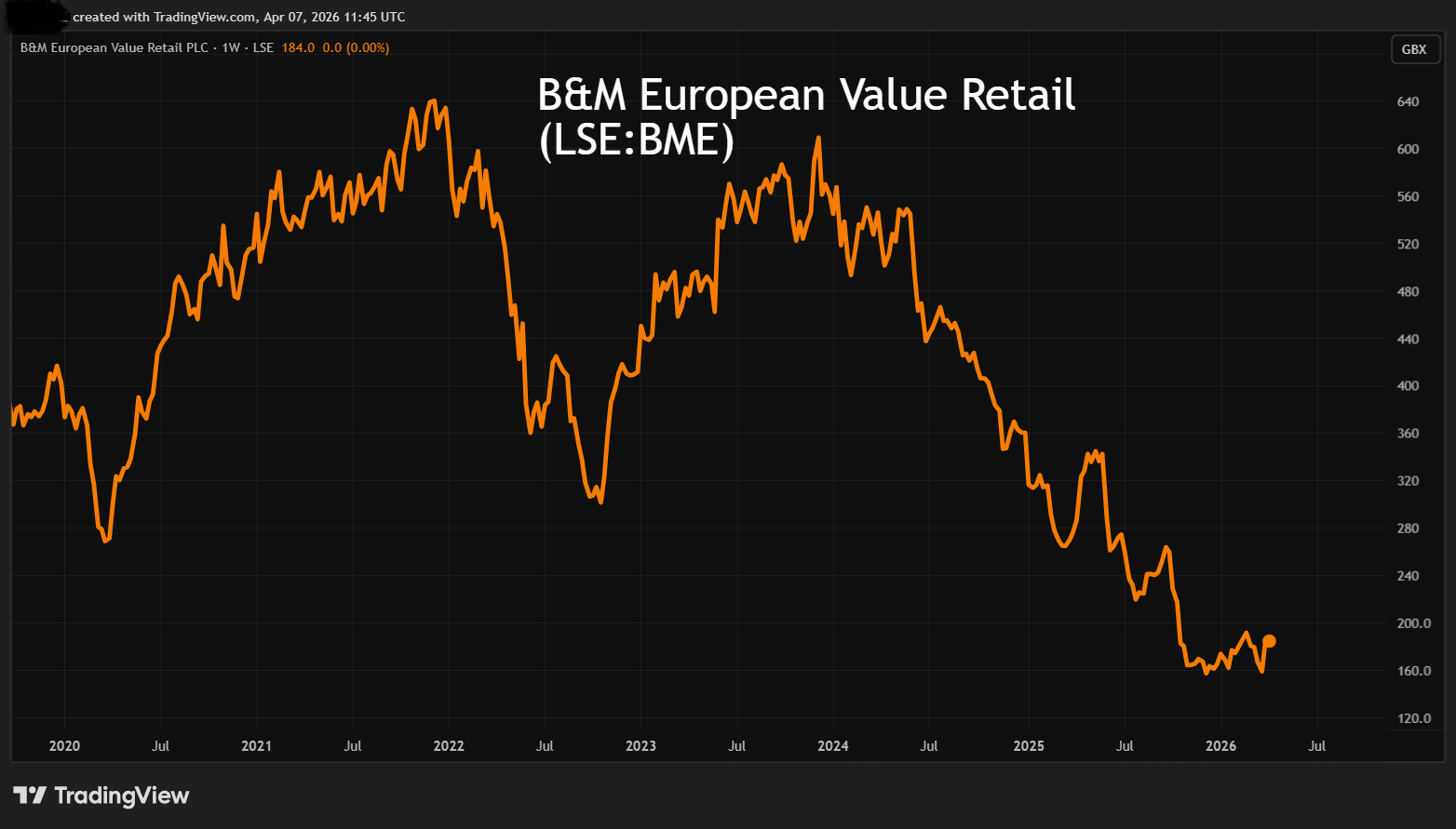
Source: TradingView. Past performance is not a guide to future performance.
Private equity shareholders are gone, but among institutions, BlackRock notably doubled its stake to 10.8% as disclosed on 23 March, becoming the largest shareholder. That could constitute averaging down, where it is easy to fall prey to compulsive action like a gambler tries to recoup loss by doubling down. Yet BlackRock demonstrates an interesting tussle happening between long and short operators.
The short book shows only two managers reducing – both by 0.10% to shorts of 0.79% and 0.99% – while the seven other shorters have increased since 17 March and three on 1 April even. They, therefore, see this rebound as an opportunity to increase down-bets.
The CEO appointed last May – Tjeerd Jegen – was touted as a highly capable retail veteran, hence when he started buying big chunks of shares the market (including me) took notice. From June to November 2025, he bought £1.46 million worth of shares at prices from 265p down to 158p.
Last June, at 280p, I had a “hold” stance on B&M, preferring to see the new CEO first get settled in and define his actions, and whether share option grants followed at a lower price. While I noted his share buying related to terms in his employment contract, at 253p last September I felt I should get off the fence, so upgraded to “buy” on the rationale of the CEO’s calibre being applied to a well-established business.
The direction of travel looked broadly favourable given B&M has demonstrated – even recently – operating margins roughly twice those for Tesco (LSE:TSCO) and has a very strong record of cash generation.
B&M European Value Retail SA
Year end 29 Mar
| 2016 | 2017 | 2018 | 2019 | 2020 | 2021 | 2022 | 2023 | 2024 | 2025 | |
| Turnover (£ million) | 2,035 | 2,431 | 3,030 | 3,273 | 3,813 | 4,801 | 4,673 | 4,983 | 5,484 | 5,571 |
| Operating margin (%) | 8.6 | 8.4 | 7.9 | 9.7 | 8.7 | 12.8 | 13.1 | 10.8 | 11.1 | 10.2 |
| Operating profit (£m) | 174 | 205 | 240 | 319 | 333 | 613 | 610 | 536 | 608 | 566 |
| Net profit (£m) | 125 | 143 | 186 | 194 | 90.0 | 428 | 422 | 348 | 367 | 319 |
| EPS - reported (p) | 12.4 | 14.3 | 18.6 | 19.8 | 20.4 | 42.7 | 42.1 | 34.7 | 36.5 | 31.8 |
| EPS - normalised (p) | 13.2 | 14.8 | 19.1 | 19.8 | 17.7 | 43.1 | 42.2 | 34.7 | 37.0 | 32.0 |
| Operating cashflow/share (p) | 14.3 | 17.9 | 19.8 | 37.5 | 54.9 | 82.5 | 49.0 | 77.9 | 74.3 | 67.1 |
| Capital expenditure/share (p) | 5.7 | 5.2 | 11.5 | 10.6 | 12.4 | 8.8 | 10.0 | 9.8 | 12.5 | 13.2 |
| Free cashflow/share (p) | 8.6 | 12.7 | 8.3 | 26.9 | 42.4 | 73.7 | 39.0 | 68.1 | 61.7 | 53.9 |
| Ordinary dividends/share (p) | 4.8 | 5.5 | 7.2 | 7.6 | 8.1 | 17.3 | 16.5 | 14.6 | 14.7 | 15.0 |
| Covered by earnings (x) | 2.6 | 2.6 | 2.6 | 2.6 | 2.5 | 2.5 | 2.6 | 2.4 | 2.5 | 2.1 |
| Return on total capital (%) | 12.8 | 13.8 | 14.8 | 12.0 | 12.8 | 23.3 | 21.2 | 19.6 | 21.5 | 18.8 |
| Cash (£m) | 91.1 | 156 | 90.8 | 86.2 | 428 | 218 | 173 | 237 | 182 | 217 |
| Net debt (£m) | 349 | 396 | 530 | 1,814 | 1,640 | 1,814 | 2,093 | 2,018 | 2,085 | 2,350 |
| Net assets (£m) | 802 | 800 | 912 | 992 | 867 | 733 | 746 | 720 | 734 | 752 |
| Net assets per share (p) | 80.2 | 80.0 | 91.1 | 99.2 | 86.7 | 73.2 | 74.5 | 71.9 | 73.2 | 74.9 |
Source: historic company REFS and company accounts.
With hindsight, both he and I should have awaited full “due diligence” given that October revealed a £7 million accounting error and the CEO delivered a second profit downgrade since his arrival. The shares fell from around 220p to below 170p, then bumped along sideways.
More positively, on a market technical view, a 22 January update saw little change in the 180p share price despite profit guidance being cut for a third time by around 8%. “Price investment” – what I regard as a weasel word – was walked out as the reason. It annoys me when retailers say this because it is not investment in business capability to deliver higher returns in future; it means cutting product prices which may simply be needed to stay competitive. In B&M’s case, it involves clearing discontinued stock.
I’m keen to not become swayed emotively by this, despite the company’s turnaround starting to look more longer term than Jegen appeared to flag initially.
If ‘profit warnings come in threes’ might a low be in?
Consensus currently expects £202 million net profit for the latest year to 29 March 2026, down from £319 million in 2025 and the £216 million forecast for 2027. This implies a price/earnings (PE) ratio of 9.1x, easing to 8.3x, against a 6% prospective dividend yield covered twice by earnings and greater by cash flow (see historic table).
If Jegen has found the low point for operations and can build from here, this might come across as a support level based on fundamentals. Obviously, the macro context will be significant, including what higher inflation might allow him to achieve.
Debt interest also continues to weigh, where inflation could compromise rate cuts. Last September’s balance sheet had just over £1 billion of debt plus nearly £1.5 billion lease liabilities, in context of £711 million negative net assets or £1.75 billion negative net tangible assets. Total debt generated a £74 million interim net interest charge, swiping half of operating profit.
So, revenues definitely need to grow, although the unfolding consumer environment rekindles doubts about whether B&M has fully shaken off like-for-like revenue declines. UK retail (81% of group revenue) slipped 0.6% like-for-like in the “golden quarter” to 27 December, while France edged up 0.4% and Heron Foods eased 0.1% - hence the group continues to fall behind in inflation-adjusted terms.
- Five AIM growth shares for your ISA in 2026
- Sign up to our free newsletter for investment ideas, latest news and award-winning analysis
December had shown 3% like-for-like sales growth “with similar trends in early January”, which is clearly not enough to overcome a poor October and November. B&M issued a post-close trading statement on 15 April last year, and this time around will be highly significant as to whether any uptrend persists.
A Which? survey last October showed B&M’s chief UK rival, Home Bargains, as cheaper than other supermarkets albeit failing to provide a similar range of produce. Home Bargains led with a £44.55 average price for 17 items, with Tesco (when including Clubcard) second and Lidl third. B&M lay in sixth position at £47.32, implying more “price investment” is needed!
Jegen argues “the full benefits will take time to come through” and, although he might have under-estimated the challenge in his early days, I would not write him off.
By comparison, Tesco’s net profit is expected to approach £2 billion in its current year to 27 February 2027 and, despite a disjointed earnings growth record, at 487p it enjoys a forward PE above 15x and yield of 3.2%.
Why risk/reward may still tilt positively for B&M shares
Perhaps I have an instinctive bias towards contrarian situations, plus intrigue at the short sellers, but if forced to choose I would hold B&M – not heavily – over Tesco. Whether to buy this week before the post-close update depends on your risk appetite. Last year’s fourth quarter showed B&M 1.8% easier in the UK on a like-for-like basis, while France grew 3.2%. Price cutting to shift discontinued stock sets a cautious context for the revenue numbers, but I think the key question is whether the group is stabilised, resisting further downside.
If so then the aggressive short trade starts to look higher risk, raising the odds of more closing of short positions, hence the shares could continue to rise even if the overall tenor of statements is nothing exciting.
Admittedly, this is quite a short-term view and UK retail may get tougher in the months ahead, but despite conflicting signals on this share I retain a “buy” stance.
On 23 February, B&M’s new group trading director bought £50,000 worth of shares at 188.7p, which looks encouraging. Maybe I repeat the “mistake” of respecting Jegen’s buying when it could be related to employment contracts, but this ex-head of buying and merchandising at Dutch value retailer Action is voting with his career, hence is unlikely to judge B&M as a sinking ship.
Edmond Jackson is a freelance contributor and not a direct employee of interactive investor.
These articles are provided for information purposes only. Occasionally, an opinion about whether to buy or sell a specific investment may be provided by third parties. The content is not intended to be a personal recommendation to buy or sell any financial instrument or product, or to adopt any investment strategy as it is not provided based on an assessment of your investing knowledge and experience, your financial situation or your investment objectives. The value of your investments, and the income derived from them, may go down as well as up. You may not get back all the money that you invest. The investments referred to in this article may not be suitable for all investors, and if in doubt, an investor should seek advice from a qualified investment adviser.
Full performance can be found on the company or index summary page on the interactive investor website. Simply click on the company's or index name highlighted in the article.
Disclosure
We use a combination of fundamental and technical analysis in forming our view as to the valuation and prospects of an investment. Where relevant we have set out those particular matters we think are important in the above article, but further detail can be found here.
Please note that our article on this investment should not be considered to be a regular publication.
Details of all recommendations issued by ii during the previous 12-month period can be found here.
ii adheres to a strict code of conduct. Contributors may hold shares or have other interests in companies included in these portfolios, which could create a conflict of interests. Contributors intending to write about any financial instruments in which they have an interest are required to disclose such interest to ii and in the article itself. ii will at all times consider whether such interest impairs the objectivity of the recommendation.
In addition, individuals involved in the production of investment articles are subject to a personal account dealing restriction, which prevents them from placing a transaction in the specified instrument(s) for a period before and for five working days after such publication. This is to avoid personal interests conflicting with the interests of the recipients of those investment articles.