Stockwatch: a market top or imminent buying opportunity?
As global events continue to have a significant effect on financial markets, analyst Edmond Jackson studies ways to trade shares in this tech sector leader.
27th February 2026 10:53
by Edmond Jackson from interactive investor

From a market tactical perspective, it’s interesting how a stock-specific and a mega-macro issue have coincided this week and might even conflate.
On Wednesday, NVIDIA Corp (NASDAQ:NVDA) announced record results, as if dismissing fears of an artificial intelligence (AI) bubble and justifying its share price outperformance of the broader US tech sector so far this year.
Yet an initial positive response by its shares fizzled out, the price easing from $197.5 to $195.6. Profit-taking continued yesterday, with the price down 5.5% to $184.9.
- Invest with ii: Open a Stocks & Shares ISA | Top ISA Funds | ISA Offers & Cashback
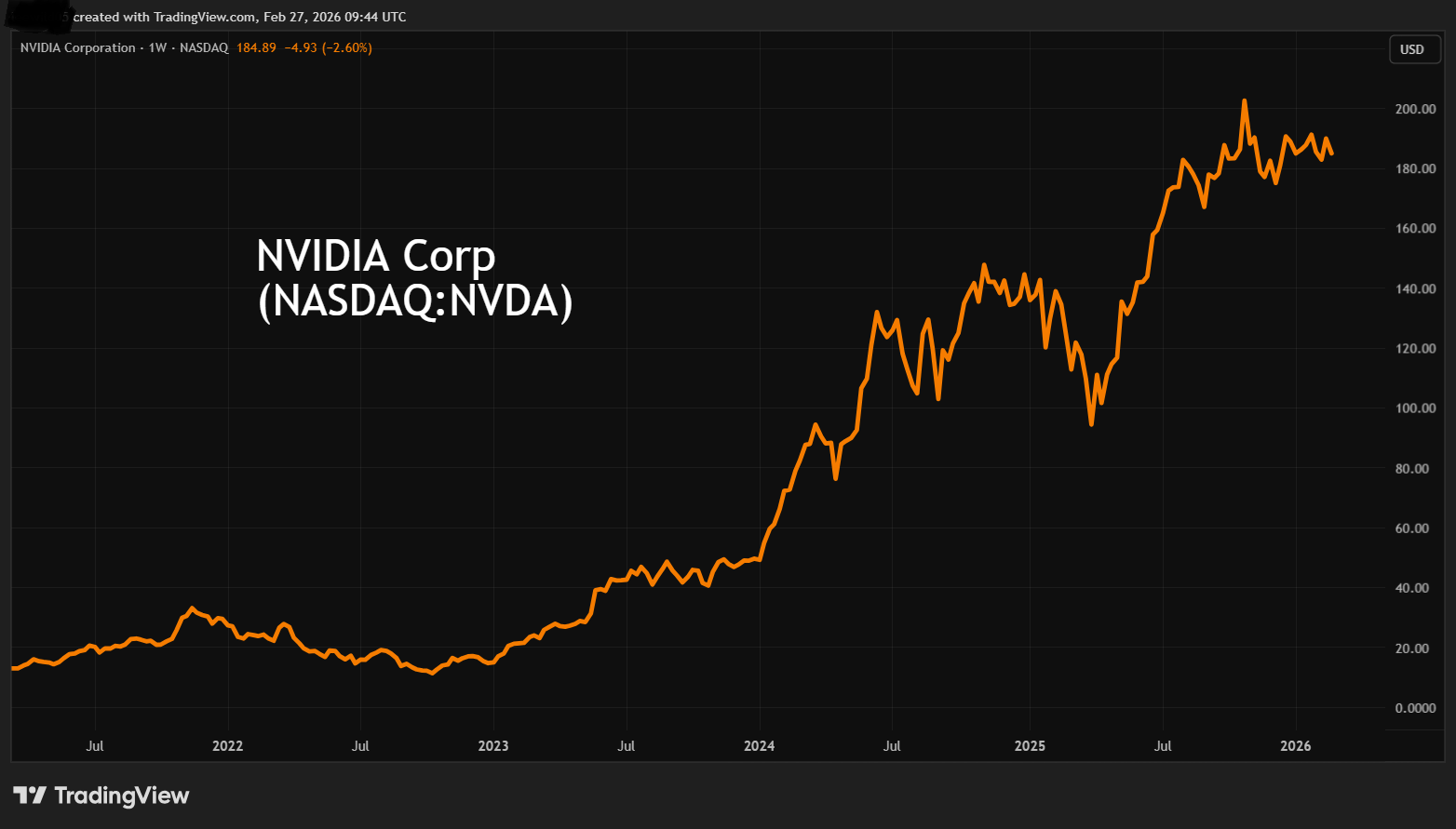
Source: TradingView. Past performance is not a guide to future performance.
Is this not typical profit-taking after a pre-results run, or despite beating even the most optimistic forecasts and raising guidance for the 25 January 2027 year, a hint of stale bulls?
Nvidia is important to equity investors given that it is a cheerleader for AI if not the wider US bull market. Taking froth out an overhyped sector is healthy and can prompt capital re-allocation, hence rallies elsewhere, but if a pin is taken to a bubble, it can bring down much else.
In which situation we also have the US/Iran conflict possibly at an all-time high. Despite Oman’s foreign minister – acting as mediator in the latest Geneva talks – citing “creative and positive ideas” from the latest session, talks ended without a deal. President Donald Trump had appeared to want an outcome this week, but there was no sign that either side had drawn closer on key issues of Iran’s right to enrich uranium and the future of such domestic stocks.
From initial US press reports, it appears the US team was disappointed by Iran’s proposals. Meanwhile, Iranian state TV reported that Tehran was determined to continue enriching uranium, rejected proposals to transfer it abroad and sought the lifting of international sanctions. This slightly contrasts with US Secretary of State Marco Rubio saying on Wednesday, “They’re not enriching right now, but they’re trying to get to the point where they ultimately can”, which is precisely what Israel, a key ally of the US, seeks to pre-empt.
- ii Tech Focus: Nvidia, software stocks, Crowdstrike, Broadcom
- Ian Cowie: are you braced for AI apocalypse or buying into AI optimism?
Discussions on a technical level are scheduled next week in Vienna. I imagine Iran will drag out negotiations as they always do, and Trump would prefer a ramp-off conflict, but one that wouldn’t carry on for weeks.
With over $1 billion (£742 million) already spent getting US forces to the Middle East and the high cost of maintaining them in alert – ditto Israel – I would not assume, like financial markets do, that “Trump always chickens out”. Without a satisfactory deal, disassembling the US fleet would be a humiliation. Indeed, Trump is more likely in to try and “get the job done”.
If a faltering high in a major cheerleader for US equities coincides with a sudden bout of “risk off” in a Middle East war, with oil prices soaring, the volatility certainly can get interesting.
There is scope, potentially, for a market top, but also buying opportunities, which brings me back to Nvidia.
Growing short and long-term risks for Nvidia
I find it appropriate to review Nvidia after re-rating my stance to “buy” at $125 in January 2025 given a PEG ratio (price/earnings (PE)-to-growth) just over 0.5 versus ARM Holdings ADR (NASDAQ:ARM), for example, on 1.5. This followed an initial “buy” rating in June 2023 as it tested $40 equivalent (before a 10-for-1 share split) which I moderated to “hold” at $152 in November 2024.
Within full-year revenue to 25 January 2026, up 65%, the fourth quarter soared 20% on Q3 and 73% on a year ago, as if underlying momentum continues to build. There has been a fourth consecutive quarter of accelerating growth. Guidance for around $78 billion revenue this year is well above consensus for $72.6 billion including among the most bullish.
Yet a near four-point decline in the annual gross margin to 71.0% might have contributed to the share’s latest drop:
Nvidia Corp - Q4 and fiscal 2026 summary
to 25 Jan
GAAP: $ million
| Q4 FY25 | Q3 FY26 | Q4 FY26 | Q/Q | Y/Y | ||
| Revenue | 39,331 | 57,006 | 68,127 | 20% | 73% | |
| Gross margin | 73.0% | 73.4% | 75.0% | 1.6 pts | 2.0 pts | |
| Operating expenses | 4,689 | 5,839 | 6,794 | 16% | 45% | |
| Operating income | 24,034 | 36,010 | 44,299 | 23% | 84% | |
| Net income | 22,091 | 31,910 | 42,960 | 35% | 94% | |
| Diluted earnings per share $ | 0.89 | 1.30 | 1.76 | 35% | 98% | |
| Fiscal 2026 summary | FY25 | FY26 | Y/Y | |||
| Revenue | 130,497 | 215,938 | 65% | |||
| Gross margin | 75.0% | 71.0% | (3.9) pts | |||
| Operating expenses | 16,405 | 23,076 | 41% | |||
| Operating income | 81,453 | 130,387 | 60% | |||
| Net income | 72,880 | 120,067 | 65% | |||
| Diluted earnings per share $ | 2.94 | 4.90 | 67% |
Source: Nvidia newsroom.
Driving growth is Nvidia’s 90% share of the AI chip market where a huge rise in spending on data centres has meant beating expectations each quarter since the 2024 fiscal year.
Sceptics now question whether these core customers – major cloud service providers such as Amazon Web Services, Microsoft Azure and Google Cloud – will sustain it. Yet this boom looks to have way further to go. Global data centre capacity is projected to nearly double by 2030, with AI inference workloads expected to take over by 2027, requiring a wider distribution of data centres.
With these top “hyperscalers” due to raise such capex to over $600 billion this year, this could represent a near-term hump. Yet an emerging trend towards “edge” data centres closer to users is expected to raise global spending on edge IT infrastructure to $378 billion by 2028.
Obviously, valuation-wise, care is needed not to overpay for Nvidia where the sense of a “historic PE around 50, forward of 25 and a 0.5 PEG” seems liable to change.
- Eight FTSE 100 stocks to pay £6bn of dividends in March
- Sign up to our free newsletter for investment ideas, latest news and award-winning analysis
My eyebrows are raised at questions over revenue “circularity” – where Nvidia invests in a company, only for it then to purchase chips from Nvidia – given this was one way the software group Autonomy Corporation inflated its financial performance. More needs to come out as to the extent that this may have boosted Nvidia and whether it looks too good to be true.
China is another googly, where Nvidia still has not sold its US-approved China AI chips, and it starts to look as if local rivals will take over. US export controls did relax a requirement for a lower-capability chip for the Chinese market amid concern such chips could undermine US national security. Last December, Trump allowed a more advanced chip, so long as the US got a 25% cut of sales.
China is also a potential disruptor to global AI given a flurry of Chinese AI chipmakers and large language model developers have floated in Hong Kong and mainland China in recent months. While slightly lagging the US for capabilities, the products are far cheaper, hence it’s possible to envisage them constituting a global majority longer term.
Whether such factors could be enough to unsettle buyers of any market drop is all the more relevant now if the Middle East comes to war.
Nvidia is a ‘coiled spring’
A post-results note from JP Morgan cites the potential for Nvidia’s specialised H200 and B200 chips capturing the lion’s share of high-margin enterprise spend. To focus on a 4% recent fall in the gross margin is foolhardy versus a transition to new Blackwell and Vera Rubin architecture.
While I concede that this gets above my head, it sounds great for refreshing the story. We even have names instead of obtuse modern acronyms. Frequently, growth shares are a question of “does the story come across well?”
JP Morgan further argues that current production ramp-up is intentionally conservative to ensure quality, creating a supply-demand imbalance that will lead to even bigger beats in the second half of 2026.
From my experience of the 1999-2000 tech boom/bust, I would be mindful how industry specialists can cede wider objectivity, especially if/when they come under the spell of a persuasive CEO. As a generalist, one can be a decent judge of the overall risk/reward profile.
On public information to date, I tilt to favour Nvidia as a medium-term “hold” and draw attention to current profit-taking, which could get more interesting if markets go “risk off” in response to Middle East strikes. There looks to be potentially another buying opportunity ahead if there is a conflation of fear factors.
Edmond Jackson is a freelance contributor and not a direct employee of interactive investor.
These articles are provided for information purposes only. Occasionally, an opinion about whether to buy or sell a specific investment may be provided by third parties. The content is not intended to be a personal recommendation to buy or sell any financial instrument or product, or to adopt any investment strategy as it is not provided based on an assessment of your investing knowledge and experience, your financial situation or your investment objectives. The value of your investments, and the income derived from them, may go down as well as up. You may not get back all the money that you invest. The investments referred to in this article may not be suitable for all investors, and if in doubt, an investor should seek advice from a qualified investment adviser.
Full performance can be found on the company or index summary page on the interactive investor website. Simply click on the company's or index name highlighted in the article.
Disclosure
We use a combination of fundamental and technical analysis in forming our view as to the valuation and prospects of an investment. Where relevant we have set out those particular matters we think are important in the above article, but further detail can be found here.
Please note that our article on this investment should not be considered to be a regular publication.
Details of all recommendations issued by ii during the previous 12-month period can be found here.
ii adheres to a strict code of conduct. Contributors may hold shares or have other interests in companies included in these portfolios, which could create a conflict of interests. Contributors intending to write about any financial instruments in which they have an interest are required to disclose such interest to ii and in the article itself. ii will at all times consider whether such interest impairs the objectivity of the recommendation.
In addition, individuals involved in the production of investment articles are subject to a personal account dealing restriction, which prevents them from placing a transaction in the specified instrument(s) for a period before and for five working days after such publication. This is to avoid personal interests conflicting with the interests of the recipients of those investment articles.