Stockwatch: a rare but risky example of rapid growth
After recently backing this interesting emerging markets growth story, analyst Edmond Jackson believes there’s still an opportunity to gain exposure.
17th April 2026 12:19
by Edmond Jackson from interactive investor

Do strong annual results from micro finance provider ASA International Group (LSE:ASAI) affirm undervaluation of its shares? Or is a 4.5x price/earnings (PE) and 4.75% yield justified given emerging market exposure – especially if credit demand gets hit by the Middle East conflict tilting the global economy into recession?
This actually is a point relevant to anyone holding bank shares. Barclays (LSE:BARC) shares, for example, are up 15% from a March low as financial shares classically lead a stock market rebound. Yet last Wednesday Professor Ken Rogoff, a former chief economist at the International Monetary Fund (IMF), argued that markets are being naïve to assume “mission accomplished” in the Iran war.
- Invest with ii: Top UK Shares | Share Tips & Ideas | Cashback Offers
A recession – defined by two consecutive quarters of decline in gross domestic product (GDP) – can cut lending by around 30%, hence even if we do not actually reach that scenario, lending could still be affected as higher energy prices reverberate. This war may yet have a pervasive influence.
I drew attention to ASA in January, broadly as a “buy” at 238p, although I did say “decide your own timing” when net profit was expected to grow to over $60 million (£44 million) in 2026.
Unsurprisingly, it was hit by the outbreak of war, falling from 248p on 27 February to 181p by 31 March, but it has recovered with the wider market rally and last Wednesday’s annual results to reach 227p. The medium-term chart still affirms a bull trend:
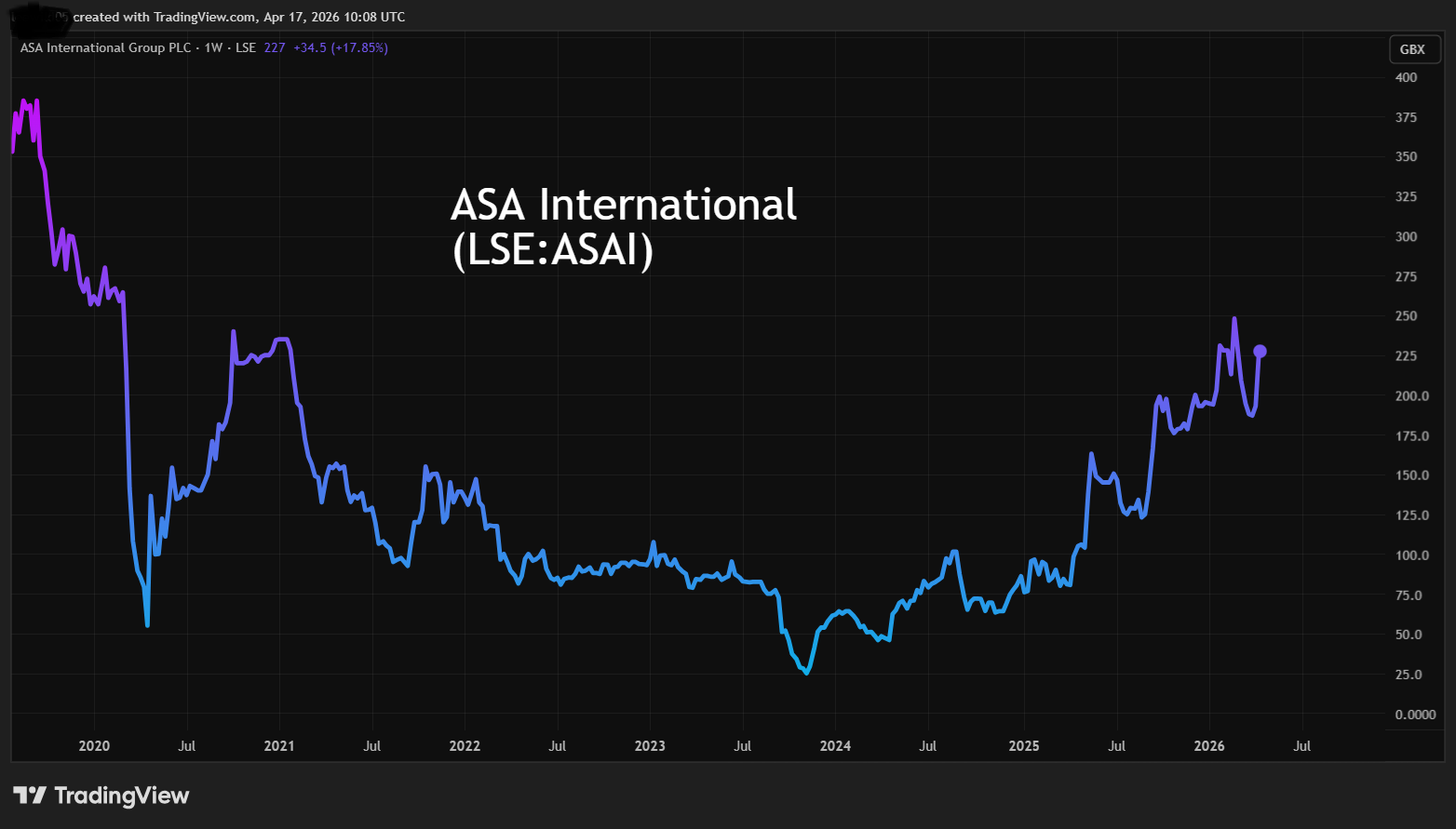
Source: TradingView. Past performance is not a guide to future performance.
2025 results stand out in market lacking growth shares
Net profit is up 69% to $56.5 million at constant currency, or by 98% (translating African and Asian currencies into a weaker US dollar). There is scant difference from $57.2 million underlying profit, and 97% earnings per share (EPS) growth to 57 cents involves no difference between basic and diluted numbers.
While full accounts are not included in the company announcement, scrolling down to pages 136 to 139 in the annual report, downloadable from ASA’s website, shows an operation refreshingly clean of adjustments, typical of acquisitive or turnaround companies.
- ISA investing: nine ii experts reveal their ISA tips for 2026-27
- Sign up to our free newsletter for investment ideas, latest news and award-winning analysis
This aspect of foreign exchange translation can be a nuisance to anyone relying on data screening to decipher growth shares. For example, FX caused a fall in 2023 numbers, which strictly speaking means ASA might not qualify for the price/earnings-to-growth (PEG) ratio that otherwise is highly attractive at 0.3 – assuming 2026 onwards is not disrupted.
Moreover, ASA’s credit loss element is already low – only 3.0% of total operating income versus 3.6% in 2024, hence if bad debts were indeed to rise in a global slowdown they might not conflate badly with reduced credit demand. Such a double whammy effect is the chief reason bank shares sell off on recession fears.
ASA International Group - financial summary
Year-end 31 Dec
| 2019 | 2020 | 2021 | 2022 | 2023 | 2024 | 2025 | |
| Total revenue ($m) | 180 | 153 | 200 | 188 | 160 | 214 | 300 |
| Operating margin (%) | 52.0 | 27.9 | 34.8 | 46.8 | 32.3 | 29.7 | 34.7 |
| Operating profit ($m) | 93.6 | 42.5 | 69.7 | 88.2 | 51.6 | 63.5 | 104 |
| Net profit ($m) | 34.0 | -0.7 | 8.8 | 17.9 | 9.2 | 29.2 | 56.5 |
| Reported earnings/share (cents) | 34.0 | -0.7 | 8.8 | 17.9 | 9.2 | 29.2 | 57.0 |
| Normalised earnings/share (cents) | 34.0 | -0.7 | 8.8 | 17.9 | 9.2 | 29.2 | 57.0 |
| Operating cashflow/share (cents) | -26.4 | -8.2 | 12.5 | 43.1 | -17.3 | -24.1 | -53.5 |
| Capital expenditure/share (cents) | 2.8 | 1.0 | 2.2 | 6.2 | 7.5 | 6.1 | 7.1 |
| Free cashflow/share (cents) | -29.2 | -9.1 | 10.4 | 37.0 | -24.8 | -30.3 | -60.6 |
| Dividend/share (cents) | 0.0 | 0.0 | 0.0 | 0.0 | 0.0 | 7.1 | 14.3 |
| Covered by earnings (x) | 0.0 | 0.0 | 0.0 | 0.0 | 0.0 | 4.1 | 4.0 |
| Return on capital (%) | 16.7 | 7.3 | 12.4 | 18.0 | 10.5 | 19.4 | 23.0 |
| Return on equity (%) | 14.7 | -0.7 | 8.4 | 18.5 | 11.0 | 33.2 | 35.1 |
| Cash ($m) | 65.5 | 71.8 | 66.5 | 50.5 | 48.5 | 79.1 | 107 |
| Net debt (%) | 339 | 354 | 343 | 298 | 307 | 365 | 317 |
| Net assets/share (cents) | 108 | 105 | 104 | 89.8 | 77.9 | 98.5 | 162 |
Source: company accounts.
Mind you, the apparent negative and worsening cash flow relates to loan growth.
The net interest margin is a whopping 39%, up from 34% in 2024 and compares with just over 4% for Barclays, which is still ahead of the circa 3% benchmark regarded as acceptable. This ratio derives from interest revenue minus interest costs divided by loan values, and is a key performance measure for lenders.
It implies usurious lending rates at ASA, a bit like how payday loan and subprime lenders have been criticised. Yet it is hard to argue with the loan portfolio rising 33% to $611 million last year, driven by Ghana, Pakistan, Uganda, Tanzania and Kenya. The customer base implicitly accepts the terms, certainly enough to provide this extent of growth, with ASA citing “the continued trust of our 2.8 million clients”.
It would also imply less by way of competition in short-term loans, which obviously could change in time if new providers target ASA’s margins.
Payments outstanding over 30 days have fallen from only 2.2% to a remarkably low 1.8%. Any sense of bad debt risk could therefore be misplaced, the real risk being whether slowdown spreads to developing countries. South East Asia and Africa seem liable to be especially hard hit by an extended Iran war due to higher shipping and energy costs, exacerbating inflation in some countries.
For example, in Nigeria, inflation is already around 15% although the country could be among the world’s six largest economies in 2075 (also includes India and Pakistan) if predictions by Goldman Sachs prove accurate.
On a long-term view then, even if this current war does disrupt more widely, ASA is an interesting smaller selection for a SIPP or ISA taking a decades-long view. Return on average equity rose from 33% to 44% last year, a strong long-term indicator.
Total dividend doubled last year
A 14.3 cents per share dividend represents only a 25% payout ratio, and you might argue that $107 million cash at the bank (only $28.9 million of which has restricted use) could be applied for even greater payout and/or buybacks.
While possibly rash to suddenly re-rate the dividend further, a track record of 3-8x earnings cover suggests the board is aware that earnings and cash flows might vary.
To an extent offsetting macro risk, however, management pitches how 2025 growth was derived from its “refined strategy adopted at the start of the year, alongside strengthened leadership layers and an expanded product suite”.
- New price target for BP shares after upgrade
- Funds and trusts the pros are buying and selling: Q2 2026
They also extol a digital transformation programme, hence “a more compelling and seamless offering to our clients and setting the stage for broader resilience, efficiency and innovation across the group”. That implicitly supports dividend growth if not long-term total return, although obviously all businesses need to be achieving digital compliance nowadays, in the UK currently for taxation.
In terms of something new that’s genuinely able to add growth rather than chiefly keep operations up to date, a “micro-insurance” product is being rolled out in Africa in partnership with an “insurtech” leader. This involves life and health policies that are traditionally out of reach for many.
Risk of Middle East conflict acknowledged
The board is closely monitoring the Middle East situation “and any potential impact on economic activity, inflation, local currencies and growth in ASA’s operating countries”. Yet they still believe the group is more resilient than it was previously, with profit growth in January and February helped by continued improvements in productivity.
At 227p, ASA shares remain down 27% from their 313p listing price in July 2018, despite the financial record recovering pretty well from the disruption of Covid. For aficionados of “bowl” charts, however, ASA is shaping up as a colossal one if fundamentals continue to improve and the shares follow.
The disappointing slump to just 25p in November 2023 related to a combination of factors but was classic emerging markets risk that include political turmoil in key regions, undermining sentiment. There was also the pandemic, then write-offs in India and a winding down of operations there, plus debt covenant breaches in 2024 relating to portfolio risks.
Yet the 2025 turnaround shows management has substantially dealt with these issues having repositioned the business well. It is possible the shares continue to “climb a wall of worry” (related to the above factors) given ASA’s numbers and ratios now defy them.
I therefore retain a “buy” stance, but take your own view as to whether markets are complacent as to Iran war risk, hence investment timing.
Edmond Jackson is a freelance contributor and not a direct employee of interactive investor.
Important information – SIPPs are aimed at people happy to make their own investment decisions. Investment value can go up or down and you could get back less than you invest. You can normally only access the money from age 55 (57 from 2028). We recommend seeking advice from a suitably qualified financial adviser before making any decisions. Pension and tax rules depend on your circumstances and may change in future.
Important information: Please remember, investment values can go up or down and you could get back less than you invest. If you’re in any doubt about the suitability of a Stocks & Shares ISA, you should seek independent financial advice. The tax treatment of this product depends on your individual circumstances and may change in future. If you are uncertain about the tax treatment of the product you should contact HMRC or seek independent tax advice.
These articles are provided for information purposes only. Occasionally, an opinion about whether to buy or sell a specific investment may be provided by third parties. The content is not intended to be a personal recommendation to buy or sell any financial instrument or product, or to adopt any investment strategy as it is not provided based on an assessment of your investing knowledge and experience, your financial situation or your investment objectives. The value of your investments, and the income derived from them, may go down as well as up. You may not get back all the money that you invest. The investments referred to in this article may not be suitable for all investors, and if in doubt, an investor should seek advice from a qualified investment adviser.
Full performance can be found on the company or index summary page on the interactive investor website. Simply click on the company's or index name highlighted in the article.
Disclosure
We use a combination of fundamental and technical analysis in forming our view as to the valuation and prospects of an investment. Where relevant we have set out those particular matters we think are important in the above article, but further detail can be found here.
Please note that our article on this investment should not be considered to be a regular publication.
Details of all recommendations issued by ii during the previous 12-month period can be found here.
ii adheres to a strict code of conduct. Contributors may hold shares or have other interests in companies included in these portfolios, which could create a conflict of interests. Contributors intending to write about any financial instruments in which they have an interest are required to disclose such interest to ii and in the article itself. ii will at all times consider whether such interest impairs the objectivity of the recommendation.
In addition, individuals involved in the production of investment articles are subject to a personal account dealing restriction, which prevents them from placing a transaction in the specified instrument(s) for a period before and for five working days after such publication. This is to avoid personal interests conflicting with the interests of the recipients of those investment articles.