Nvidia breaks records as Wall Street makes ‘astonishing’ recovery
Money is piling into tech stocks again and markets are at new highs despite unresolved conflict in the Middle East. City writer Graeme Evans explains what’s fuelling the optimism.
16th April 2026 15:42
by Graeme Evans from interactive investor
Credit: Jakub Porzycki/NurPhoto via Getty Images.
The longest-ever winning streak by NVIDIA Corp (NASDAQ:NVDA) and a three-day 10% bounce for Microsoft Corp (NASDAQ:MSFT) shares today ensured the S&P 500 index opened above 7,000 for the first time.
The sudden revival of Wall Street’s AI trade and impact of the Middle East ceasefire means the benchmark is back above its pre-war level, having jumped by 10.7% over the last 11 sessions.
- Invest with ii: Buy US Stocks from UK | Most-traded US Stocks | Cashback Offers
This pace even outstrips last year's Liberation Day bounce-back, which saw a 10.1% rise over the same period. In fact, the S&P 500 has achieved a 10%-plus rally in 11 sessions only 15 times this century – averaging roughly once every couple of years.
Deutsche Bank said that the velocity of the ascent was “nothing short of astonishing”, adding that the market has largely adhered to the typical geopolitical playbook by achieving a full recovery within six or seven weeks.
Confidence in the AI build-out has benefited from this week’s first-quarter results by Taiwan Semiconductor Manufacturing Co Ltd ADR (NYSE:TSM) and Europe-listed counterpart ASML Holding NV (EURONEXT:ASML) - both top 10 holdings of Scottish Mortgage Ord (LSE:SMT) Investment Trust.
They lifted their revenue 2026 guidance, with ASML describing how its customers were accelerating their capacity expansion plans for this year and beyond.
City bank Berenberg, which retains a Buy stance on ASML shares, said: “In our view, the favourable semiconductor capex spending environment is set to continue in the near term, supported by strong AI-related demand and a constrained memory market.”
- Will tech giants drive another US earnings beat?
- ISA investing: nine ii experts reveal their ISA tips for 2026-27
UBS added that the upgrade was notable because ASML typically revises its guidance around mid-year, suggesting better visibility on strong demand amid long-term supply agreements.
The wider boost to tech sentiment meant Nvidia shares closed last night near to $200 for a market capitalisation of $4.8 trillion (£3.6 trillion), having risen 11 consecutive days in the semiconductor giant’s best run on record.
The shares were at $165 at the start of trading on 31 March, when we reported that a multiple of about 19.6 times forecast 12-month earnings was the company’s lowest since 2019.
Microsoft was also down to 20 times from about 35 in August last year. Its shares remain more than 13% lower year-to-date despite a 10% surge over the past three sessions - its best run in six years.
Microsoft shares traded higher at $413.92 today, while Nvidia drifted in a session when the S&P 500 index held its position above 7,000, hitting a record 7,040 in early deals.
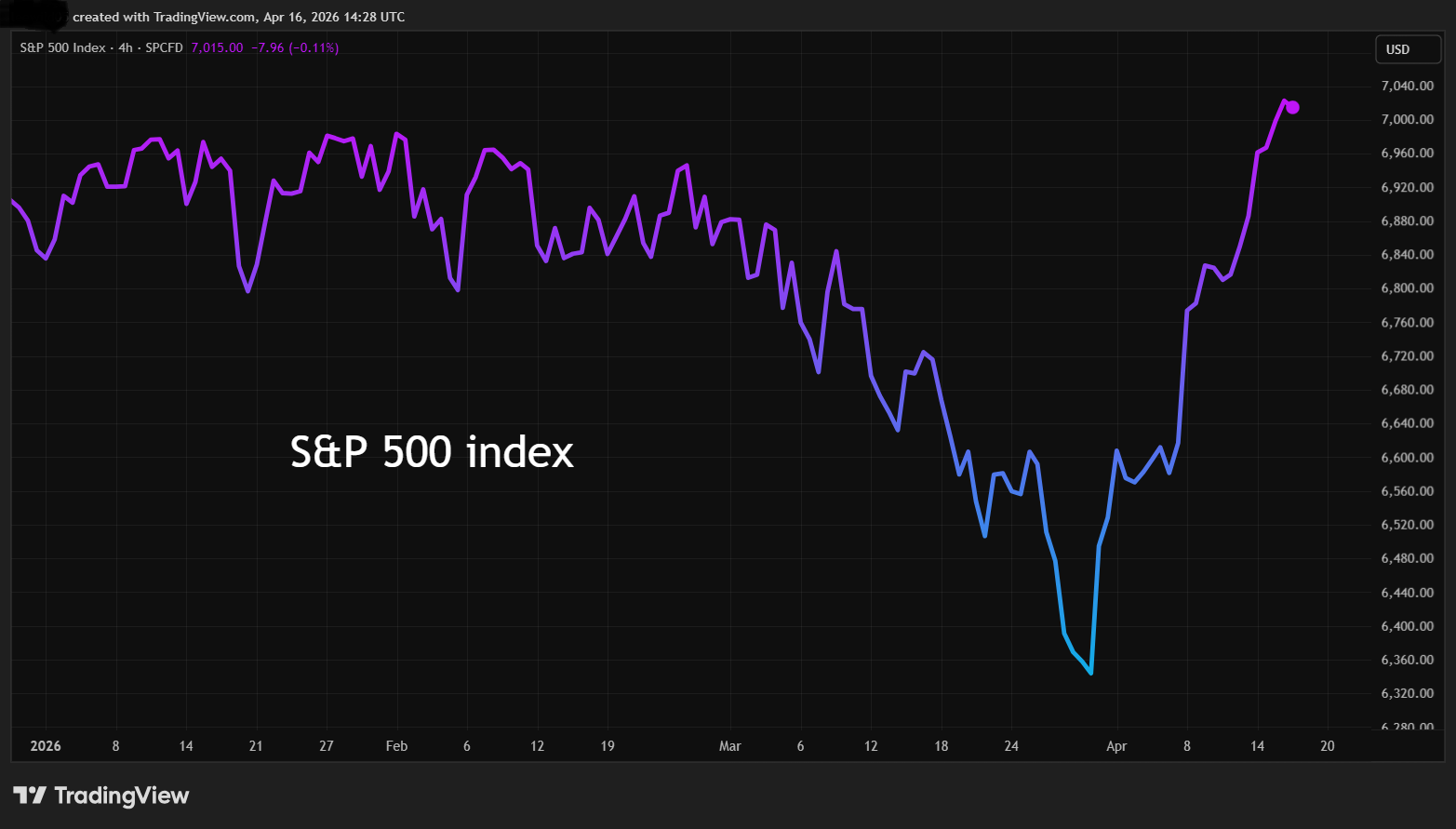
Source: TradingView. Past performance is not a guide to future performance.
The US benchmark’s revival follows a period up to the end of March when a combination of the war and AI disruption fears compressed its forward price/earnings (PE) multiple by 17%.
Risk assets have since rallied on expectations of declining oil prices and the potential avoidance of a stagflationary shock. Recent economic data has also helped the mood, particularly the strongest US payrolls in 15 months and a mild inflation print for March.
Deutsche Bank said platforms like Polymarket showed the market pricing the probabilities of a permanent US/Iran peace deal by the end of May and June at 59% and 72% respectively.
The return to normal traffic in the Strait of Hormuz for the same periods is rated at 60% and 75% respectively.
Deutsche Bank added: “While such a swift resolution is the most likely outcome, the historical precedent of failed peace talks between Russia and Ukraine in March/April 2022, despite initial optimism, serves as a pertinent reminder of potential downside risks.”
Stocks have advanced even though energy prices are highly unlikely to make an immediate return to pre-conflict levels.
UBS Global Wealth Management said: “These uncertainties mean investors should be prepared for continued bouts of market volatility.”
However, it believes that healthy US profit growth is likely to underpin further stock gains.
The US earnings season is off to a strong start, with banks including JPMorgan Chase & Co (NYSE:JPM) and Morgan Stanley (NYSE:MS) the beneficiaries of increased volatility and a strong quarter of fee-generating deal activity.
- ii view: JP Morgan trading bounty overshadowed by outlook caution
- Sign up to our free newsletter for investment ideas, latest news and award-winning analysis
UBS expects S&P 500 corporate profits to increase about 17% for the first quarter of this year, which would mark the fastest pace of growth since the fourth quarter of 2021.
It said: “On forward guidance, we believe there is a good chance that forecasts will be better than feared.
“So far, there is scant evidence of negative impact from the conflict in earnings revisions, and the bottom-up next 12-month S&P 500 earnings per share estimate continues to march higher.”
The bank has maintained its “Attractive” stance on US equities, favouring consumer discretionary, financials, healthcare, industrials and utilities in the current climate.
These articles are provided for information purposes only. Occasionally, an opinion about whether to buy or sell a specific investment may be provided by third parties. The content is not intended to be a personal recommendation to buy or sell any financial instrument or product, or to adopt any investment strategy as it is not provided based on an assessment of your investing knowledge and experience, your financial situation or your investment objectives. The value of your investments, and the income derived from them, may go down as well as up. You may not get back all the money that you invest. The investments referred to in this article may not be suitable for all investors, and if in doubt, an investor should seek advice from a qualified investment adviser.
Full performance can be found on the company or index summary page on the interactive investor website. Simply click on the company's or index name highlighted in the article.