Rolls-Royce: what to look for in its next trading update
After an incredible rally, shares in the civil aerospace firm have fallen sharply. Graeme Evans reveals what one City analyst expects to hear from management.
29th April 2026 15:19
by Graeme Evans from interactive investor
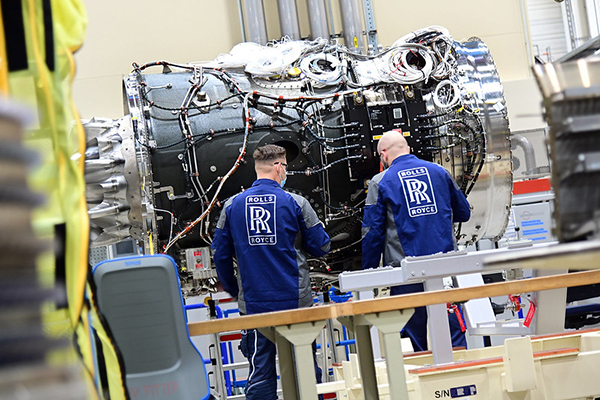
Rolls-Royce workers beside a Pearl 10X engine. Credit: Rolls-Royce via Flickr.
The civil aerospace headwinds behind a 18% fall for Rolls-Royce Holdings (LSE:RR.) shares will be addressed tomorrow when the engines giant delivers its first update since the start of the Iran war.
The statement ahead of the company’s AGM in Derby will be the second year in a row that the company’s financial transformation has been overshadowed by industry-wide challenges.
- Invest with ii: Open a Low Cost SIPP | What is a SIPP | Interactive investor Offers
Last year’s gathering was told by chief executive Tufan Erginbilgic that a “more resilient and agile” Rolls-Royce had delivered a strong start to the year and that he expected mitigating actions to offset the impact of global tariff increases.
The focus of this year’s meeting will be on the outlook for engine flying hours (EFHs) amid the impact of Middle East cancellations and jet fuel crisis on Rolls’ widebody fleet.
UBS notes that the large majority of Rolls’ spare parts sales are based on long-term service agreements with continuous payments, rather than being at the time of the shop visit.
“As a result, Rolls has significant negative working capital, and therefore greater direct near-term exposure to engine flying hours.”
The bank’s modelling shows that 2026 EFHs will be flat year-on-year at 111% of 2019 levels, rather than the company’s recent guidance for between 115%-120%.
This means that UBS is at the low end of the company’s guidance range for free cash flow of between £3.6 billion-£3.8 billion.
- Seraphim Space’s share issue: all you need to know
- Trading Strategies: are Rio Tinto shares worth buying now?
- Prepare for UK bank sector dividend windfall
The bank has reiterated its sales forecasts for defence and highlights the potential for the power systems division to deliver upside to the City consensus and current guidance.
In its note published at the end of last week, UBS cut its price target by 100p to 1,400p but reiterated a Buy stance.
This compares with today’s level of 1,115.6p after shares fell from a record 1,363p in the days after February’s forecast-beating results and launch of a three-year plan to buy back shares worth up to £9 billion. It also declared a final dividend of 5p a share, which is due on 3 June.
UBS said: “We continue to see upside in Rolls-Royce, especially relative to peers, given the idiosyncratic turnaround story centered on pricing and margin upside.”
It adds that a strong balance sheet and widebody exposure were reasons to believe that Rolls is likely to be more insulated than other firms through a downturn.
The bank believes that airlines are likely to cut widebody capacity less quickly than they do for narrowbody routes, where Rolls has no current exposure.
- Three corporate bonds make first move to appeal to DIY investors
- Sign up to our free newsletter for investment ideas, latest news and award-winning analysis
- FTSE 100 shares round-up: GSK, Mag 7 review, interest rates
This is backed up by high frequency data that shows while widebody traffic growth has stabilised, declines in narrow body traffic growth have accelerated.
UBS adds that 60% of Rolls’ current flying hours are delivered on new generation engines against 40-50% for peers, reducing the risk of retirements.
These articles are provided for information purposes only. Occasionally, an opinion about whether to buy or sell a specific investment may be provided by third parties. The content is not intended to be a personal recommendation to buy or sell any financial instrument or product, or to adopt any investment strategy as it is not provided based on an assessment of your investing knowledge and experience, your financial situation or your investment objectives. The value of your investments, and the income derived from them, may go down as well as up. You may not get back all the money that you invest. The investments referred to in this article may not be suitable for all investors, and if in doubt, an investor should seek advice from a qualified investment adviser.
Full performance can be found on the company or index summary page on the interactive investor website. Simply click on the company's or index name highlighted in the article.