Stockwatch: a volatile AIM share with new growth story
It’s been quite a ride for this small-cap, but analyst Edmond Jackson likes the business and its prospects. Here’s why.
28th April 2026 12:12
by Edmond Jackson from interactive investor

Gear4music appears to have stabilised after a difficult few years and, as a value-based retailer of musical instruments and equipment, may now be positioned to benefit if buyers seek cheaper items whether for leisure or education.
- Invest with ii: Open an ISA | Top ISA Funds | Transfer an ISA to ii
This AIM-listed company has a vertically integrated business model driven by online sales. Over 97% of sales are direct to consumer, selling third-party brands and high-margin own-brand products supported by 12 physical showrooms.
For illustration, a Yamaha tenor saxophone I bought in 1988 cost me around £750, the equivalent model’s best price now is around £1,400, which is also sold by Gear4music (Holdings) (LSE:G4M). Its website does, however, also have a Rosedale tenor sax for £500, hence for those just wishing to experiment and see how far it goes, Gear4music makes this realistic.
Obviously, the macro question is whether discretionary spending will be supported if energy prices remain stubbornly high, with a wide-ranging upshot for inflation and the cost of living. Yet with as many as 15% of the UK population playing a musical instrument, a value retailer may still thrive.
For its own-brand instruments, Gear4music sources significantly from independent manufacturers in South-East Asia, hence another macro question about how many instruments might currently be sat in containers near the Strait of Hormuz. It is a similar concern I have had regarding electrical goods imported by Currys (LSE:CURY).
Mean reversion to more sensible market value
I originally wrote about Gear4music in October 2016 when various retail shares were on exorbitant price/earnings (PE) ratios, such as ASOS (LSE:ASC) at around 75x and Boohoo (Debenhams Group (LSE:DEBS)) on 60x. Both companies proved loss-making from 2022, hence so much for the “efficient markets hypothesis”!
Gear4music had listed on AIM in June 2015 and tripled in value to 370p amid fast revenue growth. While I could not see a margin of safety, the story was strong, and near-term growth was attractive, hence it appeared interesting as a high risk/reward speculation.
- eyeQ: why Shell just triggered a ‘buy’ signal
- Insider: finance chief bets heavily on this FTSE 250 tech stock
The shares had risen to 975p by September 2021 when I last wrote about the company, concluding that “a ‘sell’ stance seems harsh, however respecting integration risks with a £9 million acquisition, also a possible change in the financial environment, it looks wise to lock in some gains”. The forward PE was as high as 33x, so an aspect of mean-reversion was due in time. Gear4music does not pay dividends, and the share price was 8.5x net tangible assets.
This proved a peak and the shares plunged in 2022, trading below 100p in 2023 as weaker consumer demand conflated with overvaluation. Covid lockdowns had provided an unsustainable boost and Gear4music was left with a challenge to reduce inventory and related debt. Its shares did not properly begin rising until April 2025, up from 110p, despite that coinciding with a huge profit warning which meant the valuation still looked stretched. At least excess inventories were being cleared and net debt reduced.
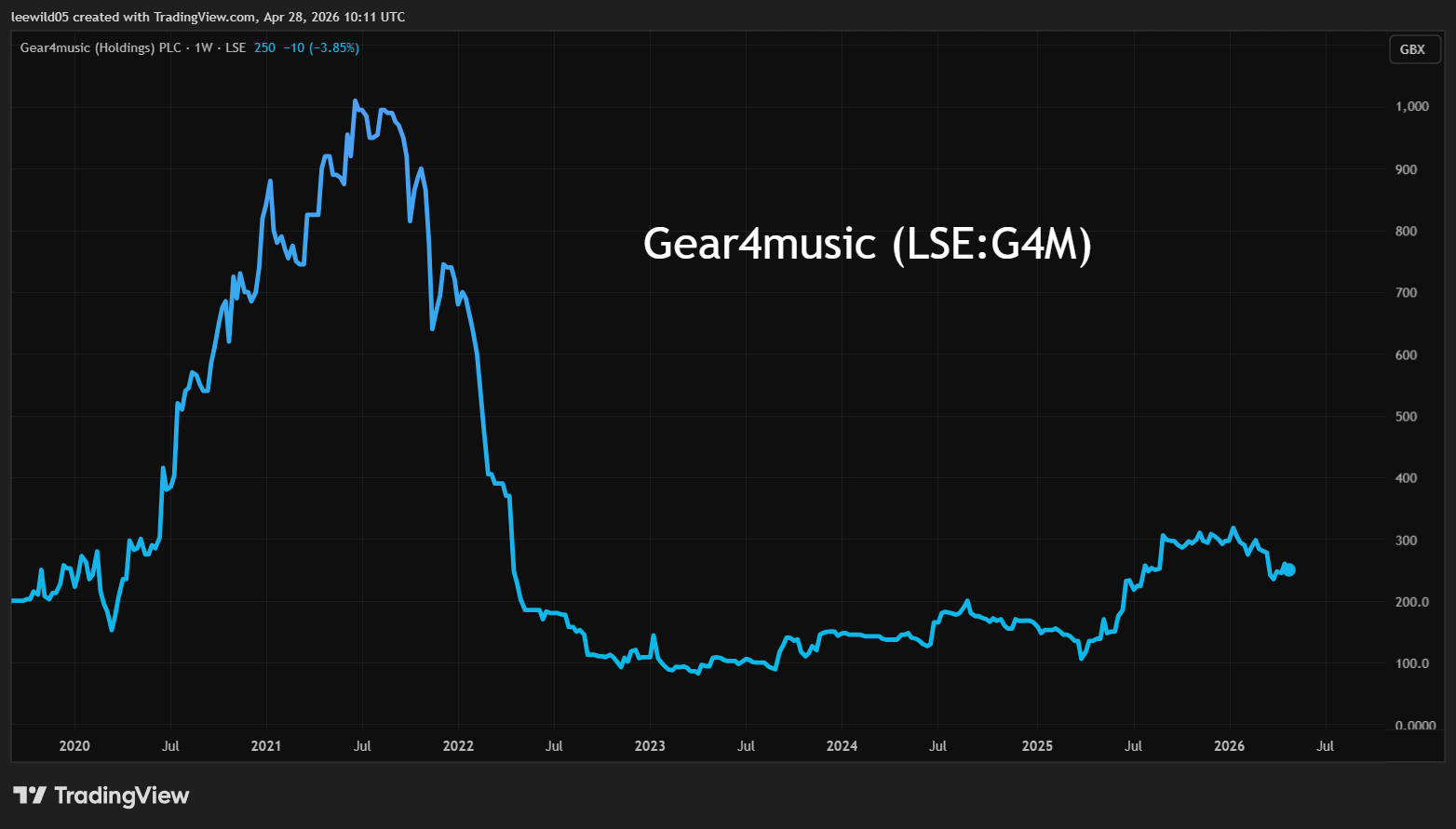
Source: TradingView. Past performance is not a guide to future performance.
A big recovery, however, is expected – and affirmed by a 21 April update – in respect of the latest financial year to 31 March. Net profit is tipped to rebound from borderline over the previous three years to £8.2 million which is plenty strong in a 11-year context.
A 20 January update had cited 27% like-for-like UK revenue growth in the September to December peak quarter, representing 59% of group total, with Europe and rest-of-world up 39% and constituting the remainder. This affirmed “the underlining strength and scalability of our international platform”. A 15-year lease was signed for a new automated York warehouse from the March 2027 year and management upgraded guidance for March 2026.
Admittedly, the operating margin has never budged above 10%, Gear4music appearing quite vulnerable to market shifts and needing tight control. As a retailer it enjoys a strong cash flow profile, but this has not extended either to dividends or share buybacks. Net debt has, however, more than halved since 2022.
Gear4music - financial summary
year end 31 Mar
| 2016 | 2017 | 2018 | 2019 | 2020 | 2021 | 2022 | 2023 | 2024 | 2025 | |
| Turnover (£ million) | 35.5 | 56.1 | 80.1 | 118 | 120 | 157 | 148 | 152 | 144 | 147 |
| Operating margin (%) | 0.8 | 4.7 | 2.5 | 0.0 | 3.4 | 9.8 | 4.1 | 0.8 | 1.9 | 2.2 |
| Operating profit (£m) | 0.3 | 2.6 | 2.0 | 0.0 | 4.1 | 15.4 | 6.1 | 1.3 | 2.8 | 3.2 |
| Net profit (£m) | 0.0 | 2.3 | 1.4 | -0.2 | 2.6 | 12.6 | 3.7 | -0.6 | 0.7 | 0.8 |
| EPS - reported (p) | -0.2 | 11.4 | 6.7 | -0.8 | 12.2 | 59.7 | 17.3 | -3.1 | 3.0 | 3.8 |
| EPS - normalised (p) | 1.9 | 11.4 | 6.7 | -0.7 | 12.3 | 59.7 | 17.2 | -3.0 | 4.3 | 3.8 |
| Return on equity (%) | 22.0 | 9.1 | -0.9 | 12.8 | 45.2 | 10.3 | -1.7 | 1.7 | 2.1 | |
| Return on total capital (%) | 3.0 | 19.9 | 7.9 | 0.0 | 11.3 | 32.7 | 7.9 | 2.0 | 4.6 | 5.4 |
| Operating cashflow/share (p) | -1.8 | 0.5 | 0.8 | 12.3 | 35.3 | 70.4 | -35.2 | 93.9 | 66.2 | 37.6 |
| Capital expenditure/share (p) | 8.3 | 10.8 | 43.9 | 21.4 | 16.8 | 20.6 | 28.8 | 30.1 | 17.7 | 18.3 |
| Free cashflow/share (p) | -10.1 | -10.3 | -43.2 | -9.1 | 18.5 | 49.8 | -64.1 | 63.8 | 48.6 | 19.3 |
| Cash (£m) | 3.6 | 3.0 | 3.5 | 5.3 | 7.8 | 6.2 | 3.9 | 4.5 | 4.7 | 5.6 |
| Net debt (£m) | -2.6 | -0.4 | 5.0 | 7.5 | 16.2 | 6.7 | 33.8 | 23.1 | 16.7 | 14.2 |
| Net assets (£m) | 9.4 | 11.7 | 18.9 | 18.7 | 21.6 | 34.3 | 38.0 | 37.2 | 38.4 | 39.3 |
| Net assets per share (p) | 46.4 | 58.2 | 90.5 | 89.3 | 103 | 164 | 181 | 177 | 183 | 187 |
Source: historic company REFS and company accounts.
The 21 April update provided a seventh consecutive upgrade to guidance for the latest financial year to 31 March, although 2027 guidance was left unchanged – profit being expected to falls as the cost base expands to support the new warehouse.
At 250p currently, a forward PE around 12.5x feels about right given real risks to discretionary consumer spending. Yet there are new angles for a growth story due to “smart instruments” such as guitars and pianos with integrated apps for learning, while home studio equipment remains in high demand. Gear4music is very well-placed in both respects. Concerns about rival online start-ups taking market share seem yet to materialise.
Mixed online consumer reviews
On Trustpilot, Gear4music rates only 2.1 out of 5 with 38 reviews. I think one has to be careful how that is not a high number of posts and any business is liable to have an element of dissatisfied customers venting online.
Mind though, the consistent dilemma is how items may be listed as available, but the ordering experience suggests not. For example, an item ordered as a birthday present, with a confirmed delivery slot of 15 to 16 December then moved to mid-January without informing the customer. From this review, it appears “the generic copy-and-paste response that ignored everything I said” implies that customer service is relatively low-staffed, with costs kept low by employing AI chatbots.
- Top 10 funds for SIPP accumulation and drawdown pension savers
- Sign up to our free newsletter for investment ideas, latest news and award-winning analysis
That is, however, significantly par for the course nowadays and seen widely across service industries, unless the business puts customer service ahead of margin.
At least this is chiefly an administration issue, and there are scant complaints about the quality of instruments that Gear4music sells. How many of us do take this risk where price and quality are appealing? I would suggest plenty.
Five months ago, a reviewer stated: “I’ve bought several items from them over the years, including a bass, effects pedal and an electric drum-kit. Never had an issue and products are always quality and value.”
No insiders trading either way
You have to go back to April 2025 when two directors bought over £24,000 of Gear4music shares at between 107p and 114p. The pivotal trade has proven to be the founder and then CEO selling over £12 million worth at 730p in late 2021, although he retains 22.8% of the company and did buy £92,500 worth at 185p in May 2022, plus £25,500 at 102p that November.
In terms of funds, Crucible Clarity increased its holding from 4.3% to 5.3% last January, although Kenway Global reduced from 3.9% to 2.9%.
You could therefore say holders await more direction and are trading according to risk preference.
The extent that consumer spending could be hit over the next 12 months and whether a recession follows, remains pretty speculative. If it happens, then the shares seem unlikely to rally when there is not even yield compensation for holding risk. Top management is essentially the same given the founder CEO transitioned to executive chair, with the chief commercial officer since 2012 “promoted” to CEO.
Even so, I think this share price level warrants a “buy” stance in respect of underlying improvements made, scope for music enthusiasts to buy the equipment even through a recession, restoration of a growth trend and longer-term dividend prospects.
Edmond Jackson is a freelance contributor and not a direct employee of interactive investor.
AIM stocks tend to be volatile high-risk/high-reward investments and are intended for people with an appropriate degree of equity trading knowledge and experience.
These articles are provided for information purposes only. Occasionally, an opinion about whether to buy or sell a specific investment may be provided by third parties. The content is not intended to be a personal recommendation to buy or sell any financial instrument or product, or to adopt any investment strategy as it is not provided based on an assessment of your investing knowledge and experience, your financial situation or your investment objectives. The value of your investments, and the income derived from them, may go down as well as up. You may not get back all the money that you invest. The investments referred to in this article may not be suitable for all investors, and if in doubt, an investor should seek advice from a qualified investment adviser.
Full performance can be found on the company or index summary page on the interactive investor website. Simply click on the company's or index name highlighted in the article.
Disclosure
We use a combination of fundamental and technical analysis in forming our view as to the valuation and prospects of an investment. Where relevant we have set out those particular matters we think are important in the above article, but further detail can be found here.
Please note that our article on this investment should not be considered to be a regular publication.
Details of all recommendations issued by ii during the previous 12-month period can be found here.
ii adheres to a strict code of conduct. Contributors may hold shares or have other interests in companies included in these portfolios, which could create a conflict of interests. Contributors intending to write about any financial instruments in which they have an interest are required to disclose such interest to ii and in the article itself. ii will at all times consider whether such interest impairs the objectivity of the recommendation.
In addition, individuals involved in the production of investment articles are subject to a personal account dealing restriction, which prevents them from placing a transaction in the specified instrument(s) for a period before and for five working days after such publication. This is to avoid personal interests conflicting with the interests of the recipients of those investment articles.