Where to invest in Q2 2026? Four experts have their say
Our asset allocation panel share their views on the areas where they are bullish and bearish.
22nd April 2026 11:56
by Jim Levi from interactive investor

If Gilbert and Sullivan were composing operas in the 21st century instead of in the 1870s they might have written a song about fund managers. It could have been entitled A Fund Manager’s Job is Not a Happy One instead of the one they actually wrote about policemen for ThePirates of Penzance.
David Coombs of Rathbones always finds it a struggle to persuade his clients to buy good companies when they are out of favour in the market and the share price is falling.
- Our Services: SIPP Account | Stocks & Shares ISA | See all Investment Accounts
A case in point recently has been the shares of Blackstone Inc (NYSE:BX), the US asset manager with an exposure to the apparent crisis in the private credit market. The shares plunged from $163 in mid-January to as low as $102 by mid-March. They have since recovered to around $130.
Coombs insists: “You have got to buy stocks that are going down and that obviously affects short-term performance. But that is how you perform well in the long term. You don’t buy at the bottom unless you are incredibly lucky.”
What happened to Blackstone shares has been reflected more widely in equity markets so far in 2026. Wall Street’s S&P 500 index, for example, was trading just below the 7,000 level towards the end of January. But President Donald Trump’s war with Iran sent the index down 600 points by the end of March. Although the Middle East crisis is far from over, the S&P 500 has confidently surged to a new peak of just over 7,000 on hopes of an end to the conflict.
Comforting words for investors come from Dorian Carrell at Schroders: “We see China playing a key role in a gradual de-escalation of the war in the Middle East with traffic through the Strait of Hormuz gradually returning to normal.”
US shares back in favour
It is a calming view broadly shared by the other panel members and as a result it is very noticeable that Wall Street is back in favour. In our last update in January three of the four panel members were underweight US equities (scoring below the neutral rating of five) and nobody was overweight. Now all four are overweight the sector. The average score for Wall Street now is 6.25 against only 4.25 last time.
The strongest bull among them is Rob Burdett who has raised his score for US equities from four to seven, while Coombs and Carrell have both has gone from four to six. Burdett says: “I am focusing on smaller US companies, which are beginning to perform. US consumers have been getting their tax credits while the market is now being supported by the prospect of massive spending on AI infrastructure. In addition, President Trump is going to have to get things going in the economy ahead of the mid-term elections in November.”
Coombs says: “The US economy is much more resilient than either the UK or Europe partly because it is energy self-sufficient. So, there are areas of the US market that look very attractive to us.”
- Funds and trusts the pros are buying and selling: Q2 2026
- ISA investing: nine ii experts reveal their ISA tips for 2026-27
- Time to upgrade to Vanguard LifeStrategy 2.0?
Although the surge in oil and gas prices may mean higher inflation and higher interest rates for a longer period, Burdett believes in the creative destruction capacity of capitalism. “Some companies are better at taking advantage of higher interest rates and higher inflation than others,” he says. “And, of course, rising unemployment may reduce the pressure on wage costs. So, inflation is good for stock picking in equities.”
Craig Hoyda, standing in for Max Macmillan at Aberdeen for this quarterly piece, has also gone overweight US equities but is more cautious. It is the only equities sector where he has raised the score. Hoyda, an investment director, notes: “We believe we are approaching the end of the cycle. However, we are not there yet, and equities can continue to perform over the next few months.” Aberdeen remains overweight in all equity sectors apart from the UK where he has lowered his score from six to five.
The area topping the leaderboard
Emerging markets, particularly Asia, are now easily our panel of fund managers’ favourite sector with an average score now of 7.5 and with Schroders’ Carrell raising his score from seven to nine.
“We are very keen on some Asian markets where earnings multiples of less than 10 are available and growth prospects very high,” he says. “Overall, you are paying very low multiples for better earnings growth. We are hoping also that China will soon be lifted out of its deflationary phase.”
- How to build a higher-risk ISA portfolio
- How to build a medium-risk ISA portfolio
- How to build a cautious ISA portfolio
Exposure to UK equities is being cut back a notch by both Aberdeen’s Hoyda and Burdett. Hoyda says: “UK equities have performed well since mid-January but the warnings from the International Monetary Fund (IMF) about Britain being the worst affected of the major economies by the oil crisis makes us more cautious.”
Coombs has not altered his UK equities score but he has been selling stocks such as Next (LSE:NXT) - very exposed to the UK economy - and buying HSBC Holdings (LSE:HSBA), which is increasingly emphasising its Asian expansion.
There has not been much alteration in the scores for Japanese equities, which after emerging markets are the most favoured sector. Carrell says: “We at Schroders are real believers in the new Prime Minister Sanae Takaichi and we think investors will increasingly look at Japan and see an opportunity because of its political stability and the more favourable treatment of shareholders by companies.”
Mixed messages
There is a real division of opinion between Burdett and Coombs on European equities. “The European economy - and that includes the UK - now seems to be like a cork bobbing in the ocean getting squeezed between the two great centres of power in Washington and Beijing,” Coombs claims. “Recent enthusiasm for European stocks is probably now at an end although we have recently bought Hermes International SA (EURONEXT:RMS), the French luxury goods supplier favoured in Middle Eastern markets.”
Burdett, in contrast, believes the result of the Hungarian election and the ousting of Victor Orban will lead to a more unified approach within Europe to increased defence spending and that will improve growth prospects. He increases his score from seven to eight.
There are mixed messages from the panel about the UK government bond market where both Burdett and Carrell have edged their scores higher. But both Aberdeen’s Hoyda and Rathbones’ Coombs have reduced exposure. Yields have risen lately and the division of opinion resides on whether those yields have gone high enough to attract buyers or whether they need to go still higher. Coombs sold gilts (UK bonds) in the wake of the Gorton and Denton by-election, which was won by The Green Party. Hoyda thinks bond investors won’t like the prospect of political instability if the upcoming elections go the way the opinion polls are indicating.
- ISA investing: nine ii experts reveal their ISA tips for 2026-27
- Sign up to our free newsletter for investment ideas, latest news and award-winning analysis
Global bonds are more favoured with three of the panel remaining overweight the sector. But corporate bonds remain out of favour with three of the four panel members, but Burdett bucks the trend in retaining his score of six as the sole optimist.
The gold price is gradually recovering from its end of March lows but is still a long way from its end of January peak. The scores of the panel remain unchanged and there is an even balance between two who are not very interested and two who remain enthusiasts.
The panel sends mixed messages on the property sector. Rents are rising and there is a shortage of high-quality commercial property for institutions to invest in. Burdett has decided to take some profits after the strong performance by the Real Estates Investment Trust index in the first quarter but Coombs has edged up his score from four to five. Carrell admits he would give a higher score if residential property were excluded from the mix.
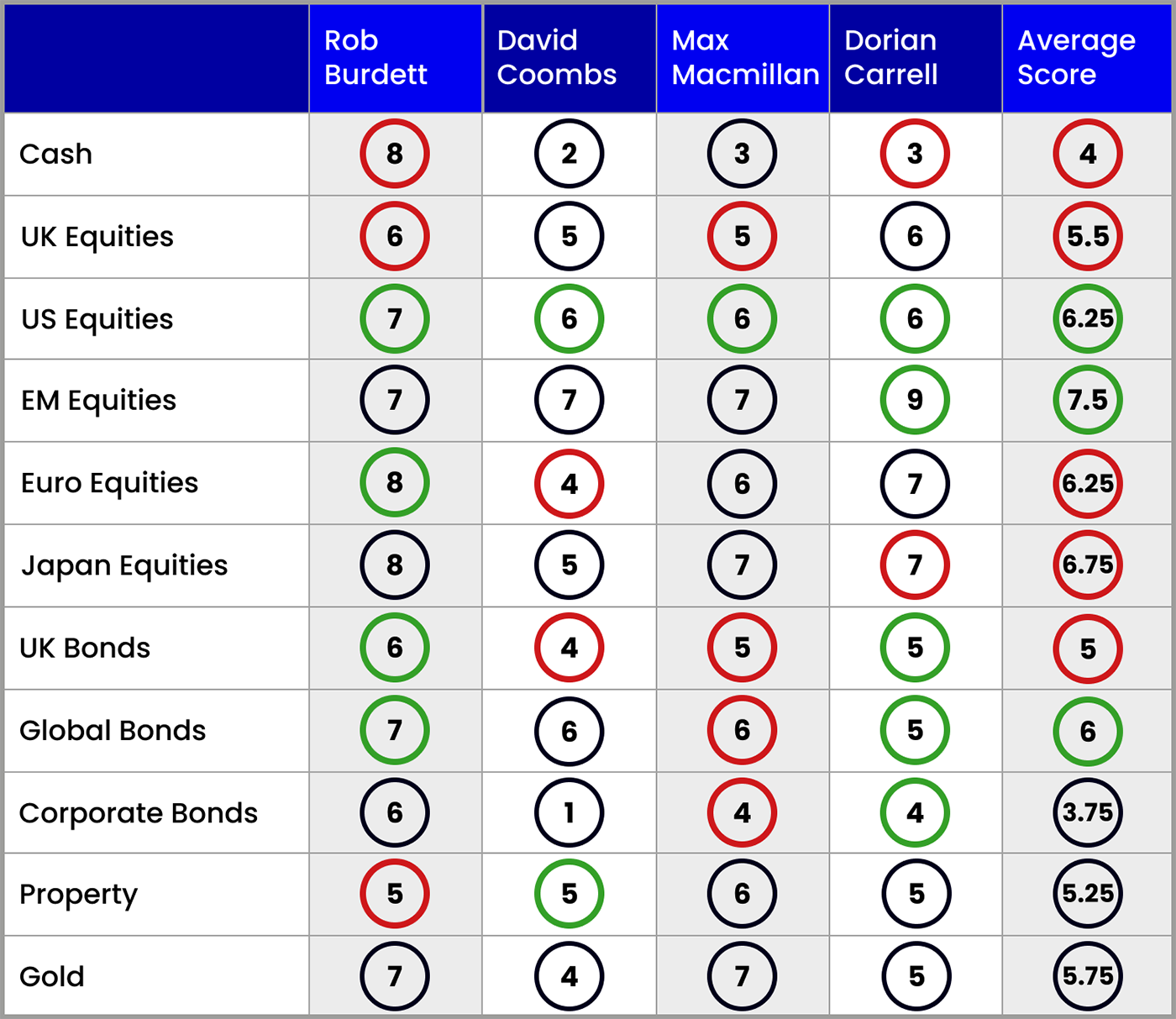
Note: the scorecard is a snapshot of views for the second quarter of 2026. How the panellists’ views have changed since the fourth quarter of 2025: red circle = less positive, green circle = more positive. Key to scorecard: EM equities = emerging market equities. 1 = poor, 5 = neutral and 9 = excellent.
Panellist profiles
Rob Burdett is head of multi-manager with Nedgroup Investments.
Dorian Carrell is head of multi-asset income at Schroders.
David Coombs is head of multi-asset investments at Rathbones.
Max Macmillan is head of strategic asset allocation at Aberdeen.
These articles are provided for information purposes only. Occasionally, an opinion about whether to buy or sell a specific investment may be provided by third parties. The content is not intended to be a personal recommendation to buy or sell any financial instrument or product, or to adopt any investment strategy as it is not provided based on an assessment of your investing knowledge and experience, your financial situation or your investment objectives. The value of your investments, and the income derived from them, may go down as well as up. You may not get back all the money that you invest. The investments referred to in this article may not be suitable for all investors, and if in doubt, an investor should seek advice from a qualified investment adviser.
Full performance can be found on the company or index summary page on the interactive investor website. Simply click on the company's or index name highlighted in the article.