Stockwatch: this heavily shorted FTSE 100 share now offers value
Having sunk to multi-year lows in March, this blue-chip share has enjoyed a modest bounce. Analyst Edmond Jackson reveals why he believes it’s now a contrarian buy.
1st May 2026 11:33
by Edmond Jackson from interactive investor

Autotrader Group (LSE:AUTO) is an intriguing conundrum. Its chart can look as if February and March manifested a “double bottom” reversal pattern, but many shares have recently risen as investors have been happy to buy the drop.
- Invest with ii: Top UK Shares | Share Tips & Ideas | Cashback Offers
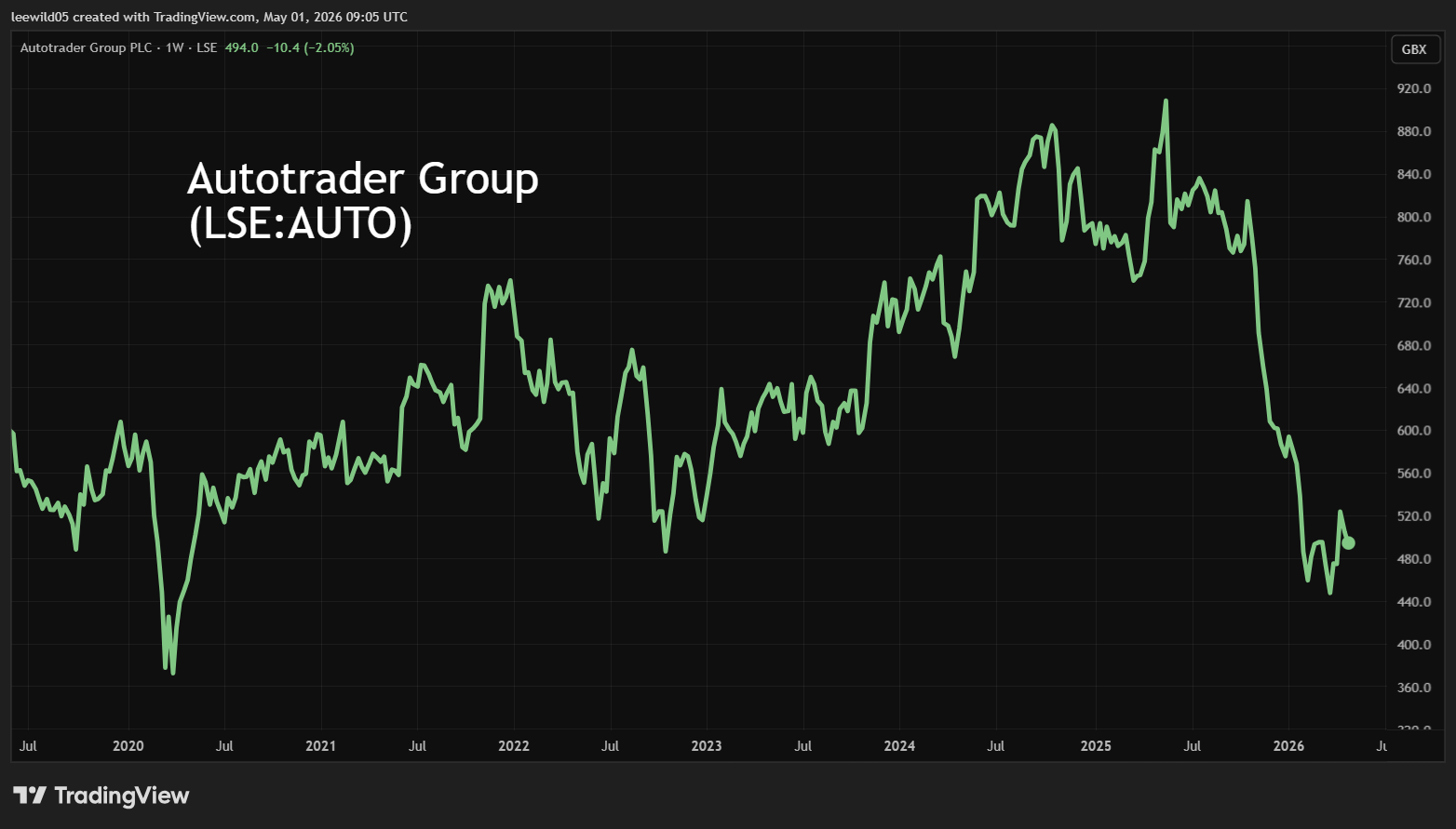
Source: TradingView. Past performance is not a guide to future performance.
This is the UK’s largest automotive sales platform. Listed in 2015, it offers a comprehensive used car buying experience and proprietary vehicle data, involving partners across the automotive industry. Key financial statistics suggest a growth business. Revenue has risen from £369 million in 2020 to £667 million projected for the current March 2027 year, which would represent over 80% top line growth, and consistently, too.
The business model enjoys resilient operating margins above 60%, hence similar returns on capital, while net finance costs (mostly leases) barely make a shave on operating profit. Low capital expenditure means free cash flow ahead of earnings.
Such a profile should typically involve a price/earnings (PE) ratio in the 20s, or even higher perhaps, but at 496p currently Autotrader’s PE is 12.8 times the earnings per share (EPS) consensus for the year to 31 March 2027, assuming net profit of £325 million. The prospective yield is 2.6% with 3x earnings cover.
Currently a strong conviction short among hedge funds
Yet the disclosed short position in Autotrader (institutions over 0.5% of the issued share capital) has soared from zero last December to 10.1%, making it the fourth most-shorted share on the London market.
For what it’s worth, this is slightly down on 10.5% recently as two funds continue to decrease, although nine have increased their short positions in March or April. Marshall Wace, whom I respect, was short 1.1% as of 28 April.
- Bank of England holds rates but prospect of hikes loom
- Trading Strategies: are Rio Tinto shares worth buying now?
Considering Autotrader is a £4.1 billion FTSE 100 company, these amount to conviction bets, even if hedge funds involved are well diversified on the short trade.
Their rationale most likely is that new AI entrants threaten to disrupt Autotrader’s competitive advantage, hence margins in the long run. Examples include Motoria, allowing buyers to stipulate their needs and obtain listings according to such criteria; Seeze, which finds vehicles listed below estimated market value; and WheelsAI, which aims to help buyers find their best car with verified checks and enhanced search.
In the near term, there are warnings of a reduction in five- to seven-year-old used car supply and a risk the shares get dropped from the FTSE 100 index.
A parallel with analytics group Relx?
RELX (LSE:REL) is also in the FTSE 100 and quite similarly sold off on AI encroachment fears. After halving since last July to near 2,000p in February, its market price is currently around 2,680p. Both companies are challenged by new AI entrants yet are embracing AI. Autotrader says “we see a rich future pipeline of AI opportunities to drive improved performance, efficiency and time saving for our customers...building on our advertising, data and digital retailing products”.
The crux seems to be whether AI enhancement of a currently superior overall platform – enjoying strong support among car dealers, the principal source of Autotrader’s revenue – can withstand greater competition from start-ups. And who knows what kind of edge new arrivals might develop over time?
Not surprisingly, management pitches for a happy medium: “We believe AI platforms will increasingly become an alternative interface to existing search engines for car buyers to discover our brand...we expect to increase our visibility and integration, although we remain cautious over the nature and extent of data we share.” At least they perceive the threat and are ready to adjust.
- Seraphim Space’s share issue: all you need to know
- How to protect your pension from a midlife curveball
49% of traffic already derives from the Autotrader app and (like Relx) management contends “the value of Autotrader is the proprietary data that enables us to deliver a powerful and unique consumer and retailer experience...developed by us over many years, unique to the UK vehicle market and difficult to replicate”.
A dilemma with this, however, is it sounding essentially like what Autotrader should be taking anyway, to sustain its business, whereas new AI entrants make the marketplace more crowded and are liable to take share. Amazon Autos is also rolling out as a sales platform, likely in the UK soon.
There is also a parallel with Rightmove (LSE:RMV) where both companies have an approximate 75% UK market share.
Lack of trading updates
One’s instinct when seeing an ostensibly strong business is to check recent trading and the outlook. Yet the last time Autotrader reported was its 6 November half-year results to 30 September, which showed revenue and profit up 5-6%, although at the per share level buybacks helped earnings rise 11% and the dividend by 9%. This was backed by operational cash flow up 7% to £214 million, ahead of earnings.
91% of revenue derived from “trade” - retail forecourts rose 6% year-on-year, while consumer services fell 9%.
The statement on current trading and the outlook was quite generic: “We continue to see strong levels of demand for used cars, with a record number of cross platform visits on Autotrader...the number of cars advertised during the first half also increased, although numbers involve low single-digit growth.”
Yet the full-year outlook to 31 March was still affirmed, requiring Autotrader to announce if that has changed, with annual results due on Thursday 21 May. I suspect hedge funds are anyway taking a longer-term bearish view that may not manifest for a while.
Autotrader - financial summary
Year end 31 Mar
| 2020 | 2021 | 2022 | 2023 | 2024 | 2025 | |
| Turnover (£ million) | 369 | 263 | 433 | 500 | 571 | 601 |
| Operating margin (%) | 70.2 | 61.3 | 70.2 | 59.3 | 61.1 | 62.7 |
| Operating profit (£m) | 259 | 161 | 304 | 297 | 349 | 377 |
| Net profit (£m) | 205 | 128 | 245 | 234 | 257 | 283 |
| EPS - reported (p) | 22.1 | 13.2 | 25.6 | 24.8 | 28.1 | 31.6 |
| EPS - normalised (p) | 22.0 | 13.2 | 25.6 | 23.3 | 28.1 | 31.6 |
| Operating cashflow/share (p) | 21.1 | 12.9 | 28.4 | 28.3 | 31.4 | 34.0 |
| Capital expenditure/share (p) | 0.2 | 0.1 | 0.3 | 0.4 | 0.4 | 0.4 |
| Free cashflow/share (p) | 20.9 | 12.8 | 28.1 | 27.9 | 31.0 | 33.6 |
| Dividend/share (p) | 2.4 | 5.0 | 8.2 | 8.4 | 9.6 | 10.6 |
| Covered by earnings (x) | 9.2 | 2.6 | 3.1 | 3.0 | 2.9 | 3.0 |
| Return on total capital (%) | 54.7 | 31.6 | 62.1 | 49.1 | 58.6 | 65.1 |
| Cash (£m) | 37.6 | 45.7 | 51.3 | 16.6 | 18.7 | 15.3 |
| Net debt (£m) | 282 | -10.6 | -41.8 | 52.1 | 15.9 | -11.8 |
| Net assets (£m) | 142 | 459 | 473 | 527 | 552 | 569 |
| Net assets per share (p) | 15.4 | 47.5 | 50.1 | 57.4 | 61.2 | 64.7 |
Source: company accounts.
Kernow Asset Management expresses undisclosed position
Kernow is a small hedge fund formed in 2019, specialising in contrarian UK equities, and getting attention for how it previously bought into over-50s travel and insurance group Saga (LSE:SAGA), which proceeded to multiple by four to six times. Other key holdings include Secure Trust Bank (LSE:STB), Frasers Group (LSE:FRAS), CMC Markets (LSE:CMCX), Metro Bank Holdings (LSE:MTRO), Galliford Try Holdings (LSE:GFRD) and Card Factory (LSE:CARD). Take your view on those as to this manager’s credentials on the contrarian tack.
While currently too small to feature in disclosed holdings (around the 5% level rather than 3%), Kernow’s February newsletter mentioned a position taken in Autotrader, citing the rationale that the business is “evolving from billboard to toll booth”. Regarding car dealers’ use of the platform, the company said: “It is difficult to abandon the castle when that is the only place customers spend money securely,” hence it being hard for dealers to boycott Autotrader despite it frustratingly reducing control of their opening negotiation price.
- Three corporate bonds make first move to appeal to DIY investors
- Sign up to our free newsletter for investment ideas, latest news and award-winning analysis
Investigation by Competition and Markets Authority
A CMA investigation was declared on 27 March, the day when Autotrader shares struck a 445p multi-year low. The shares have actually been climbing since, albeit in sympathy with the market. The CMA is investigating five firms over fake and misleading reviews; Feefo and Autotrader specifically over whether they denied consumers a fully rounded picture of people’s experiences by omitting some bad reviews.
Significantly a function of your risk appetite
There are inherent uncertainties here, hence scope to take contrasting views on whether Autotrader’s historic “moat” is breached by AI, similar to fears about Relx recently.
Relx appeared to attract no short selling but is capitalised about 11x Autotrader, hence any shorts over the 0.5% threshold would have been risky indeed.
Shorting has become a crowded trade, so if the downward momentum is slowing, it may prompt short sellers to close positions and buy back stock - so-called short covering. Usually, a prime target for shorting is a failing business with high debts and questionable accounts, none of which apply here.
On that basis, I am inclined to think Autotrader is worth considering as a contrarian “buy”.
Edmond Jackson is a freelance contributor and not a direct employee of interactive investor.
These articles are provided for information purposes only. Occasionally, an opinion about whether to buy or sell a specific investment may be provided by third parties. The content is not intended to be a personal recommendation to buy or sell any financial instrument or product, or to adopt any investment strategy as it is not provided based on an assessment of your investing knowledge and experience, your financial situation or your investment objectives. The value of your investments, and the income derived from them, may go down as well as up. You may not get back all the money that you invest. The investments referred to in this article may not be suitable for all investors, and if in doubt, an investor should seek advice from a qualified investment adviser.
Full performance can be found on the company or index summary page on the interactive investor website. Simply click on the company's or index name highlighted in the article.
Disclosure
We use a combination of fundamental and technical analysis in forming our view as to the valuation and prospects of an investment. Where relevant we have set out those particular matters we think are important in the above article, but further detail can be found here.
Please note that our article on this investment should not be considered to be a regular publication.
Details of all recommendations issued by ii during the previous 12-month period can be found here.
ii adheres to a strict code of conduct. Contributors may hold shares or have other interests in companies included in these portfolios, which could create a conflict of interests. Contributors intending to write about any financial instruments in which they have an interest are required to disclose such interest to ii and in the article itself. ii will at all times consider whether such interest impairs the objectivity of the recommendation.
In addition, individuals involved in the production of investment articles are subject to a personal account dealing restriction, which prevents them from placing a transaction in the specified instrument(s) for a period before and for five working days after such publication. This is to avoid personal interests conflicting with the interests of the recipients of those investment articles.