Stockwatch: should you follow Warren Buffett into tech giant?
Despite handing over control of his investment vehicle, the world’s most famous investor is still very active. Analyst Edmond Jackson assesses recent stakebuilding.
26th May 2026 12:25
by Edmond Jackson from interactive investor
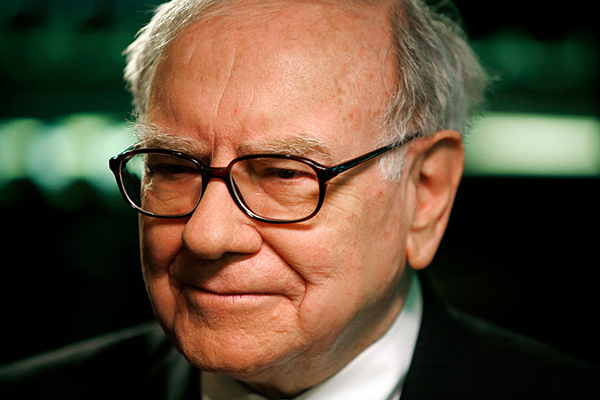
Photo: Timothy Fadek/Corbis via Getty Images.
It is timely to consider how Berkshire Hathaway Inc Class B has more than tripled its stake in Google parent Alphabet Inc Class C, making this its seventh-largest equity holding at around $16.6 billion (£12.4 billion).
It comes despite market valuation risks, with potentially higher US inflation affecting growth share multiples. Meanwhile, Bill Ackman’s Pershing Square investment company is on the opposite side of the trade, selling down its successful Alphabet investment to switch into Microsoft Corp.
- Invest with ii: SIPP Account | Stocks & Shares ISA | See all Investment Accounts
Value, according to Buffett principles (some anyway), is implied in Alphabet, even though 95-year-old chair Warren Buffett (pictured) has handed control to CEO Greg Abel. Alphabet’s dominant position in digital advertising, its surging cloud revenues and strength in AI appear to match Buffett’s preference for a competitive “moat” to sustain quality earnings.
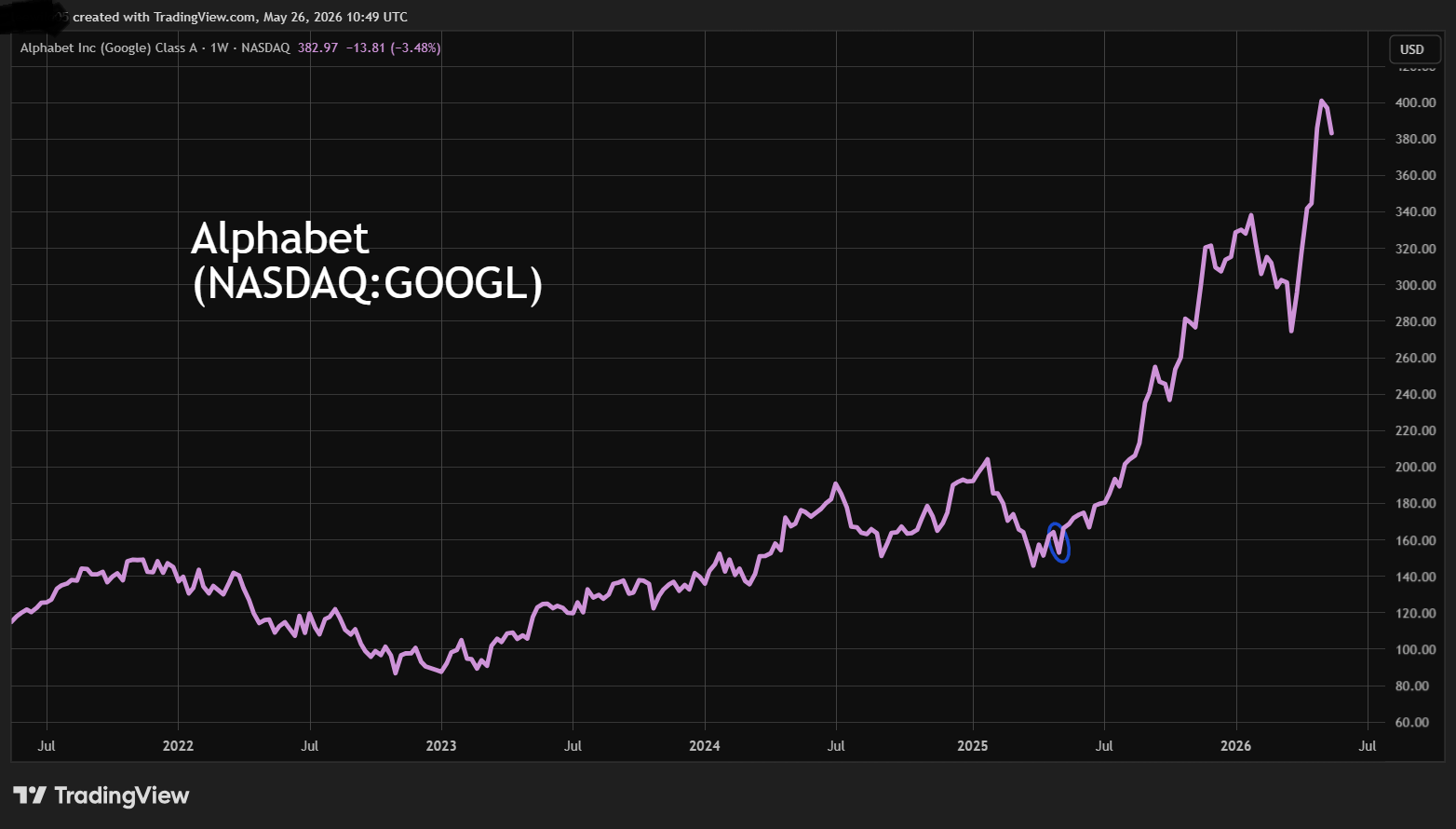
The logic would be that despite a trailing price/earnings (PE) ratio around 30x at $379, Alphabet is well placed to grow into a high valuation over time, so don’t fuss over investment timing.
I initially drew attention in July 2021, wary of Alphabet’s 28x trailing PE versus inflation risk, but respecting its calibre as an international growth share. With a “hold” stance I therefore suggested to buy dips from $2,730 ($136 nowadays after a 20 for 1 stock split). This proved correct in the short to medium term, given a 36% decline by November 2022.
I concede, however, only to asserting “hold” several times thereafter, whereas Berkshire manifestly signals greater belief in a “buy” rating – at least up to $320 or so. Abel appears to have averaged up recently: initially the A class shares were bought at an average price of $209 during the first quarter of 2025, then added to at an average price of $320 in the first quarter of 2026.
It accords with how Buffett’s strategy shifted (admittedly around half a century ago) from his early mentor Benjamin Graham, who emphasised a discount to net assets as a benchmark for intrinsic value, to Phil Fisher, a renowned 20th-century growth investor who prioritised intangible growth qualities along with figures. Better to buy into a quality growth business at a fair price than a turnaround “bargain”.
Source: TradingView. Past performance is not a guide to future performance.
Is US inflation a key factor for Alphabet and big tech shares?
Growth shares rise in times of falling inflation because their future profits are more valuable. Cheaper borrowing also fuels investment, and such shares tend to have high returns on capital. The opposite also applies, however.
While in July 2021 I noted a strong earnings release from Alphabet saying that this highlighted its appeal as a quality growth share, I said its flat response might relate to concerns over US inflation, possibly leading to higher interest rates. Market price fell 36% to $87 equivalent by early November 2022 before rallying to $205 by end-January 2025.
Hence, you could say it is axiomatic the Strait of Hormuz promptly resumes genuine free flow of shipping, otherwise inflation will soon soar. AI-related price pressures already helped April’s US consumer price inflation rise to 3.8% from 3.3% in March, but higher fuel prices will impact next.
More positively, if the US and Iran can reach a reliable working settlement, then oil prices could “look through” a near-term supply crunch such that fears of $150-plus a barrel do not manifest.
But if US inflation was to reach 5%, it looks likely the US Federal Reserve would raise interest rates in September.
Can company factors outweigh inflation risk?
The consensus of US analysts targets $428 for Alphabet stock over 12 months, implying 13% upside, yet 36% downside manifested due to inflation. Does $379, on a perhaps quite similar PE to 2021, therefore constitute acceptable risk/reward? The dividend yield is barely 0.2% and I don’t see how any “margin of safety” – supposedly a key Buffett principle – can be quantified. You have to rely on competitive strengths.
Alphabet is, however, presenting the biggest upgrade to its Search box function in 25 years. Rather than return a simple list of web links, there will be “an AI-powered interactive experience at all times”. Yet for a while I have noticed Google Search tends to return “thinking” then, within seconds, an AI overview of summary information plus a list of web links.
The new Search box is said to “expand to accommodate longer, more conversational queries” and have an AI-powered suggestion system to help users craft more complex and nuanced inquiries.
The hope must be that this raises users’ attention time for Google to yield advertising revenue. It already enjoys around a 90% share of the global search engine market with Microsoft’s Bing (within the Windows Edge browser) - its closest competitor with only 5%.
With Google Search, Maps and Gmail, constituting 56% of group revenue, this advance could be significant for Alphabet’s earnings quality, although digital advertising can still fluctuate.
YouTube is 15% of revenue, its advertisements at 10% with a 12% revenue growth rate, while subscriptions are 5%. Alphabet’s purchase of YouTube for $1.65 billion in 2006 is widely considered to be one of the most successful tech acquisitions, evolving from a risky start-up to global media powerhouse. While Alphabet doesn’t disclose its net profit, the platform is estimated now to be worth $400-500 billion.
Google Cloud is 13% of revenue, providing enterprise cloud infrastructure and productivity tools such as Google Workspace. Yet there is tough competition from Amazon.com Inc and Microsoft.
Google Subscriptions, Platforms and Devices similarly constitute 12% of revenue from the sale of apps and branded hardware such as Pixel phones.
Dominance in digital advertising is therefore Alphabet’s key offering, which you could say has a cyclical element. It’s the same with the shares (when highly rated) according to inflation. I therefore find it hard to exclude a sense that one should pay some attention to investment timing.
Does Microsoft offer more compelling valuation?
While Alphabet remains the third-largest holding for the UK’s Fundsmith Equity I Acc, Ackman’s Pershing Square Holdings Ord has sold 95% of the holding it built from early 2023 - making gains of more than 280% - and re-investing in Microsoft after its shares dropped on cloud growth concerns and accelerated AI infrastructure spending.
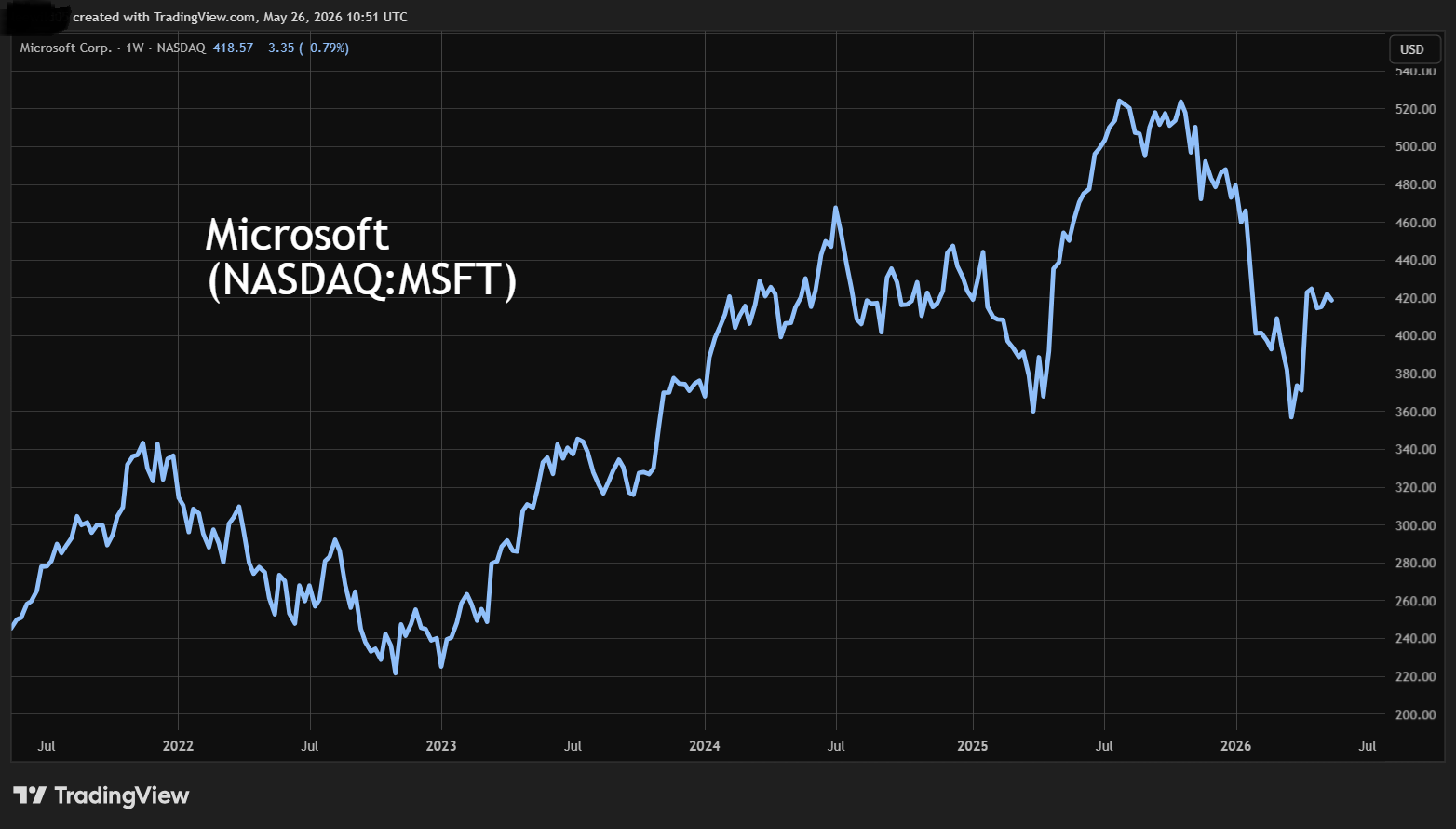
Bill Ackman has publicly acknowledged this sale was “not a bet against the company” and has maintained a bullish long-term stance on Alphabet for its competitive moat and AI capabilities. He does, however, regard Microsoft as more attractively valued despite a 25x trailing PE and sub-0.9% yield at $419.
It would appear that he is attracted by Microsoft’s AI initiatives such as its Copilot productivity tools and the Azure cloud infrastructure, enabling the company to capitalise on both consumer and business workflows. My hands are up as to judging this kind of thing.
- Insider: directors build stakes in unloved FTSE 350 stocks
- Sign up to our free newsletter for investment ideas, latest news and award-winning analysis
While Microsoft has recovered 17% from its $357 low for 2026 at the end of March, that fall was significantly with the wider market in response to the US/Iran war kicking off. The rebound came in mid-April to over $400, since when it has traded volatile sideways.
For what it is worth, the consensus of sell-side analysts targets $560 for Microsoft, implying 34% upside. What a change at the company and in sentiment towards it since Microsoft traded on a single-figure PE at $24.75 when I drew attention to it as a contrarian “buy” in May 2011! Such a call was easier due to an undemanding valuation, whereas now it could be a full price if the story shifts unpredictably.
This latest drop is modest in a five-year chart context, and I cannot shake off a sense of how Microsoft shares are also exposed to higher US inflation reads. In that case, it could suggest a “head-and-shoulders” reversal pattern.
Source: TradingView. Past performance is not a guide to future performance.
Long-term hold ratings, but mind macro risk
This comparison of Alphabet and Microsoft is useful to highlight what I see as pretty full valuations.
Should the US and Iran reach a broadly satisfactory settlement, then global tech would probably join a relief rally.
From a capital protection view however, I would hold off until US inflation risks are clearer, given the risk of a spike.
Edmond Jackson is a freelance contributor and not a direct employee of interactive investor.
These articles are provided for information purposes only. Occasionally, an opinion about whether to buy or sell a specific investment may be provided by third parties. The content is not intended to be a personal recommendation to buy or sell any financial instrument or product, or to adopt any investment strategy as it is not provided based on an assessment of your investing knowledge and experience, your financial situation or your investment objectives. The value of your investments, and the income derived from them, may go down as well as up. You may not get back all the money that you invest. The investments referred to in this article may not be suitable for all investors, and if in doubt, an investor should seek advice from a qualified investment adviser.
Full performance can be found on the company or index summary page on the interactive investor website. Simply click on the company's or index name highlighted in the article.
Disclosure
We use a combination of fundamental and technical analysis in forming our view as to the valuation and prospects of an investment. Where relevant we have set out those particular matters we think are important in the above article, but further detail can be found here.
Please note that our article on this investment should not be considered to be a regular publication.
Details of all recommendations issued by ii during the previous 12-month period can be found here.
ii adheres to a strict code of conduct. Contributors may hold shares or have other interests in companies included in these portfolios, which could create a conflict of interests. Contributors intending to write about any financial instruments in which they have an interest are required to disclose such interest to ii and in the article itself. ii will at all times consider whether such interest impairs the objectivity of the recommendation.
In addition, individuals involved in the production of investment articles are subject to a personal account dealing restriction, which prevents them from placing a transaction in the specified instrument(s) for a period before and for five working days after such publication. This is to avoid personal interests conflicting with the interests of the recipients of those investment articles.