Wild’s Winter Portfolios 2025: stocks rebound from war low
As hopes of peace in the Middle East cause a surge in global stock markets, Lee Wild reveals the impact on portfolios in March and where they stand with just two weeks of the investment winter to go.
16th April 2026 09:42
by Lee Wild from interactive investor

After a strong February, global stock markets had one of their worst months for years in March following US President Donald Trump and Israeli’s decision to go to war with Iran. As well as the human impact on those living in the Middle East war zone, investor portfolios took a hit as stock prices, other risk assets and gold plunged as the price of oil rocketed way past $100 a barrel.
- Invest with ii: SIPP Account | Stocks & Shares ISA | See all Investment Accounts
As traders worried about how the conflict could spread and how high oil prices might go, possibly triggering a global recession, investors bailed out of anything to do with travel and sectors with high energy use. Airlines and interest-rate sensitive stocks bore the brunt of the selling.
Tech stocks, already under pressure to explain how they hope to recover massive spending on artificial intelligence (AI), were dumped too. Meta Platforms Inc Class A (NASDAQ:META) ended the month with an 11.7% loss, Alphabet Inc Class A (NASDAQ:GOOGL) fell 7.9%, Tesla Inc (NASDAQ:TSLA) 7.6% and Microsoft Corp (NASDAQ:MSFT) a further 5.7%, taking the software giant’s decline from its October peak to 36%.
In the UK, housebuilders suffered on fears that interest rates may have to rise if high oil costs send inflation north again. Many miners struggled, as did anything that relies on a buoyant consumer.
Once the dust had settled at month-end, the FTSE AIM All Share index had dived 12.5%, the FTSE 250 index lost 10.7% and the FTSE 100 6.7%. Elsewhere, the Japanese Nikkei index slumped 13.2%, the German Dax fell 10.3% and the French Cac 8.9%. On Wall Street, the main indices were each down around 5%.
Our winter portfolios were not immune, seeing a significant chunk of the previous month’s gains wiped out. Wild’s Consistent Winter Portfolio fell 5.2%, taking returns for the five winter months so far to a negative 3.1%. A more modest 2.6% monthly decline for Wild’s Aggressive Winter Portfolio meant it did at least preserve a gain of 1.6% for this year’s seasonal strategy. However, the FTSE 350 benchmark index was easily the worst affected, slumping 7.2% during the month, reducing its winter profit from 11.7% to a modest 3.7%.
- ISA investing: nine ii experts reveal their ISA tips for 2026-27
- Five ways to hit the 2026-27 tax year running
As a reminder, the consistent winter portfolio is made up of the five FTSE 350 companies that have risen the most winters (between 1 November and 30 April) over the past decade. Entry criteria is relaxed slightly for the aggressive winter portfolio, giving up some consistency in return for potentially bigger profits. Still, all constituents must have risen in at least eight of the previous 10 winters. It’s also worth repeating that these are data-driven portfolios requiring no manual intervention.
However, as I write there are just two weeks of this six-month strategy left to run. Happily, a ceasefire in the Middle East and hopes of a permanent resolution to the conflict have sent stock markets racing back toward their pre-war levels and, in the case of Wall Street, to record highs! Currently, the consistent portfolio is up 2%, the aggressive basket of shares is up 8.5%, a record for the winter so far, and the FTSE 350 index is up 8%.
Wild’s Consistent Winter Portfolio 2025-26
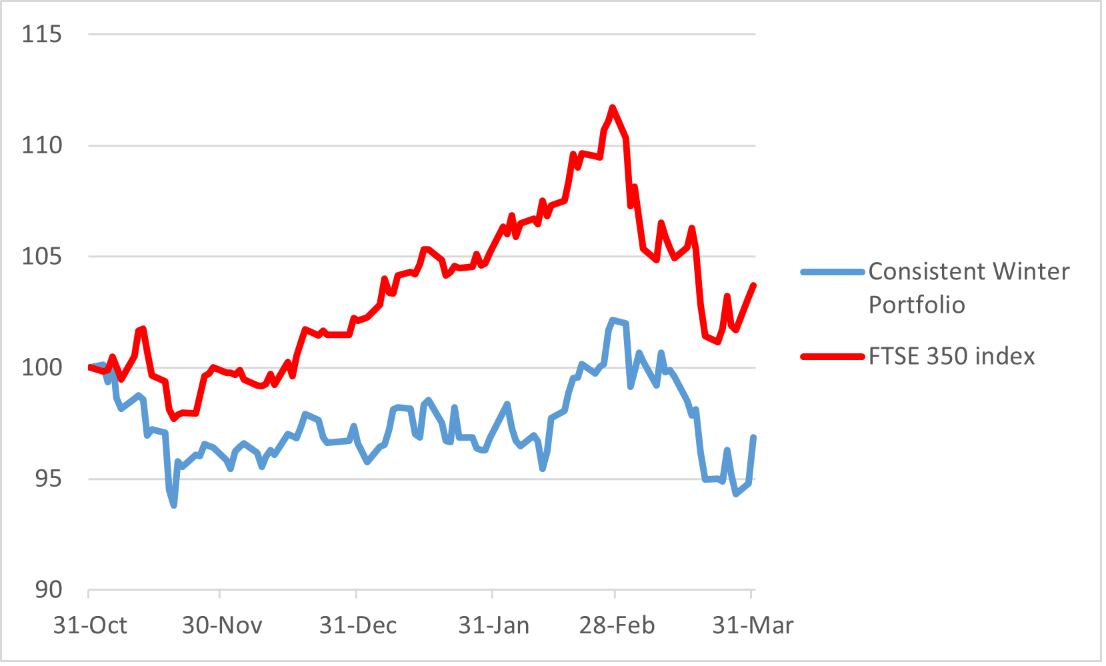
Past performance is not a guide to future performance.
We’ll start with the good news and a 6.3% jump for insurance firm Admiral Group (LSE:ADM). It’s had a poor winter but record annual profits thanks to a strong UK motor business went some way to reversing January’s slump. Shares are now down only 3.8% this winter season having been down as much as 19% two months ago.
A solid end-of-year trading update supported Halma (LSE:HLMA), although wider market turmoil saw the safety products conglomerate suffer a monthly share price decline of 9.1%. However, it is still up 7.2% this winter.
- How to build a medium-risk ISA portfolio
- Alternatives to the most-popular ISA funds
- How to build a higher-risk ISA portfolio
Transport operator FirstGroup (LSE:FGP) had another stinker. Despite predicting “modest growth” in adjusted profit for the year to March, investors needed no excuse to dump stock, leaving shares down 9.6% for the month and 20.9% over the past five months.
Soft-drinks maker AG Barr (LSE:BAG) fell 6.3% despite well-received annual results at the end of March. Those losses dragged performance for the seasonal strategy 2.5% into the red.
IT services firm Computacenter (LSE:CCC) took a 5.8% hit as a mixed set of annual results had little chance of supporting the shares in such a troublesome month. Still, it is the portfolio’s second-best performer this winter with a 4.3% profit.
Wild’s Aggressive Winter Portfolio 2025-26
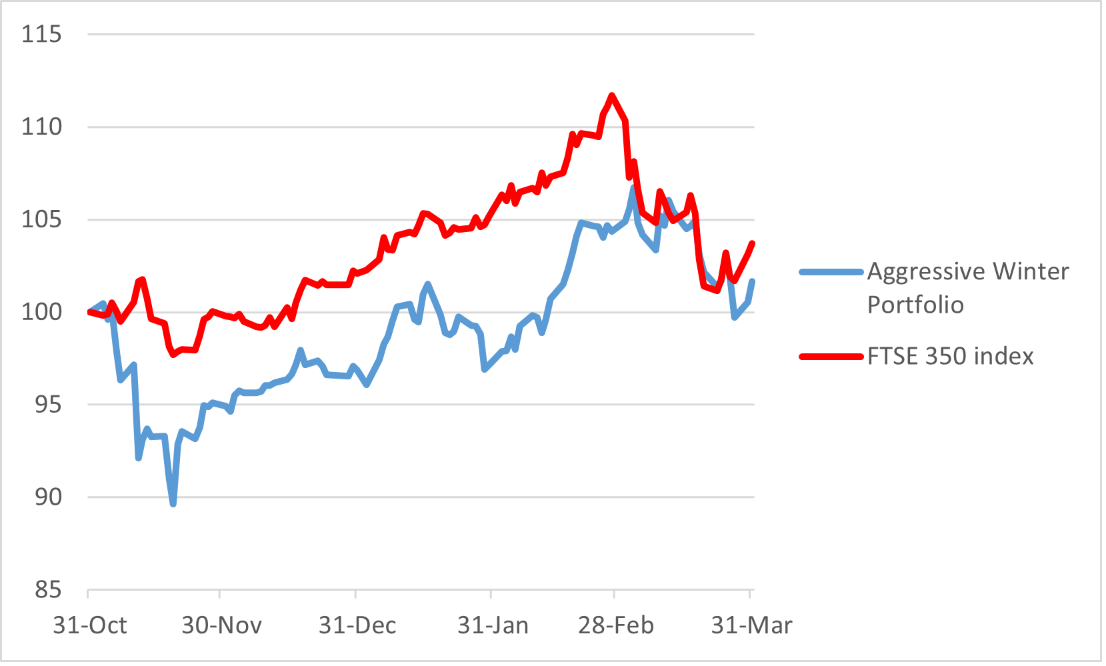
Past performance is not a guide to future performance.
Wild’s Aggressive Winter Portfolio has been more resilient this winter than its historically more reliable cousin, and its performance in March was no different. Despite the obvious pressures, it outperformed the FTSE 350 for periods during the month, something it’s not done since November.
While FirstGroup, which appears in both this year’s portfolios, did poorly, losses elsewhere were more modest, while a 4.2% gain for BAE Systems (LSE:BA.) took the defence contractor’s winter returns to 17.6%.
- The 11 ‘forever shares’ I’ve picked for my kids’ Junior ISAs
- Sign up to our free newsletter for investment ideas, latest news and award-winning analysis
Games Workshop Group (LSE:GAW) has been a great addition to the portfolio this year, and a 1.1% drop for the month still leaves shares in the fantasy wargames company up 11.1% this winter.
Underperforming meat packer Hilton Food Group (LSE:HFG) turned in a 3.4% loss, although a 20.7% five-month deficit is not the worst it’s been since this year’s portfolio began at the end of October. News of a resilient core meat business in its annual results certainly made the monthly share performance more respectable.
Finally, engineering contractor Keller Group (LSE:KLR) started March with great annual results that sent its shares to a record high. Understandably, they then drifted lower with the wider market, ending the month with a 4.6% decline. However, a 21% profit for the past five months means it’s still had a cracking winter so far.
These articles are provided for information purposes only. Occasionally, an opinion about whether to buy or sell a specific investment may be provided by third parties. The content is not intended to be a personal recommendation to buy or sell any financial instrument or product, or to adopt any investment strategy as it is not provided based on an assessment of your investing knowledge and experience, your financial situation or your investment objectives. The value of your investments, and the income derived from them, may go down as well as up. You may not get back all the money that you invest. The investments referred to in this article may not be suitable for all investors, and if in doubt, an investor should seek advice from a qualified investment adviser.
Full performance can be found on the company or index summary page on the interactive investor website. Simply click on the company's or index name highlighted in the article.
Disclosure
We use a combination of fundamental and technical analysis in forming our view as to the valuation and prospects of an investment. Where relevant we have set out those particular matters we think are important in the above article, but further detail can be found here.
Please note that our article on this investment should not be considered to be a regular publication.
Details of all recommendations issued by ii during the previous 12-month period can be found here.
ii adheres to a strict code of conduct. Contributors may hold shares or have other interests in companies included in these portfolios, which could create a conflict of interests. Contributors intending to write about any financial instruments in which they have an interest are required to disclose such interest to ii and in the article itself. ii will at all times consider whether such interest impairs the objectivity of the recommendation.
In addition, individuals involved in the production of investment articles are subject to a personal account dealing restriction, which prevents them from placing a transaction in the specified instrument(s) for a period before and for five working days after such publication. This is to avoid personal interests conflicting with the interests of the recipients of those investment articles.