Shares for the future: lessons from manufacturing’s Willy Wonka
We have lost sight of how things are made and the consequences of making them that way, but analyst Richard Beddard has met someone seeking to change all that.
15th May 2026 15:00
by Richard Beddard from interactive investor

Gene Wilder as Willy Wonka in the 1971 film ‘Willy Wonka and the Chocolate Factory’. Credit: Silver Screen Collection/Getty Images.
I am taking a break this week, so in lieu of company analysis I have prepared a book review. It is a book about manufacturing that promises to tell us not only “how the world is made”, but “how we can do it better”.
Let us start at the very beginning, with the pages of endorsements. My favourite is “Reading this book is like being given a tour of the world’s factories by a real-life Willy Wonka.”
- Invest with ii: Top UK Shares | Share Tips & Ideas | Cashback Offers
Manufacturing’s Willy Wonka is the author Tim Minshall (pictured below), a professor of innovation at the University of Cambridge. I can testify that his Wonka-ish enthusiasm, imbued in the book’s pages, extends to real life because I was in the audience at a talk he gave to promote the book.
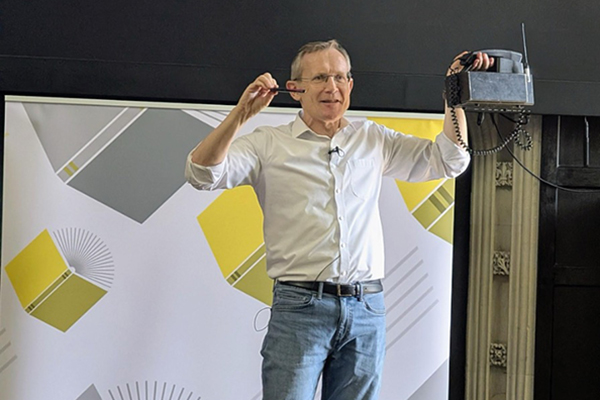
Tim Minshall compares distant generations of mobile phones on stage at the Cambridge Book Festival, April 2026.
Minshall’s central message is that we have lost sight of how things are made, and the consequences of making them that way.
“Manufacturing has become like the sewage system”, he writes, “Essential for our lives yet out of mind until something goes wrong... And lately, a lot of things have been going wrong.”
The book starts with a case study on toilet paper. You probably used 100 rolls last year. Each of the up to five layers of toilet paper can be made of fibres from Scandinavian trees, which add strength, blended with fibres from South American trees, which add softness.
Layers of toilet paper are our first step into a complex world. Minshall takes us to forests, sawmills, pulp mills, rolling mills, distribution centres, and supermarkets. Processes use gigantic machinery and are connected by fleets of ships, trucks, trains and vans. Thousands of humans co-ordinating, making and moving, bring you one pack of toilet paper.
The resilience of the toilet paper manufacturing network was tested during the Covid pandemic, when demand from consumers increased 700%.
There was an element of hysteria in the panic buying, but it was also logical. We were spending more time at home. Demand for “commercial” toilet paper (for offices) dropped, but it is thicker and typically contains more recycled fibre. It is packaged in larger bundles than the consumer product. Factories could not just switch, and the shelves emptied.
The complexity of assembling even simple products, like toilet paper, at scale and the efficiency of the networks that produce them makes manufacturing susceptible to shocks. It is hard to predict how one node’s failure will affect the others.
With anecdotes and explanations like this, Your Life is Manufactured gives us a crash course in the history of mass production, lean manufacturing, factory automation, logistics and outsourcing, and dumps us at an interesting juncture. Innovation and digitalisation herald more change, but we are simultaneously experiencing the consequences of the extractive, globalised world we already live in.
- Sign up to our free newsletter for investment ideas, latest news and award-winning analysis
- Seven inheritance tax planning mistakes to avoid
Innovation and digitalisation, though, are extensions of earlier phases of disruption and automation, making manufacturing more efficient and exposing us to new risks. High among them is the role of humans. Digitalisation means we can order food to our front door, but the jobs created are low-value gig economy jobs delivering it.
Minshall worries small manufacturers with limited resources will not have the resources to use new technologies. And he recognises that digitalisation is dependent on two huge “machines” - the internet and the semiconductor manufacturing industry. Both have big vulnerabilities and consequently could be disrupted.
To see how manufacturing can address these problems, he takes inspiration from the Covid pandemic when by necessity and ingenuity vital products were designed and manufactured locally on incredibly compressed timescales.
Big manufacturers repurposed factories to make ventilators. Makers used new technology, such as 3D printing, to make face shields for health workers. A clothing company switched to making reusable surgical gowns, an innovation that improved on single-use gowns from China.
Minshall’s understanding of hospitals changed when he was called in to help Cambridge’s hospital reconfigure to accommodate a dramatic increase in patients, the likely enormous demand for oxygen, reduced staffing, the dangers of transmission, and, morbidly, all the dead bodies.
Hospitals, he realised, are factories manufacturing healthcare. Indeed, they have long made plaster casts, and manufacturers site facilities nearby so they can trial and develop devices. With the advent of personalised medicine, therapies will likely be manufactured in hospitals, or nearby, because the “vein to vein” time between extraction of cells from the human body and their reinjection is so critical.
Simultaneously, hospitals are using digital technologies to move beyond their buildings and provide “virtual wards” at home. The barriers of distance and scale that have separated us from manufacturing, are coming down.
A sustainable future requires manufacturers to move less and more cleanly. By prefabricating parts of buildings in factories, construction companies are reducing emissions from transport. Where it can, production should move closer to home, which will also create higher value jobs. Where it can’t, captains should sail more slowly, railway networks should carry a greater proportion of freight, and the way these vehicles are propelled needs to change to reduce our oil dependency.
The principle of reduce, reuse, recycle, has become a “common currency” in manufacturing, but it needs to be embraced more fully and extended to include lots of other Rs (renovate, repair...). At some point though, Minshall acknowledges that manufacturers’ enthusiasm for these principles may come up against their imperative to grow revenue and profit.
He says we need to rethink manufacturers’ business models so they depend less on obsolescence and more from extending the life of their products. Inspiration comes from the provision of jet engines as a service by manufacturers such as Rolls-Royce Holdings.
Today, manufacturers are responsible for maintaining and repairing jet engines, because they lease them to airlines. The manufacturer reduces its costs by designing better engines and fixing them before serious problems develop. Real-time data collected onboard jet engines and streamed back to Rolls-Royce’s operation rooms means engineers can pre-empt problems and schedule repairs or maintenance before a plane even lands.
The book is punctuated with examples of progress, but it is too slow for us to thrive on this planet. We have shirked responsibility by outsourcing manufacturing, and therefore responsibility for the emissions. Sustainable manufacturing heaps more complexity on already complex systems requiring tough decisions. Each node in manufacturing networks is dependent on others, so change presents a massive coordination problem.
- Wild’s Winter Portfolios 2025: both beat the market
- Income from £250K, IHT and pensions, and are ETFs riskier than funds?
- Sector Screener: two FTSE 350 stocks for long-term growth
Although the hurdles seem daunting, I loved the book. It covers a lot of ground lightly (but also provides links and reading lists for further exploration). It is fun and optimistic, but not blindly so. It ends with a flow chart of the process used in its own manufacture.
Your Life is Manufactured has renewed my enthusiasm for listed manufacturers that, like Renishaw, are enabling the transition to smarter manufacturing, or like Thorpe (F W), that have already made great strides towards sustainability.
The day after Tim Minshall pitched his book to us, our village hall hosted a farmer’s market selling local produce. Outside, a young couple had parked a mobile refillery. You provide the jar, they fill them from sacks within their van with loose coffee, nuts, sugar and spices.
Apart from fixing manufacturing, the author’s other agenda is to nudge consumers, or at least those that can afford it, in the right direction. He wants us to think twice before clicking “buy it now” for a product sourced far away. We filled our boots at the market.
If that sounds bucolic to you, Minshall believes a new industrial revolution ushered in by data sensors processed by server farms will give us a much greater appreciation of how things are made. “We have had returned to us the sight we had before the First Industrial Revolution, a time when we had a much greater, more intimate, connection with the process of manufacturing.” That, he says, will help us make things less bad. And then better.
Inevitably the book is stronger on where we are and how we got here than where we are going. But I have seen glimpses of the future that might work better, and that is encouraging.
There is a sequel to Your Life Is Manufactured coming. That too is encouraging.
No shares for the future!
The Decision Engine table will return next week. The last one is at the bottom of this article.
Richard Beddard is a freelance contributor and not a direct employee of interactive investor.
For more on the Decision Engine and Share Sleuth, please see Richard’s explainer.
Contact Richard Beddard by email: richard@beddard.net or on X: @RichardBeddard
These articles are provided for information purposes only. Occasionally, an opinion about whether to buy or sell a specific investment may be provided by third parties. The content is not intended to be a personal recommendation to buy or sell any financial instrument or product, or to adopt any investment strategy as it is not provided based on an assessment of your investing knowledge and experience, your financial situation or your investment objectives. The value of your investments, and the income derived from them, may go down as well as up. You may not get back all the money that you invest. The investments referred to in this article may not be suitable for all investors, and if in doubt, an investor should seek advice from a qualified investment adviser.
Full performance can be found on the company or index summary page on the interactive investor website. Simply click on the company's or index name highlighted in the article.
Disclosure
We use a combination of fundamental and technical analysis in forming our view as to the valuation and prospects of an investment. Where relevant we have set out those particular matters we think are important in the above article, but further detail can be found here.
Please note that our article on this investment should not be considered to be a regular publication.
Details of all recommendations issued by ii during the previous 12-month period can be found here.
ii adheres to a strict code of conduct. Contributors may hold shares or have other interests in companies included in these portfolios, which could create a conflict of interests. Contributors intending to write about any financial instruments in which they have an interest are required to disclose such interest to ii and in the article itself. ii will at all times consider whether such interest impairs the objectivity of the recommendation.
In addition, individuals involved in the production of investment articles are subject to a personal account dealing restriction, which prevents them from placing a transaction in the specified instrument(s) for a period before and for five working days after such publication. This is to avoid personal interests conflicting with the interests of the recipients of those investment articles.