SpaceX IPO: everything you need to know
With Elon Musk’s space business expected to launch on the stock market this summer, we look at what the company does, its valuation and possible ways to buy the shares.
14th May 2026 15:24
by Graeme Evans from interactive investor
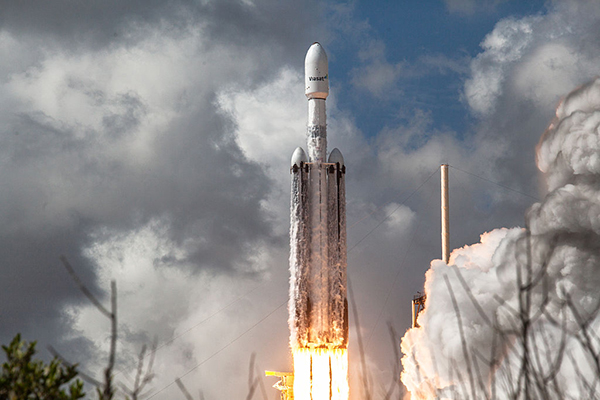
SpaceX Falcon Heavy rocket lifts off from the Kennedy Space Center, Florida, carrying a ViaSat-3 F3 satellite into geostationary transfer orbit. Photo: Manuel Mazzanti/NurPhoto via Getty Images.
The countdown to Elon Musk’s SpaceX initial public offering (IPO) is under way as the rockets-to-AI conglomerate attempts to raise a stock market record $75 billion (£55 billion).
Retail investors are set to be at the heart of next month’s planned debut which, at a reported $1.75 trillion, is poised to make SpaceX more valuable than Meta Platforms Inc Class A and Tesla Inc, and one of the 10 biggest companies in America.
- Invest with ii: Most-traded US Stocks | Buying US Shares in UK ISA | Cashback Offers
The IPO will provide investors with exposure to a business whose operations span reusable rocket launches, Starlink satellite broadband, artificial intelligence (AI) and social media.
Musk founded Space Exploration Technologies Corp in 2002, having used the $100 million proceeds from the sale of his stake in PayPal as seed capital.
SpaceX has since launched more rockets than any government programme in history as it builds the infrastructure for satellite communications and the next era of space exploration. Its interplanetary goals include lunar and Mars missions.
Musk’s vision of space-based data centres as the answer to the energy needs of AI firms took a step forward with February’s acquisition of artificial intelligence start-up xAI, which includes the social media platform X and chatbot Grok.
The deal valued the combined business at $1.25 trillion, but reports have suggested the company is targeting a much higher figure in the stock market listing.
Musk will be hoping to replicate the IPO success of his Tesla electric car business, which raised $226 million in its $1.6 billion 2010 debut. It’s now the world's most valuable automaker, worth $1.3 trillion.
A successful SpaceX IPO will reward early backers including Google owner Alphabet Inc Class A and holders of Baillie Gifford’s Scottish Mortgage Ord Investment Trust and Edinburgh Worldwide Ord.
Investment trusts with exposure to space (ex Seraphim Space Investment Trust)
| Investment trust | Investee company | Portfolio weighting % |
| Edinburgh Worldwide Ord | SpaceX (private) | 20.40 |
| Scottish Mortgage Ord | SpaceX (private) | 19.30 |
| Baillie Gifford US Growth Ord | SpaceX (private) | 14.90 |
| Schiehallion Fund Ord | SpaceX (private) | 12.80 |
| RIT Capital Partners Ord | SpaceX (private) | 2.50 |
| Monks Ord | SpaceX (private) | 2.43 |
| Allianz Technology Trust Ord | Rocket Lab Corp | 0.76 |
| HarbourVest Global Priv Equity Ord | SpaceX (private) | 0.70 |
| Ashoka WhiteOak Emerging Markets Ord | Hanwha Aerospace Co Ltd | 0.59 |
Source: theaic.co.uk/Morningstar/companies. Excludes Seraphim Space. Molten Ventures has around 7% of its portfolio invested in ICEYE, Isar Aerospace and SatVu. Table may not be exhaustive.
The IPO is set to have broader implications for the Wall Street tech sector as funds rebalance portfolios to raise cash for SpaceX allocations. The move sets the tone for other mega-cap listings, potentially including Anthropic and OpenAI.
What does SpaceX do?
The primary growth engine is Starlink, which now has 10,000 satellites in low-Earth orbit providing broadband connectivity to more than 10 million customers worldwide.
Commercial adoption has included several major airlines, with British Airways and Iberia owner International Consolidated Airlines Group SA currently rolling out Starlink wi-fi across its aircraft.
Starlink offers passengers download speeds of up to 150-450 megabits per second (Mbps) and upload speeds of 20-70Mb per second. According to UK regulator Ofcom, the UK home average maximum download speed was 223Mb per second in 2024.
Government usage of Starlink internet includes in the White House and in other US federal buildings, while the technology has played a significant role in Ukrainian military communications.
In the UK, it has been used as part of a government initiative to ensure that some of the country’s remotest homes and businesses are connected to better broadband.
The vertical integration of SpaceX has been crucial to Starlink’s success, given the cost benefit of reusable Falcon 9 rockets within the launch and transportation side of the business.
- Scottish Mortgage on SpaceX and running winners vs taking profits
- Ian Cowie: the case for defence and how to play the sector
SpaceX has launched more rockets than any government programme in history, with 170 in 2025 and 138 in 2024, representing an orbital launch roughly every two days.
Its Falcon Heavy and crewed Dragon spacecraft provide opportunities in commercial, scientific, and governmental missions.
SpaceX’s Starship spacecraft is a fully reusable transportation system designed to carry both crew and cargo to Earth orbit and eventually the Moon and beyond.
Alongside Musk as chief executive and chief technology officer of SpaceX, Gwynne Shotwell (pictured below) has been president and chief operating officer since 2008.
Time magazine called her a pioneering figure in space without needing a spacesuit, highlighting her critical role in Starlink's finance, customer management and government affairs.
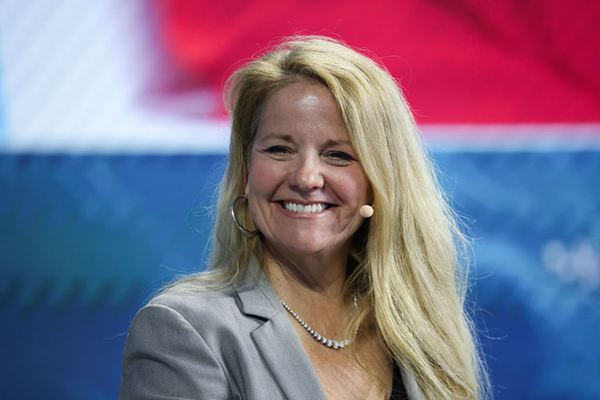
Credit:Joe Raedle/Getty Images.
What about future prospects?
This year, Starship will begin delivering the much more powerful V3 Starlink satellites to orbit, with each launch adding more than 20 times the capacity to the constellation as the current Falcon launches of the V2 Starlink satellites.
Starship will also launch the next generation of direct-to-mobile satellites, which will deliver full cellular coverage everywhere on Earth.
February’s merger of SpaceX and Musk’s artificial intelligence start-up xAI has reinforced his vision of space-based data centres as the answer to the energy needs of AI firms.
Musk estimates that within two or three years the lowest-cost way to generate AI compute will be in space. This will enable companies to forge ahead in training their AI models and processing data at speed and scale.
Musk said global electricity demand for AI cannot be met with terrestrial solutions and that the only logical solution is to transport these resource-intensive efforts to a location with vast power and space.
By directly harnessing near-constant solar power with little operating or maintenance costs, satellites will transform the world’s ability to scale compute power.
He estimates that a million tons per year of satellites generating 100 kilowatt (kW) of compute power per ton would add 100 gigawatts of AI compute capacity annually, with no ongoing operational or maintenance needs.
What do we know about the financials?
SpaceX has yet to file public financial statements, although reports have said it generated more than $18.5 billion in revenues from launch services and satellite broadband operations last year. Adjusted earnings amounted to $6.5 billion.
Full details will be released when SpaceX publishes its prospectus ahead of the IPO.
Much of the growth comes from aviation and maritime connectivity contracts, as well as government agreements for emergency communications.
Recurring revenues from Starlink’s subscription model provides diversification from the more cyclical launch market.
Research by Ark Venture Fund, which has SpaceX as its largest holding, suggests that the company has reduced launch costs by about 95% since 2008 — from roughly $15,600 per kilogram to under $1,000 per kilogram via Falcon 9.
- SpaceX: trusts to gravitate towards for exposure
- Sign up to our free newsletter for investment ideas, latest news and award-winning analysis
It added that a fully reusable Starship, targeting sub-$100 per kilogram, would represent another order-of-magnitude cost decline and unlock addressable markets that do not yet exist.
According to Reuters, SpaceX has spent more than $15 billion developing its next-generation Starship rocket. This compares with a recent annual funding agreement for Nasa at an unchanged $24 billion in 2027.
Who owns SpaceX?
Musk is believed to hold about 42% of SpaceX’s equity through a dual-class share structure that gives him around 78% of the voting power. He is set to retain strategic control following the IPO.
Google owner Alphabet recently disclosed in a regulatory filing that it holds a stake of about 6%. This dates back to 2015, when Google and Fidelity became new investors in a funding round that raised $1 billion and valued SpaceX at $12 billion.
PayPal co-founder and former chief executive Peter Thiel has been on board since 2008, when his Founders Fund led a funding round at a challenging time for SpaceX.
Edinburgh-based Baillie Gifford was one of eight investors in SpaceX’s December 2018 funding round, which valued SpaceX at $31 billion.
Baillie Gifford’s Scottish Mortgage, Baillie Gifford US Growth Ord and Edinburgh Worldwide investment trusts injected £54 million into SpaceX.
The total value of the firm’s holdings across its trusts is now reported to be £3.9 billion, including about £3 billion for Scottish Mortgage.
The trust said at the time of the purchase that a holding in SpaceX “would have been unimaginable without our patient, controversial and unashamed backing of Tesla”.
SpaceX has overtaken Tesla to become Scottish Mortgage’s biggest overall holding at 19.3%, having delivered a total return of 1,197% in the five years to the end of 2025. This is only bettered over the same period by NVIDIA Corp at 1,364%.
Meanwhile, February’s acquisition of xAI brought in investors including Nvidia, Cisco Systems Inc and Qatar Investment Authority.
When will an IPO take place?
June is seen as the most likely month, potentially to coincide with Musk's 55th birthday on 28 June, or when Jupiter and Venus align in the night sky for the first time in three years.
Under Securities and Exchange Commission (SEC) rules, the public S-1 prospectus must be released at least 15 days before the company begins marketing shares to investors.
The paperwork will provide detail on everything from SpaceX’s revenue and margin performance to the structure of Musk’s ownership arrangements post the IPO. It will show whether the fundamentals are strong enough to withstand such a valuation.
A confidential version of the document was submitted to the SEC at the start of April.
SpaceX will be keen to gain first mover advantage as the likes of OpenAI and Anthropic are also in the IPO pipeline and will be seeking cash from Wall Street investors.
SpaceX is also pushing for changes that could accelerate the path to listings in the S&P 500 index and Nasdaq, which will be crucial for driving demand from index trackers.
Will retail investors be involved?
Some reports have said that Musk wants to set aside up to 30% of the available shares for retail investors, including those in the UK.
This is much more than the usual 5% or 10% and contrasts with some IPOs where retail investors are locked out and end up paying well above the opening price.
It is thought that the company is planning to host 1,500 retail investors at a special event not long after the launch of the IPO roadshow in June.
SpaceX chief financial officer Bret Johnsen reportedly said: “Retail is going to be a critical part of this and a bigger part than any IPO in history.”
How much is the company worth?
Speculation has focused on a valuation of $1.75 trillion, which compares with $1.25 trillion when February’s merger deal valued SpaceX at $1 trillion and xAI at $250 billion.
This price tag made SpaceX the world’s most valuable private company, ahead of ChatGPT business OpenAI at about $850 billion and AI firm Anthropic at $380 billion.
Fundraising rounds, tender activity and the acquisition of xAI have been part of the company’s valuation journey from a reported $46 billion in 2020 to the $1.75 trillion IPO target.
Large private fundraising rounds, which attracted longer-term institutional investors, took place on a periodic basis up until June 2022, when the reported valuation stood at $125 billion.
Tender offers, which provide a way for employees and shareholders to offload holdings, have been the source of liquidity and price discovery since then.
The most recent took place in December, with a reported SpaceX valuation of $800 billion.

Astronauts prepare to travel to the SpaceX Falcon 9 rocket and Dragon spacecraft at Cape Canaveral, Florida, in February 2026. Photo: Jim WATSON/ AFP via Getty Images.
How will the IPO rank?
Saudi Aramco holds the IPO world record after raising $25.6 billion through the sale of about 1.5% of the company in a December 2019 listing that valued the business at $1.7 trillion. Subsequent overallotment increased the amount raised to $29.4 billion.
Alibaba Group Holding Ltd ADR generated $25 billion on the New York Stock Exchange in 2014 and telecoms business SoftBank $23.5 billion in Tokyo in 2018.
The UK’s record IPO is miner and commodity marketing giant Glencore, which attracted a value of $59.2 billion when it raised $10 billion in May 2011.
How does the SpaceX valuation compare?
SpaceX is set to exceed the current $1.2 trillion valuation of Tesla but is still worth much less than five of the remaining Magnificent Seven mega-cap tech companies.
Nvidia leads Wall Street with a valuation of $5 trillion, followed by Alphabet ($4.8 trillion), Apple Inc ($4.2 trillion), Microsoft Corp ($3.1 trillion) and Amazon ($3 trillion). Facebook owner Meta Platforms is valued at $1.6 trillion.
Semiconductor firms Broadcom Inc and Taiwan Semiconductor Manufacturing Co Ltd ADR have similar valuations to the SpaceX estimate at about $2 trillion, while the aerospace sector’s most valuable is GE Aerospace at a more modest $320 billion.
The mooted SpaceX valuation is comparable with Turkey’s 2025 GDP figure at $1.6 trillion and is just under half the UK’s $4 trillion.
The entire value of the FTSE 100 index is about $3.2 trillion (£2.4 trillion), led by HSBC Holdings with a market capitalisation of $314 billion (£232 billion).
Is the valuation justified?
This will depend on the revenue and margin detail in the prospectus, as well as longer-term opportunities such as the development of Starship and space-based data centres.
However, Liberty Street Advisors’ Private Shares Fund, which first invested in SpaceX in 2019, said recently that the company’s valuation increases have consistently tracked underlying execution rather than market sentiment.
It added: “Step-ups have followed tangible progress across launch cadence, the growth of Starlink into a large recurring-revenue business, and expanding government and defense engagements.
“This pattern reflects sustained investor demand and confidence in SpaceX’s fundamentals.
“A similar execution-driven valuation dynamic is increasingly evident across leading private AI and infrastructure companies, where adoption milestones and operating scale are driving value well ahead of public listings.”
The fund adds that the longer-term opportunity for SpaceX could be meaningfully larger, given the scope of the platform and the role it plays across multiple large and long-duration markets.
It said: “Commentary from several long-term investors has highlighted views that look past near-term IPO valuations, pointing to SpaceX’s broad platform and long-duration opportunity as factors that could support a larger long-term valuation perspective.”
- ISA investing: nine ii experts reveal their ISA tips for 2026-27
- World Cup 2026: why the economic impact will be staggering
These perspectives tend to focus on the company’s expanding role across launch, satellite communications, and government missions, suggesting that traditional public-market comparisons may not fully reflect the scale of the opportunity.
At $1.75 trillion, Reuters said SpaceX would carry a price-to-revenue multiple of 56 and a price-to-EBITDA (underlying profit) multiple of 109. Tesla is valued at 12 times expected revenue and 79 times EBITDA, while the forward-looking S&P 500 index average is closer to 21 times earnings.
SpaceX is growing revenue at 20-30% annually with 50%-plus EBITDA margins.
There is the potential that much lower launch costs and the creation of orbital data centres could deliver compute at a cost about 25% lower than terrestrial alternatives.
Ark Venture Fund said: “The thesis is early stage, but it is the reason the combined entity commands a strategic premium that no sum-of-the-parts model fully captures.”
Scottish Mortgage also points out strategic partnerships with government agencies, competitive pricing dynamics and continual innovation provide a high barrier to entry in the industry.
However, potential investors will have concerns about over-reliance on Musk and his control of the company through a dual-class ownership structure.
And while Starlink is the dominant player, it is not without competition after Amazon recently expanded its Amazon Leo satellite network through the acquisition of Globalstar.
The tie-up adds direct-to-device services to its low Earth orbit satellite network and extends cellular coverage to customers beyond the reach of terrestrial networks.
Amazon and Apple have also announced an agreement for Amazon Leo to power satellite services for the iPhone and Apple Watch, including emergency SOS via satellite.
Your guide to buying SpaceX shares with ii
Whether early investment in SpaceX is available or not to UK retail investors, you will be able to buy shares through ii on the first day they start trading.
Here are the steps you can take in advance to be ready for day 1:
1. Open an account
You will be able to hold shares in our Trading Account, SIPP, ISA and Junior ISA.
2. Complete the exchange agreements
You need to complete this form before you make your first international trade. We will prompt you to complete the agreements the first time you search for an international share price.
3. Complete a United States dealing (W-8) form
Before you can buy US-listed shares you need to have completed a W-8 form. You can do this online by logging in and visiting our Useful Forms page. You don’t need to do this if you are only investing in a SIPP.
On the day shares are admitted there will likely be an initial period of price stabilisation, after which trading commences. This may only be a few minutes but can take a few hours.
These articles are provided for information purposes only. Occasionally, an opinion about whether to buy or sell a specific investment may be provided by third parties. The content is not intended to be a personal recommendation to buy or sell any financial instrument or product, or to adopt any investment strategy as it is not provided based on an assessment of your investing knowledge and experience, your financial situation or your investment objectives. The value of your investments, and the income derived from them, may go down as well as up. You may not get back all the money that you invest. The investments referred to in this article may not be suitable for all investors, and if in doubt, an investor should seek advice from a qualified investment adviser.
Full performance can be found on the company or index summary page on the interactive investor website. Simply click on the company's or index name highlighted in the article.