FTSE 100 round-up: Rolls-Royce, HSBC, oil and interest rates
Global stock markets remain volatile, with winners and losers. Graeme Evans reveals the big movers, drivers of sentiment, and what City analysts think of the current situation.
24th March 2026 14:04
by Graeme Evans from interactive investor
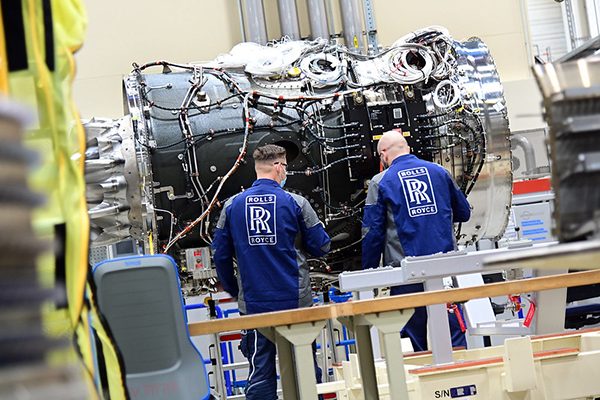
Credit: Rolls-Royce via Flickr
Fresh falls for Rolls-Royce Holdings (LSE:RR.), HSBC Holdings (LSE:HSBA) and other pre-conflict top performing stocks today highlighted mounting market scepticism over diplomatic efforts to end the Middle East war.
Amid sharply conflicting messages from Iran and the US over the chances of a resolution, the FTSE 100 index reached midday broadly unchanged at 9,903.
- Invest with ii: Open an ISA | ISA Investment Ideas | ISA Offers & Cashback
However, this masked jittery trading that saw a 100-point fall from 9,936 in early dealings to a low of 9,839.20 an hour later before a modest recovery ahead of the US opening bell then further drop back toward intraday lows.
Rolls-Royce fell 25p to 1,158p to trade at its cheapest level since the end of last year, while HSBC dropped 20.8p to revisit Friday’s four-month low at 1,162.2p. There was also no appetite for a return to Barclays (LSE:BARC), which traded at 378p for its weakest position since October.
Other fallers included Anglo American (LSE:AAL), which has now lost a fifth of its value since the start of the war after the price of copper resumed its fall this morning.
Biggest FTSE 100 fallers since war began
Company | Price | Change since war began (%) | One-month change (%) | 2026 (%) | Forward dividend yield | PE ratio |
261.15p | -28.5 | -29.9 | -31.5 | 5.6 | 9.4 | |
1112.75p | -26.1 | -27.2 | -18.1 | 5.6 | 11.0 | |
3138p | -26.0 | -22.2 | -5.9 | 4.3 | 11.9 | |
352.7p | -24.0 | -25.1 | -30.9 | 3.6 | 5.8 | |
4025p | -23.9 | -19.1 | 4.0 | 3.7 | 7.4 |
Source: ShareScope. Past performance is not a guide to future performance.
The FTSE 100 uncertainty reflected little change in Brent crude, which at more than $100 a barrel continues to underline the potential for a stagflationary shock to the global economy.
The potential impact was highlighted in today’s closely watched purchasing managers’ index (PMI) reading for the UK economy, which at a weaker-than-expected 51 showed that downside growth risks and upside inflation risks have already materialised.
- Stockwatch: a FTSE 100 stock to play end of Iran war
- AIM market winners and losers since Iran war broke out
While still above the neutral level of 50, S&P Global said private sector output growth across factories and the services sector “slowed to a crawl” in March, as firms dealt with heightened risk aversion among customers and surging price pressures.
Cost growth in the manufacturing sector was especially severe, being the sharpest since the depreciation of sterling following Black Wednesday in 1992.
S&P Global said the figures were another reminder of the challenge facing the Bank of England as it seeks to ensure a hawkish interest rate outlook does not exacerbate downturn risks.
This backdrop weighed on UK-focused stocks in today’s session as Marks & Spencer Group (LSE:MKS) fell another 4.1p to 328.6p and JD Sports Fashion (LSE:JD.) dropped 1.4p to revisit April’s multi-year low at 67.9p.
Biggest FTSE 100 risers since war began
Company | Price | Change since war began (%) | One-month change (%) | 2026 (%) | Forward dividend yield | PE ratio |
548.85p | 14.9 | 16.5 | 26.8 | 4.7 | 13.2 | |
3400.5p | 10.6 | 14.4 | 24.1 | 3.3 | 12.7 | |
3113p | 5.0 | 10.3 | -2.0 | 5.7 | 13.2 | |
5827.5p | 2.7 | 3.4 | 10.1 | 1.1 | 26.6 | |
355.6p | 1.9 | 1.5 | 0.1 | 1.5 | 26.1 |
Source: ShareScope. Past performance is not a guide to future performance.
The FTSE 250 index fell over 200 points in early trade to 21,034.65, and the mid-cap benchmark has now lost 11% of its value since the war started and 6% year-to-date.
It finished yesterday’s session in negative territory, although it had been as low as 20,654 prior to US President Donald Trump’s market-moving social media post that America’s planned strikes against Iranian energy sites have been postponed for five days.
The FTSE 100 closed 0.2% lower at 9,894.15 as weaker oil and defence stocks watered down the initial boost of President Trump’s comments. Having been in correction territory following a fall of more than 10% from last month’s record, the blue-chip index traded as high as 10,036.65.
Market | Price | Change since war began (%) | One-month change (%) | 2026 (%) |
FTSE AIM All-Share | 712 | -13.2 | -12.8 | -7.1 |
Swiss Market Index | 12390 | -11.6 | -11.5 | -6.7 |
DAX Xetra (Germany) | 22430 | -11.3 | -10.2 | -8.4 |
FTSE 250 | 21086 | -11.2 | -10.3 | -6.2 |
Nikkei 225 | 52252 | -11.2 | -8.8 | 3.8 |
S&P BSE 100 Index (Mumbai) | 23592 | -10.8 | -11.5 | -13.7 |
CAC 40 (Paris) | 7688 | -10.4 | -9.8 | -5.7 |
FTSE All-Share | 5279 | -9.8 | -8.0 | -1.3 |
FTSE 350 | 5339 | -9.8 | -7.9 | -1.3 |
FTSE 100 | 9862 | -9.6 | -7.7 | -0.7 |
SSE Composite Index (Shanghai) | 3813 | -8.4 | -7.4 | -3.9 |
Hang Seng (Hong Kong) | 25064 | -5.9 | -5.7 | -2.2 |
Dow Jones Industrial Average | 46209 | -5.7 | -6.0 | -3.9 |
S&P 500 | 6581 | -4.3 | -4.5 | -3.9 |
Nasdaq Composite | 21947 | -3.2 | -4.0 | -5.6 |
Bovespa Stock Index (Brazil) | 181932 | 1.5 | 1.5 | 12.9 |
Source: ShareScope.
The VIX index of volatility fell back from above the 30 mark to a still elevated 26, setting the tone for a stronger performance during Wall Street’s 16th trading session since the start of the war.
The upturn fuelled hopes that the current crisis will be in keeping with the historical average, after Deutsche Bank’s analysis of more than 30 geopolitical shocks since 1939 found that US equities tend to bottom after 15 days at a little over 4% below their pre-shock level.
Even if there’s a resolution to the conflict, UBS said today that investors should be wary of assuming that the path to a restoration of energy flows will be smooth.
It said: “Shippers will need to develop the confidence that threats have been neutralised, which could take time. Production that has been shut could take time to bring back online.
“Meanwhile, oil product inventory levels are running low in various economies and could necessitate still higher prices to ration demand before stocks are refilled.
“Against this backdrop, it looks likely that energy prices will remain elevated for at least the near term, weighing on growth, and driving episodic volatility.”
- Stockwatch: hedges and opportunities amid the crisis
- Sign up to our free newsletter for investment ideas, latest news and award-winning analysis
But with inflation now lower than it was at the onset of the 2022 energy price spike, UBS also said it does not believe central banks will be forced into raising interest rates.
Its wealth management office also told clients today: “We believe Monday’s market gyrations validate our view that investors should not attempt to trade geopolitics and should maintain strategic equity holdings.
“Markets are forward-looking and can often trade on the ‘second derivative’: a situation merely getting ‘less worse’ can be sufficient for markets to bounce.”
These articles are provided for information purposes only. Occasionally, an opinion about whether to buy or sell a specific investment may be provided by third parties. The content is not intended to be a personal recommendation to buy or sell any financial instrument or product, or to adopt any investment strategy as it is not provided based on an assessment of your investing knowledge and experience, your financial situation or your investment objectives. The value of your investments, and the income derived from them, may go down as well as up. You may not get back all the money that you invest. The investments referred to in this article may not be suitable for all investors, and if in doubt, an investor should seek advice from a qualified investment adviser.
Full performance can be found on the company or index summary page on the interactive investor website. Simply click on the company's or index name highlighted in the article.