FTSE 100 share winners: Rolls-Royce, Persimmon and Unilever
Stock markets remain volatile, but there are some big movers on this sunny day in the Square Mile. City writer Graeme Evans discusses the standout performers.
30th April 2026 14:59
by Graeme Evans from interactive investor
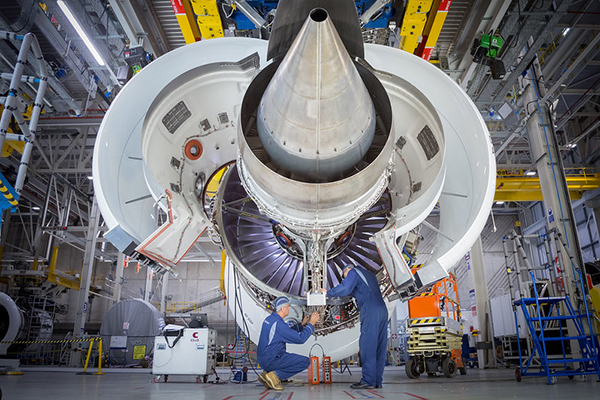
The Rolls-Royce Trent 7000 testbed prep. Credit: Rolls-Royce via Flickr.
Updates by Rolls-Royce Holdings (LSE:RR.), Persimmon (LSE:PSN) and Unilever (LSE:ULVR) today reassured investors as the FTSE 100 index shook off some of its recent weakness with a bounce of more than 1%.
The trio, whose shares have been among the worst performing since the start of the Middle East war, rallied alongside gains for stocks in the utility, defence and mining sectors.
- Invest with ii: Top UK Shares | Share Tips & Ideas | Cashback Offers
The FTSE 100 index lifted 141 points to 10,354, which compares with 10,934 prior to the start of the conflict and the post-war low point of 9,670 in mid-March.
Rolls shares, which began today’s session 19% below their early-March peak, staged a fightback by lifting 77.2p to 1,175.8p on the back of today’s first-quarter AGM trading update.
The company continues to expect large engine flying hours (EFH) at between 115% and 120% of 2019 levels, having recorded a figure of 115% in the first three months of the year.
The unchanged guidance follows a significant recovery in the EFH of Middle Eastern airlines, with Trent XWB engines fully recovered to pre-conflict levels. Growth in other regions remains strong due to the reallocation of capacity.
Rolls pointed out that the vast majority of economically driven airline capacity reductions were in the narrowbody sector where it has no exposure.
The company reiterated guidance of £4 billion to £4.2 billion of underlying operating profit and £3.6-3.8 billion of free cash flow for 2026.
- Rolls-Royce: what to look for in its next trading update
- Bank of England holds rates but prospect of hikes loom
Morgan Stanley, which has a price target of 1,500p, said: “We think this update should go a long way in appeasing some concerns currently in the market.”
In the Defence division, Rolls said a strong start to the year was driven by improved aftermarket performance alongside more than a 20% year-on-year increase in deliveries. It reported strong demand for both its mature and new programmes.
March was a record month for orders in its Power Systems division, which continues to benefit from data centre and governmental demand. The order backlog stood at £7.3 billion at the end of last month.
Jefferies, which has a price target of 1,530p, said: “The group mentions ‘further confidence’ in its guide, a wording it has used in the past, prior to guidance increases with first half results.”
UBS added that the company’s messaging was “broadly consistent with the positive tone set by other engine makers this quarter”.
Persimmon shares rose 22p from last night’s two-year low to stand at 1,049p after it reported no material impact from the Iran conflict and resultant economic uncertainty.
While enquiries have softened slightly in the last few weeks, sales have remained resilient, and Persimmon said its interactions with institutional customers in the affordable and build-to-rent sectors remain positive after it added 19 new partners over the last 12 months.
It reported early signs of increased inflation in the supply chain, driven by higher energy costs, which are likely to impact the second half of 2026 and into 2027. However, Persimmon said it is looking to mitigate these where possible.
- Standard Chartered revival continues with record first-quarter results
- Trading Strategies: are Rio Tinto shares worth buying now?
Private forward sales are up 7% on the prior year to £1.8 billion, with an average selling price of £306,900 up 5% compared to the same point last year.
Jefferies, which has a price target of 1,591p, said: “Compared to others, this trading update from Persimmon appears confident. Management are comfortable with market forecasts for 2026, albeit we note this has slipped mildly in the past two months.”
The shares have fallen 24% year-to-date versus the wider sector’s 34% decline. At last night’s 1,027p, they were on a multiple of 10 times earnings for a slight premium to the wider sector.
Peel Hunt said: “We continue to believe that Persimmon is best placed of the large housebuilders, selling the right product, in the right areas at the right time, while the limited exposure to fire remediation given more flexibility around capital deployment.” The broker has a price target of 1,400p.
Unilever shares had fallen 23% since the start of the war, partly due to a negative reaction to the company’s plans for the demerger of its foods business.
The consumer goods group rose 72.5p to 4,287p in today’s session after it reported first-quarter underlying sales growth of 3.8%. This consisted of volume growth of 2.9% and price of 0.9%.
Foods delivered growth of 2.2%, which compared with 3.6% for Beauty & Wellbeing, 3.7% for Personal Care and 6.1% for Unilever’s brands in the Home Care category.
The company highlighted emerging markets momentum, led by strong growth in India and good recovery in Latin America. Turnover of 12.6 billion euros (£11 billion) fell 3.3% as the positive underlying sales growth and net acquisitions and disposals were offset by currency movements.
At the foot of the FTSE 100, Whitbread (LSE:WTB) shares dropped another 85p to trade near their post-pandemic low point of last month at 2,300p. They had been more than 3,200p in October.
Alongside annual results, the Premier Inn owner unveiled a new five-year plan that it expects will result in a material step up in margins and shareholder returns by 2031.
This will be achieved by reallocating capital spend to the highest-returning opportunities, while still growing its number of open rooms from 86,582 in today’s results to 96,000.
It will recycle £1.5 billion of freehold property and increasingly look to grow on a leasehold basis, while Whitbread also intends to accelerate the replacement of its Beefeater and Brewers Fayre restaurants with a more tailored food and drink offering.
- Seraphim Space’s share issue: all you need to know
- How to protect your pension from a midlife curveball
The transition of the 197 remaining branded restaurants is expected to reduce total food sales by between £140 million and £160 million and cause a £40 million reduction in current year profits. This narrows to £10 million when offset by gains from Whitbread’s existing growth plan.
Today’s results showed a broadly flat adjusted profit of £483 million, with 1% growth in UK accommodation sales, cost efficiencies and a marked increase in German profitability dented by high cost inflation and interest costs. The full-year dividend is unchanged at 60.6p a share and will be paid on 3 July.
In terms of guidance for this year, Whitbread said gross inflation is expected to be at the top end of its previously guided range of 6.5%-7.5% on its £1.7 billion UK cost base. This includes changes to business rates that will result in an impact of about £35 million.
The forward booked position is ahead of last year but the current geopolitical climate means there’s limited visibility of short-term demand.
Chief executive Dominic Paul said the new five-year plan will make Whitbread assets work harder and create a stronger, higher-returning business that “delivers for our guests, teams and shareholders”.
He added: “We’ve already made great progress in the transformation of Whitbread, despite external headwinds, and I’m excited by what’s coming next. This plan will transform Whitbread into a higher-margin, higher-returning pure-play hotel business.”
- Three corporate bonds make first move to appeal to DIY investors
- Sign up to our free newsletter for investment ideas, latest news and award-winning analysis
Weir Group (LSE:WEIR) shares fell 162p to 2,602p after it announced that Jon Stanton is to stand down after 10 years as chief executive. He will leave in August and be succeeded by Andrew Neilson, who joined Weir in 2010 and is currently president of the company’s Minerals division.
During his decade in charge, Stanton drove the repositioning of Weir away from cyclical businesses with a focus on the supply of equipment and spares needed by mining customers to extract metals in a more sustainable and efficient way.
Weir said it was now a stronger company and well positioned to become a quality compounder with significant long-term growth potential and best-in-class operating margins.
The change of leadership was announced as Weir reiterated full-year guidance and said activity levels in core mining markets were still strong. The shares were 3,500p at the end of February.
These articles are provided for information purposes only. Occasionally, an opinion about whether to buy or sell a specific investment may be provided by third parties. The content is not intended to be a personal recommendation to buy or sell any financial instrument or product, or to adopt any investment strategy as it is not provided based on an assessment of your investing knowledge and experience, your financial situation or your investment objectives. The value of your investments, and the income derived from them, may go down as well as up. You may not get back all the money that you invest. The investments referred to in this article may not be suitable for all investors, and if in doubt, an investor should seek advice from a qualified investment adviser.
Full performance can be found on the company or index summary page on the interactive investor website. Simply click on the company's or index name highlighted in the article.